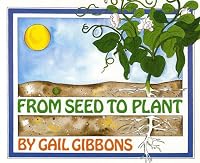
From Seed to Plant
by Gail Gibbons
On This Page
Description
Explores the intricate relationship between seeds and the plants which they produce.Tags
Recommendations




Member Reviews
Gail Gibbons writes the best nonfiction books for primary learners. They are always engaging for the students and she has a knack for explaining difficult content in a way that young readers can understand.
Gibbons, G. (1991). From Seed to Plant. New York,NY: Holiday House.
Experiment books clarify basic scientific understandings. From Seed to Plant explains the plant cycle. Gibbons first defines seed. Then she points out that plants grow into flowers and that is where seeds begin. However, even before a seed grows, it needs to be pollinated. Gibbons further explains the different ways pollination occurs.
Gibbons presents information in a clear manner. The text is written in simple English that is appropriate for young children. All vocabulary words are defined. The book only includes facts. Gibbons avoids the use of anthropomorphism.
The illustrations are extremely effective because they clarify ideas. All illustrations and diagrams are show more labeled. Even the “From Seed to Plant” project has numbered and illustrated directions, making it easy for readers to understand the task.
Even though the book is intended for primary-age readers, it does not oversimplify the plant cycle. The “From Seed to Plant” activity also provides children an opportunity to interact with science.
Gibbons is successful in writing about a challenging concept, the plant cycle, in a concise way that is suitable for her targeted audience. I like how she provides step-by-step instructions for raising bean plants. While I have never considered myself to have a “green thumb,” even I am tempted to grow a bean plant. Her clear instructions will have even the most unconfident botanists feel confident. show less
Experiment books clarify basic scientific understandings. From Seed to Plant explains the plant cycle. Gibbons first defines seed. Then she points out that plants grow into flowers and that is where seeds begin. However, even before a seed grows, it needs to be pollinated. Gibbons further explains the different ways pollination occurs.
Gibbons presents information in a clear manner. The text is written in simple English that is appropriate for young children. All vocabulary words are defined. The book only includes facts. Gibbons avoids the use of anthropomorphism.
The illustrations are extremely effective because they clarify ideas. All illustrations and diagrams are show more labeled. Even the “From Seed to Plant” project has numbered and illustrated directions, making it easy for readers to understand the task.
Even though the book is intended for primary-age readers, it does not oversimplify the plant cycle. The “From Seed to Plant” activity also provides children an opportunity to interact with science.
Gibbons is successful in writing about a challenging concept, the plant cycle, in a concise way that is suitable for her targeted audience. I like how she provides step-by-step instructions for raising bean plants. While I have never considered myself to have a “green thumb,” even I am tempted to grow a bean plant. Her clear instructions will have even the most unconfident botanists feel confident. show less
Gail Gibbon's book "From Seed to Plant" is one of the best books I use to help my students understand the development of a plant. She explains the development in simplistic terminology without leaving out key vocabulary words (stamen, ovule, etc). The diagrams in this book are excellent illustrations that really show the students the parts of the plant they should be familiar with. I think Gibbon's use of illustrations as opposed to photographs really works in this case. She has her illustrations drawn to expose the parts of the plant the reader needs to see for each developmental point. She diagrams many of her illustrations to show each different part of the lifecycle. My students really are impressed with this book and appreciate the show more illustrations. show less
This book felt like a textbook for very young students. It presented some valuable information about how plants grow from seeds. However, even for an adult reader, it felt like the information was presented in a boring and confusing way. There was a greater focus on building vocabulary and identifying the parts of plants then there was on the overall process of how and why a plant grows. This book would be good to help facilitate the understanding of plant parts with students.
A easy to read picture book that shows the transition from a seed to a plant. The illustrations and text provide great technical insight to seed growth in a language that young students can follow.
A straightfoward beginning to botany. Shows through illustrations and explication how flowers are pollinated and seeds grow. Includes the entire plant life cycle, something often missing from other books about plants, seeds, and flowers.
A straightfoward beginning to botany. Shows through illustrations and explication how flowers are pollinated and seeds grow. Includes the entire plant life cycle, something often missing from other books about plants, seeds, and flowers.
Members
- Recently Added By
Lists

75 Books for Literacy Block: Fall 2016
75 works; 2 members

Sonlight Books
1,487 works; 25 members
Author Information

165+ Works 57,759 Members
Gail Gibbons was born in 1944 in Oak Park, Illinois. She received a degree in graphic design from the University of Illinois. She got a job doing artwork for television shows in New York City. She was eventually offered a job creating art for a children's show, where some of the children asked her if she had ever considered doing a children's show more books. Her first book, Willy and His Wheel Wagon, was published in 1975. Since then she has written and illustrated more than 170 non-fiction books for children including Nature's Green Umbrella: Tropical Rain Forests. (Bowker Author Biography) show less
Awards and Honors
Common Knowledge
- Original publication date
- 1991
- Dedication
- For Sue and Don Collins
- First words
- Most plants make seeds.
- Quotations
- Animals help scatter seeds, too. They hide acorns and nuts in the ground. Some seeds have hooks that stick to the fur of animals or people's clothes.
A seed contains the beginning of a new plant. - Last words
- (Click to show. Warning: May contain spoilers.)It [biggest flower in the world] can weigh up to twenty-five pounds and can be four feet across.
Classifications
Statistics
- Members
- 2,767
- Popularity
- 6,598
- Reviews
- 86
- Rating
- (4.35)
- Languages
- English, Spanish
- Media
- Paper, Audiobook, Ebook
- ISBNs
- 24
- ASINs
- 4