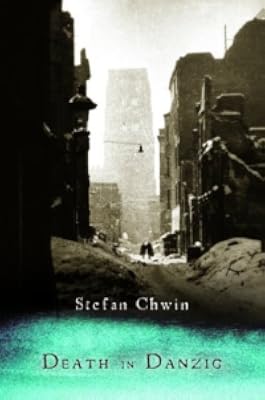
Death in Danzig
by Stefan Chwin
On This Page
Description
Germans flee the besieged city of Danzig in 1945. Poles driven out of eastern regions controlled by the Russians move into the homes hastily abandoned by their previous inhabitants. In an area of the city graced with beech trees and a stately cathedral, the stories of old and new residents intertwine: Hanemann, a German and a former professor of anatomy, who chooses to stay in Danzig after the mysterious death of his lover; the Polish family of the narrator, driven out of Warsaw; and a young show more Carpathian woman who no longer has a country, her cheerful nature concealing deep wounds. Through his brilliantly defined characters, stunning evocation of place, and memorable descriptions of a world that was German but survives in Polish households, Chwin has created a reality that is beyond destruction. show lessTags
Recommendations












































Member Recommendations

Member Reviews
Spherical, wonderfully written Polish novel about Danzig in transition from a nazi occupied Prussian city to a drab communist town, following the fates of a limited number of characters. Chwin is a master of leaving out details (about some people’s pasts), while emphasizing sound, colour and shape of the environment and combining this with meticulous descriptions from the perspective of the main characters, who all live(d) in the same street.
The novel opens with a dramatic event affecting Hanemann, professor of anatomy, who is confronted with the drowned corpse of his love during a dissection class. The man walks out, never to return at the Institute where he teaches. In a way this sets the tone and timbre of the rest of the novel show more – it is about humanity, not about what role people have played in the war or the pros and cons of one dictatorship replacing another. It is about a street and its inhabitants in transition, coming out of a horrific war, settling in for a stifling dictatorship.
At the start Danzig is in the middle of the final war siege, under bombardment, with many Germans fleeing through the last ships which dock in at the harbour. Several memorable scenes describe in a day-to-day, casual manner how people seek to flee whilst being hit by planes, by artillery shells, or by collapsing buildings. The W family manages to get out on the Bernlof, a pre-war time cruise ship, but Hanemann is not so lucky, he tries but wanders back. New arrivals like the Polish family fleeing from Warsaw, seek out empty houses in the street and occupy those. Later it transpires the Bernlof was sunk with most of its passengers drowned. A girl from the Ukraine arrives in the Polish home – everything she touches shines, a kindred spirit, but housed in a tormented body. At some stage she attacks Hanemann, displaying all the signs of war-time trauma. Later, when a deaf-mute boy gate crashes at the Polish home, she learns sign language from Hanemann, developing quite an affectionate bond.
In the end it seems a state of harmony is achieved between all the flotsam of new inhabitants, but then rumours seep through that both Hanemann and the Ukrainian girl will be picked up because of suspected unpatriotic inclinations. They both have to flee, while abducting the deaf-mute boy. They leave but are never heard of again… The new regime kicks into gear and a shadow descends on the city. show less
The novel opens with a dramatic event affecting Hanemann, professor of anatomy, who is confronted with the drowned corpse of his love during a dissection class. The man walks out, never to return at the Institute where he teaches. In a way this sets the tone and timbre of the rest of the novel show more – it is about humanity, not about what role people have played in the war or the pros and cons of one dictatorship replacing another. It is about a street and its inhabitants in transition, coming out of a horrific war, settling in for a stifling dictatorship.
At the start Danzig is in the middle of the final war siege, under bombardment, with many Germans fleeing through the last ships which dock in at the harbour. Several memorable scenes describe in a day-to-day, casual manner how people seek to flee whilst being hit by planes, by artillery shells, or by collapsing buildings. The W family manages to get out on the Bernlof, a pre-war time cruise ship, but Hanemann is not so lucky, he tries but wanders back. New arrivals like the Polish family fleeing from Warsaw, seek out empty houses in the street and occupy those. Later it transpires the Bernlof was sunk with most of its passengers drowned. A girl from the Ukraine arrives in the Polish home – everything she touches shines, a kindred spirit, but housed in a tormented body. At some stage she attacks Hanemann, displaying all the signs of war-time trauma. Later, when a deaf-mute boy gate crashes at the Polish home, she learns sign language from Hanemann, developing quite an affectionate bond.
In the end it seems a state of harmony is achieved between all the flotsam of new inhabitants, but then rumours seep through that both Hanemann and the Ukrainian girl will be picked up because of suspected unpatriotic inclinations. They both have to flee, while abducting the deaf-mute boy. They leave but are never heard of again… The new regime kicks into gear and a shadow descends on the city. show less
Very good book set in Gdansk, Poland.
Ratings
Members
- Recently Added By
Author Information

13 Works 140 Members
Some Editions
Awards and Honors
Awards
Notable Lists
Series
Belongs to Publisher Series
Common Knowledge
- Canonical title*
- Ханеман
- Original title
- Hanemann
- Original publication date
- 1995 (original Polish) (original Polish); 2004 (English: Boehm) (English: Boehm)
- Important places
- Gdańsk, Pomeranian Voivodeship, Poland; Pommeren, Polen
*Some information comes from Common Knowledge in other languages. Click "Edit" for more information.
Classifications
- Genres
- Fiction and Literature, General Fiction, Historical Fiction
- DDC/MDS
- 891.8 — Literature & rhetoric Literatures of other languages East Indo-European and Celtic literatures West and South Slavic languages (Bulgarian, Slovene, Polish, Czech, Slovak, Serbo-Croatian, and Macedonian)
- LCC
- PG7162 .H84 .H3613 — Language and Literature Slavic languages and literatures. Baltic languages. Albanian language Slavic. Baltic. Albanian Slavic Polish
- BISAC
Statistics
- Members
- 91
- Popularity
- 354,027
- Reviews
- 2
- Rating
- (4.06)
- Languages
- 7 — Czech, English, German, Polish, Russian, Spanish, Swedish
- Media
- Paper
- ISBNs
- 16