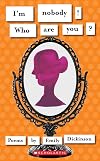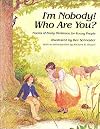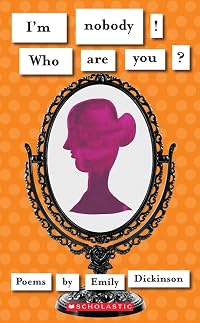
I'm Nobody! Who Are You?: Poems of Emily Dickinson for Children
by Emily Dickinson 
On This Page
Description
An illustrated collection of poems by an outstanding 19th-century American poet whose works were published posthumously.Tags
Recommendations







Member Reviews
This book is formatted especially for young readers. Emily Dickinson is a great way to introduce young people to the world of metaphor, analogy, and nuance found in poetry. Her subject is almost always nature and love and the themes are generally age appropriate for young adult readers to explore the world of poetry.
I loooooooove Emily Dickinson. I love seeing through her own words, her love of nature revealing itself to the reader. She seems to be a sensitive person yet through her poetry, there remains evidence of a fiesty spirit. I think young adults readers can really enjoy reading her work and use it to understand their own development of poerty writings.
I would have younger children draw a picture of what comes to their minds eye show more after reading a poem of hers.
For older chldren, we could discuss Emily's use of metaphor found very frequently throughout her writings and see if the students could come up with a few of their own. show less
I loooooooove Emily Dickinson. I love seeing through her own words, her love of nature revealing itself to the reader. She seems to be a sensitive person yet through her poetry, there remains evidence of a fiesty spirit. I think young adults readers can really enjoy reading her work and use it to understand their own development of poerty writings.
I would have younger children draw a picture of what comes to their minds eye show more after reading a poem of hers.
For older chldren, we could discuss Emily's use of metaphor found very frequently throughout her writings and see if the students could come up with a few of their own. show less
I don't like nor understand most poetry (that isn't written for children). I'm a lazy reader that way. I don't want to read something 3 to 5 times before I can understand it. Usually, if I want spare, I read plays. However, I found some of Emily Dickinson's poems sad yet beautiful and brimming with strength, and I understood them immediately.
"No rack can torture me,
My soul's at liberty.
Behind this mortal bone
There knits a bolder one
You cannot prick with saw,
Nor rend with scymitar.
Two bodies therefore be;
Bind one, one one will flee.
The eagle of his next
No easier divest
And gain the sky,
Than myest thou,
Except thyself may be
Thine enemy;
Captivity is consciousness,
So's liberty
"No rack can torture me,
My soul's at liberty.
Behind this mortal bone
There knits a bolder one
You cannot prick with saw,
Nor rend with scymitar.
Two bodies therefore be;
Bind one, one one will flee.
The eagle of his next
No easier divest
And gain the sky,
Than myest thou,
Except thyself may be
Thine enemy;
Captivity is consciousness,
So's liberty
This book contains a nice collection of Emily Dickinson poems for young people. The main poem, after which the book was named, reflects Emily’s views about popularity and the notion of being “somebody” within a society. Ironically, Emily was actually “somebody” for she came from a well-known and respected family in the town of Amherst, Massachusetts. But in her poem she reveals her preference of being an ordinary person (i.e. nobody) over being famous and well-known (somebody). She eloquently described well-known people as frogs, who must constantly call out (crock) their names to make their presence known in the pond (community). Part of the appeal to Emily’s poems is that something happens in every one of them, and the show more interesting thing is to find out what. Emily was clearly highly aware of nature’s beauty that surrounded her; many of her poems are about things in nature, which she saw clearly and had new things to say about them.
I found many of the poems to be very enjoyable to read more than once, because you discover new things in them as one develop deeper understanding with every pass. Although the poems in the book are relatively short and contain a nice rhyme, which reinforces the poem’s meaning, I found some of them to be hard to understand requiring higher cognitive abilities than most young children possess. I believe the book is appropriate for kids 10 years or older. show less
I found many of the poems to be very enjoyable to read more than once, because you discover new things in them as one develop deeper understanding with every pass. Although the poems in the book are relatively short and contain a nice rhyme, which reinforces the poem’s meaning, I found some of them to be hard to understand requiring higher cognitive abilities than most young children possess. I believe the book is appropriate for kids 10 years or older. show less
I really enjoyed this book because I have always loved Emily Dickenson. Her verses seem to capture the meaning of life in a very simple yet beautiful way.
This classic book of poetry by Emily Dickinson is very inspiring. She makes you think about things you haven't thought of before; outside the box. Her poems vary in size so it is perfect for people with all kinds of attention spans. I enjoyed her plays with words.
I have always enjoyed her poetry, even if it does come off a little on the dark, depressing side. We find this a lot in our English textbooks. Everyone should read at least one of her poems.
Bibliographic Information: Emily Dickinson, “I’m Nobody! Who Are You?”, Illustrated by Rex Schneider, Published by Stemmer House Publishers, Inc., ©1978, 81 pages
Genre: Poetry
Summary: This book includes poetry from all seasons and places. It involves new words for students to learn and a glossary that explains them. It has abstract photos. It involves a lot of different situations.
Tags: Childhood, Fun
My Response: I like the hand draw photos. The poetry is your typical Emily Dickinson which I really like. It is easy to read and not that long. I really like it.
Genre: Poetry
Summary: This book includes poetry from all seasons and places. It involves new words for students to learn and a glossary that explains them. It has abstract photos. It involves a lot of different situations.
Tags: Childhood, Fun
My Response: I like the hand draw photos. The poetry is your typical Emily Dickinson which I really like. It is easy to read and not that long. I really like it.
Members
- Recently Added By
Lists

Poetry Corner
187 works; 15 members
Author Information

539+ Works 30,100 Members
Emily Dickinson was born in Amherst, Massachusetts on December 10, 1830. Although one of America's most acclaimed poets, the bulk of her work was not published until well after her death on May 15, 1886. The few poems published in her lifetime were not received with any great fanfare. After her death, Dickinson's sister Lavinia found over 1,700 show more poems Emily had written and stashed away in a drawer -- the accumulation of a life's obsession with words. Critics have agreed that Dickinson's poetry was well ahead of its time. Today she is considered one of the best poets of the English language. Except for a year spent at Mount Holyoke Female Seminary in South Hadley, Dickinson spent her entire life in the family home in Amherst, Massachusetts. She never married and began to withdraw from society, eventually becoming a recluse. Dickinson's poetry engages the reader and requires his or her participation. Full of highly charged metaphors, her free verse and choice of words are best understood when read aloud. Dickinson's punctuation and capitalization, not orthodox by Victorian standards and called "spasmodic" by her critics, give greater emphasis to her meanings. (Bowker Author Biography) show less
Emily Dickinson has a Legacy Library. Legacy libraries are the personal libraries of famous readers, entered by LibraryThing members from the Legacy Libraries group.
Some Editions
Common Knowledge
- Canonical title
- I'm Nobody! Who Are You?: Poems of Emily Dickinson for Children
- Original publication date
- 1978
Classifications
Statistics
- Members
- 923
- Popularity
- 28,985
- Reviews
- 13
- Rating
- (4.01)
- Languages
- English
- Media
- Paper, Ebook
- ISBNs
- 9
- UPCs
- 1
- ASINs
- 8