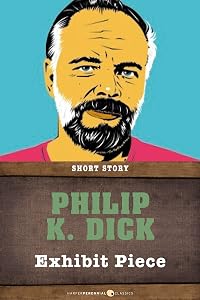
Exhibit Piece: Short Story
by Philip K. Dick
On This Page
Description
Twenty-second century historian George Miller is completely dedicated to his job studying the history and culture of the twentieth century, and has even created an accurate replica of a twentieth-century dwelling. But when George investigates an odd noise in the exhibit, he stumbles upon a strange reality existing inside of his replica. Philip K. Dick was an American science-fiction novelist, short-story writer and essayist. His first short story, "Beyond Lies the Wub," was published shortly show more after his high school graduation. Some of his most famous short stories were adapted for film, including "The Minority Report," "Paycheck," "Second Variety" (adapted into the film Screamers) and "We Can Remember It For You Wholesale" (adapted into the film Total Recall). HarperCollins brings great works of literature to life in digital format, upholding the highest standards in ebook production and celebrating reading in all its forms. Look for more titles in the HarperCollins short-stories collection to build your digital library. show lessTags
Member Reviews
Rating: 4* of five
Well now! Goodness gracious me.
Real Life is a glitzy, amazingly well-cast 45min episode of the anthology series Philip K. Dick's Electric Dreams starring Anna Paquin of True Blood fame as a futuristic lesbian supercop who has a flying car and lots of sex with her hawt wife.
Now that the straight guys are gone, here's what's cool about that: The character talks about that being a straight guy's SFnal fantasy world as she decides to go back in time to live as her straight male 20th century counterpart as a vacation. She needs to know: Is she expiating her survivor guilt by escaping to the future or is George expiating his survival guilt by escaping to the past? Since she's George and since George is her, this identity show more riddle consumes the meta level of the show's text.
Nothing about this resembles the Cold War we're-all-gonna-die plot of "Exhibit Piece" and yet the changes preserve the spirit of the original. As simple as this: What is reality? What defines reality if not experience? Can anyone rely on external criteria to define truth?
What would you do in George's place: Reality or reality are your choices, no way out, but in one you feel good and in one you feel bad but the feelings oscillate and there's no difference between...between...is there a between? Is, in fact, someone allowed to travel into time in different ways?
I love reads that leave me with big questions and this one did. I'm even happier when filmed entertainment, of which I have lower expectations than I do of reads, does the same thing. I am *shocked* when the read and the stare leave me with the same questions! Rare pleasure. show less
Well now! Goodness gracious me.
Real Life is a glitzy, amazingly well-cast 45min episode of the anthology series Philip K. Dick's Electric Dreams starring Anna Paquin of True Blood fame as a futuristic lesbian supercop who has a flying car and lots of sex with her hawt wife.
Now that the straight guys are gone, here's what's cool about that: The character talks about that being a straight guy's SFnal fantasy world as she decides to go back in time to live as her straight male 20th century counterpart as a vacation. She needs to know: Is she expiating her survivor guilt by escaping to the future or is George expiating his survival guilt by escaping to the past? Since she's George and since George is her, this identity show more riddle consumes the meta level of the show's text.
Nothing about this resembles the Cold War we're-all-gonna-die plot of "Exhibit Piece" and yet the changes preserve the spirit of the original. As simple as this: What is reality? What defines reality if not experience? Can anyone rely on external criteria to define truth?
What would you do in George's place: Reality or reality are your choices, no way out, but in one you feel good and in one you feel bad but the feelings oscillate and there's no difference between...between...is there a between? Is, in fact, someone allowed to travel into time in different ways?
I love reads that leave me with big questions and this one did. I'm even happier when filmed entertainment, of which I have lower expectations than I do of reads, does the same thing. I am *shocked* when the read and the stare leave me with the same questions! Rare pleasure. show less
Ratings
Members
- Recently Added By
Author Information

671+ Works 146,904 Members
Phillip Kindred Dick was an American science fiction writer best known for his psychological portrayals of characters trapped in illusory environments. Born in Chicago, Illinois, on December 16, 1928, Dick worked in radio and studied briefly at the University of California at Berkeley before embarking on his writing career. His first novel, Solar show more Lottery, was published in 1955. In 1963, Dick won the Hugo Award for his novel, The Man in the High Castle. He also wrote a series of futuristic tales about artificial creatures on the loose; notable of these was Do Androids Dream of Electric Sheep?, which was later adapted into film as Blade Runner. Dick also published several collections of short stories. He died of a stroke in Santa Ana, California, in 1982. (Bowker Author Biography) show less
Series
Belongs to Publisher Series
SFFaudio Podcast (224)
Work Relationships
Is contained in
Common Knowledge
- Original publication date
- 1954
Classifications
Statistics
- Members
- 11
- Popularity
- 1,999,098
- Reviews
- 1
- Rating
- (3.50)
- Languages
- English
- Media
- Paper, Ebook
- ISBNs
- 2
- ASINs
- 2