On This Page
Description
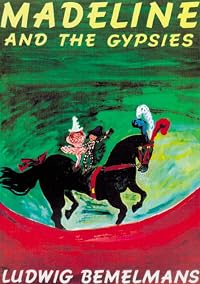
Pepito, son of the Spanish ambassador, and Madeline, rescued by gypsies during a storm, travel and perform with their wandering friends until they again find Miss Clavel.Tags
Recommendations







Member Reviews
Madeline and Pepito find themselves left behind when Miss Clavel and her class visit the local carnival one day, and are taken in by the gypsies, who feed them strong drugs and incorporate them into their circus act. As Miss Clavel agonizes about their fate, the two friends lead a carefree, adventure-filled life, one with few annoying chores or obligations - no brushing of teeth! no going to bed on time! - and plenty of fun. Every new experience palls eventually, however, and the two eventually contact Miss Clavel, who immediately sets out to collect them. The gypsy mother, on the other hand, being determined to keep them, decides to disguise them (together) as a lion...
I sometimes find it a little difficult to credit that, although show more other maliciously destructive myths about various racial, ethnic and religious minorities - Jews kill Christian babies (the Blood Libel) in esoteric blood rites! Africans are black because they are the descendents of Ham (the Curse of Ham), and naturally fit for slavery! - have been rejected, the idea of Gypsies (Romani) as dirty, carefree vagrants who kidnap non-Rom children persists as an "entertaining" trope in our literature, with few questions asked. I feel certain that, if a children's picture-book promoted either of the other two ideas mentioned above, there would be an instant outcry. Here, however, reviewers speak of the "charm" of the artwork, and the "fun" of the story. Absolute Piffle! Leaving aside the lunacy of the stereotype itself - how and why a group of people who, throughout their long and troubled history in Europe, in which they have variously been enslaved, forbidden from owning land or participating in specific professions, and deliberately targeted for extermination in the Nazi Final Solution, would have the desire (let alone the means) to take on other people's children, has never been clear to me - and ignoring all ethical concerns, Madeline and the Gypsies is just a poor story, with a clunky, awkward text (as with its predecessors, I found many of the rhymes here rather forced, and the rhythm somewhat off), and rather drab artwork.
Although I'm not really a fan of the Madeline books, this is the first one I've actively disliked. Utter dreck. show less
I sometimes find it a little difficult to credit that, although show more other maliciously destructive myths about various racial, ethnic and religious minorities - Jews kill Christian babies (the Blood Libel) in esoteric blood rites! Africans are black because they are the descendents of Ham (the Curse of Ham), and naturally fit for slavery! - have been rejected, the idea of Gypsies (Romani) as dirty, carefree vagrants who kidnap non-Rom children persists as an "entertaining" trope in our literature, with few questions asked. I feel certain that, if a children's picture-book promoted either of the other two ideas mentioned above, there would be an instant outcry. Here, however, reviewers speak of the "charm" of the artwork, and the "fun" of the story. Absolute Piffle! Leaving aside the lunacy of the stereotype itself - how and why a group of people who, throughout their long and troubled history in Europe, in which they have variously been enslaved, forbidden from owning land or participating in specific professions, and deliberately targeted for extermination in the Nazi Final Solution, would have the desire (let alone the means) to take on other people's children, has never been clear to me - and ignoring all ethical concerns, Madeline and the Gypsies is just a poor story, with a clunky, awkward text (as with its predecessors, I found many of the rhymes here rather forced, and the rhythm somewhat off), and rather drab artwork.
Although I'm not really a fan of the Madeline books, this is the first one I've actively disliked. Utter dreck. show less
I love Madeline books. But this Madeline has ended up on the Banned Book list, and I understand why. Although it was originally written in 1956/57, racial bias and stereotyping is alive and well. The way the author describes the “gypsies” is harmful stereotyping. I would have thought that although a classic, the publishing house might have tried to clean things up, or change it to remove parts like sewing the kids in lion pelts to hide them from their teacher (in effect stealing the children) would have been redone, but I cannot find that to be true. So, while I love Madeline, I think this book can stay in the catacombs from which it came.
I'm usually a fan of Madeline books.....even despite some forced rhyming and questionable lines.....I still enjoy the overall story and reading experience. My children are fans as well.
I'm also not one who gets overly offended about the politically incorrect things often found in old books....I consider the times and put things in perspective. That said.....the blatant racism and negative tropes about Gypsies in this book were just a bit too much, even for me. This is one of my least favorite in this series.
I'm also not one who gets overly offended about the politically incorrect things often found in old books....I consider the times and put things in perspective. That said.....the blatant racism and negative tropes about Gypsies in this book were just a bit too much, even for me. This is one of my least favorite in this series.
Madeline and the Gypsies features more tales of adventure and mischief for Madeline and her friend Pepito. In this episode, they wind up living every child's dream. They find themselves traveling in a circus with gypsies and performing in an act! In the end they find it's not all it's cracked up to be and are happy to be safe at home after such a crazy journey. This book teaches an important lesson to children dreaming of running away to join the circus. Don't. But seriously, it is a great book that teaches things aren't always what they're cracked up to be.
I think that I looked at this a few times when I was a child. I remember the main characters' cute harlequin costumes. But I don't appreciate it at all now. I just can't suspend the disbelief that these children would truly be able to run away with the circus, and I'm pretty sure the term 'gypsies' is being used inaccurately and disrespectfully here.
Thank you to Little Free Libraries for introducing me to books that I never would see otherwise.
Thank you to Little Free Libraries for introducing me to books that I never would see otherwise.
Madeline and the Gypsies is about two girls Madeline and Pepito who are forgotten by Miss Clavel on the ferris wheel. The Gypsy Mama takes them in and shows them all there is to see behind the scenes of a gypsy carnival. I love the rhyming in this story and how the girls go on an adventure beyond their wildest dreams.
In this story, Madeline and the rest of the girls visit a Gypsy carnival. A storm hits, and the girls leave, but of course, Madeline is missing, along with Pepito, who lives next door to the girls. They were left on top of the ferris wheel in a thunderstorm, so the Gypsy mama had them taken down, and took them in. They were then taught how to be carnival Gypsies. Miss Clavel went to retrieve Madeline and Pepito when she received a post card from them. The Gypsy mama didn't like that too much, so she sewed the two children into a lion costume so they wouldn't be recognized. In the end, Miss Clavel rescues the both of them, and all is well.
This book is simply a tale of Madeline's accidental troublemaking, like the rest of the books in the show more series, but I think there is a lesson to be learned as well. Children getting to do every single thing they want can get old when the frightening feelings of homesickness and worry set in. show less
This book is simply a tale of Madeline's accidental troublemaking, like the rest of the books in the show more series, but I think there is a lesson to be learned as well. Children getting to do every single thing they want can get old when the frightening feelings of homesickness and worry set in. show less
Members
- Recently Added By
Lists

Books About Girls
219 works; 17 members

1950s
340 works; 22 members

Written and Illustrated By
805 works; 1 member
Author Information

96+ Works 31,169 Members
Ludwig Bemelmans, April 27, 1898 - October 1, 1962 Ludwig Bemelmans was born on April 27, 1898 in Meran, then Austria. At the age of eight, his parents divorced and he moved with his mother to Regensburg, Germany. He was enrolled into various public and private schools and failed out of most of them. At the age of twelve, unsure of what else to do show more with him, Bemelmans was apprenticed to an uncle in the hotel business and proceeded to go through many jobs, being repeatedly dismissed. After supposedly shooting and almost killing a waiter, his family gave him the ultimatum of reform school or emigration to the United States. He arrived in America in 1914 with reference letters from his uncle to various hotel managers in New York. Bemelmans obtained a job as a waiter in the Ritz-Carlton, but left that job to join the Army in 1917. In the Army, he worked with German speaking recruits and as a military hospital guard. In 1918, Bemelmans became a naturalized citizen, returning to hotel and restaurant work a year later, eventually opening his own restaurant. In the 1934, at the suggestion of one of his friends, Bemelmans began to write, producing his first children's book, "Hansi." He was best known though, for his series of books about the little french girl, "Madeline," which is still a childhood favorite. "Madeline's Rescue," the second book in the series, won the Caldecott Medal in 1953. His first book for adults was entitled, "My War with the United States" and was a diary of his experiences in the service during World War I. In fact, Bemelmans usually wrote his books based on his life experiences, such as "Life Class" and "Hotel Splendide," about his life as a restaurateur, his travels to Ecuador and Italy appeared in "The Donkey Inside" and "Italian Holiday," and his brief stint as a screenwriter in Hollywood was the basis for "Dirty Eddie." Bemelmans wrote about a book or two a year and was a contributor to Town and Country and Horizon, as well as a cover illustrator for The New Yorker. In his later years, Bemelmans enjoyed some small fame from painting, with some of his work appearing in various galleries. Ludwig Bemelmans died of pancreatic cancer in New York on October 1, 1962. (Bowker Author Biography) show less
Awards and Honors
Notable Lists
Series

Work Relationships
Is contained in
Common Knowledge
- Canonical title
- Madeline and the Gypsies
- Original title
- Madeline and the Gypsies
- Original publication date
- 1959-09-01
- People/Characters
- Madeline Fogg; Pepito
- Important places
- Paris, France; France
- First words
- In an old house in Paris that was covered with vines
Lived twelve little girls in two straight lines. - Original language
- English
Classifications
Statistics
- Members
- 1,564
- Popularity
- 14,649
- Reviews
- 23
- Rating
- (3.72)
- Languages
- English, French
- Media
- Paper, Audiobook, Ebook
- ISBNs
- 29
- UPCs
- 1
- ASINs
- 15