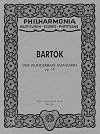
The Miraculous Mandarin, Op. 19, Sz. 73, BB 82
by Béla Bartók
On This Page
Description
(Boosey & Hawkes Scores/Books). Pantomime in One Act, after a Libretto by Menyhert Lengyel.Tags
Member Reviews
Members
- Recently Added By
Author Information

926+ Works 2,915 Members
Bela Bartok, one of the outstanding composers of the twentieth century, was born in Hungary in 1881. When he was five years old, his mother began to teach him to play the piano. By the age of nine, he had begun to compose his own music. Between 1899 and 1903, he attended the Academy of Music in Budapest; in 1907 he was appointed professor of show more piano. Bartok's early compositions were complex and not well received by the public. In 1905 he turned his attention to collecting and cataloging the folk music of his native Hungary. With the help of his friend and fellow Hungarian, composer Zoltan Kodaly, Bartok produced a series of commentaries, anthologies, and arrangements of the folk music that he had collected. Bartok's interest in folk music had a profound effect on his compositions. The influence is seen in the unadorned power of his music, especially in the rhythmic drive of fast movements and in his use of folk melodies, rhythms, and harmonic patterns. Throughout his life, Bartok had to struggle to make a living. Yet he refused to teach musical composition, believing that this would inhibit his own composing. Instead, he earned a living teaching piano and performing. During the 1920s he traveled throughout Europe giving piano recitals, and, in 1927 and 1928, he made a concert tour of the United States. In 1940, after the outbreak of World War II, Bartok left Hungary to settle in the United States, where he continued to perform and compose music. Among his most famous compositions are the Mikrokosmos for piano (1926--27), Music for Strings, Percussion, and Celesta (1936), and Concerto for Orchestra (1943). Elizabeth Sprague Coolidge became his patron and supported him. Bartok died of leukemia in 1945. (Bowker Author Biography) show less
Common Knowledge
- Canonical title
- The Miraculous Mandarin, Op. 19, Sz. 73, BB 82
- Original publication date
- 1924
- Important places*
- Roemenië
- Disambiguation notice*
- Bevat: The Miraculous Mandarin, Op. 19 (Complete Ballet); Divertimento; Sonata for Two Pianos and Percussion.
*Some information comes from Common Knowledge in other languages. Click "Edit" for more information.
Classifications
Statistics
- Members
- 12
- Popularity
- 1,873,865
- Reviews
- 1
- Rating
- (3.50)
- Languages
- 5 — Dutch, English, German, Hungarian, No linguistic content
- Media
- Paper
- ISBNs
- 3