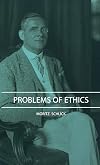
Problems of Ethics
by Moritz Schlick
On This Page
Description
Originally published in 1939. PROBLEMS OF ETHICS by MORITZ SCHLICK. TRANSLATION BY DAVID RYNIN. Foreword: THE appearance, in English translation, of Professor Moritz Schlicks Fragen dcr JLthi is timely and welcome.-Professor Schlick was the leader of the vigorous and influential Vienna Circle, a group of scientists, logicians, and philosophers who attacked in a fresh way the persistent problem as to what the nature and the significant function of philosophical reflection really is. These show more thinkers, in general, carry on the traditions of empiricism and positivism, which they have reformulated in the light of certain views arising from a logical analysis of language and symbols. Accordingly, the position which these writers represent sometimes goes by the name of logical positivism. The application of the methods and results of this type of analysis to some of the traditional problems of ethics supplies the substance of this book. It will bring home to the mind of the thoughtful reader th show lessTags
Recommendations














































Member Reviews
Members
- Recently Added By
Author Information

39+ Works 219 Members
Moritz Schlick studied at Berlin under Max Planck (see Vol. 5) and received his Ph.D. in physics in 1904. He taught at Rostock and Kiel before joining the faculty at Vienna in 1922. His early work, General Theory of Knowledge (1918), reveals his commitment to realism and to the experimental method in scientific and philosophical knowledge. At show more Vienna he led the Vienna Circle of logical positivism and was instrumental in recruiting Rudolf Carnap. The publication of Ludwig Wittgenstein's Tractatus Logico-Philosophicus (1921) influenced radically the subsequent development of his thought. Increasingly he stressed the empirical verification criterion for truth and meaning and became severely critical of statements in philosophy and elsewhere that could not meet this criterion. Hence the logical positivists whom he led became notorious for their thesis that metaphysics in non-sense. His mature epistemology was presented in the publication of the second edition of his General Theory of Knowledge (1925). He also advanced a noncognitivist theory of ethical statements in his book Problems of Ethics (1939). (Bowker Author Biography) show less
Some Editions
Classifications
Statistics
- Members
- 30
- Popularity
- 930,660
- Reviews
- 1
- Languages
- English, French, German
- Media
- Paper
- ISBNs
- 6