Lugalbanda: The Boy Who Got Caught Up in a War: An Epic Tale From Ancient Iraq
by Kathy Henderson
On This Page
Description
An ancient Sumerian tale about the youngest and weakest of eight brothers who, caught up in an ill-advised war, uses his wits and courage and eventually becomes king.Tags
Recommendations


Member Reviews
Incorporating two ancient Sumerian poems - written down on clay tablets approximately 5,000 years ago, and rediscovered in the nineteenth century, they were only recently (in the 1970s) translated - Kathy Henderson tells the tale of Lugalbanda, a prince of the Mesopotamian city of Uruk, and (eventually) the father of the epic hero Gilgamesh. The oldest written story on earth (as far as our scholarship extends thus far), it incorporates characters and creatures from Sumerian mythology, and concerns a war being waged by Lugalbanda's father, King Enmerkar, who is determined to conquer the beautiful city of Aratta, and use its treasures to glorify Uruk, and its patron goddess, Inanna.
Lugalbanda, who insists on accompanying his father's army show more on their trek to Aratta, becomes ill in the mountains, and is left behind in a cave by his loving brothers. Beseeching the gods and goddesses of the Sumerian pantheon for aid, he is cured, and, in his own inimitable style, then wins the favor of the powerful Anzu birds, who help him on his journey to retake his father's army, and who give him those blessings - such as the ability to run without becoming tired - that allow him to aid King Enmerkar, and prevent the utter destruction of Arrata.
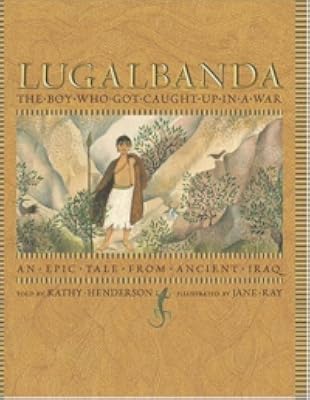
A fascinating story in its own right, Lugalbanda's tale also has the distinction of being both ancient and new, and the dizzying sense of discovery such stories always give me (I felt this most recently with The Dark Star of Itza: The Story of a Pagan Princess, which introduced me to an epic tale from the ancient Mayan civilization) made the reading experience a powerful one! My friend Miriam, who recommended this to me (many, many thanks, Miriam!), highlighted many of the appealing aspects of the story itself in her own excellent review, with which I am in complete agreement, but the artwork also deserves a mention, as I found it immensely engaging as well. Jane Ray has done quite a bit of work with fairy-tales and mythology, and her style, with its copious uses of golden accents, seems very well suited to the story here. I liked her depictions of the men of Uruk, and of Innana, but my favorite painting was the one in which Lugalbanda, lying on his side, looks out on the world from his cave.
This is just a wonderful, wonderful book, and although a picture-book, one I would recommend to anyone, young or old, who is interested in ancient Sumer, or ancient epics in general. The author's afterword is quite interesting, but now I'm hungry for more! Have the translations she mentioned been collected in an anthology of some kind? Clearly I need to do more research. Also, clearly I need to reread Gilgamesh! show less
Lugalbanda, who insists on accompanying his father's army show more on their trek to Aratta, becomes ill in the mountains, and is left behind in a cave by his loving brothers. Beseeching the gods and goddesses of the Sumerian pantheon for aid, he is cured, and, in his own inimitable style, then wins the favor of the powerful Anzu birds, who help him on his journey to retake his father's army, and who give him those blessings - such as the ability to run without becoming tired - that allow him to aid King Enmerkar, and prevent the utter destruction of Arrata.
A fascinating story in its own right, Lugalbanda's tale also has the distinction of being both ancient and new, and the dizzying sense of discovery such stories always give me (I felt this most recently with The Dark Star of Itza: The Story of a Pagan Princess, which introduced me to an epic tale from the ancient Mayan civilization) made the reading experience a powerful one! My friend Miriam, who recommended this to me (many, many thanks, Miriam!), highlighted many of the appealing aspects of the story itself in her own excellent review, with which I am in complete agreement, but the artwork also deserves a mention, as I found it immensely engaging as well. Jane Ray has done quite a bit of work with fairy-tales and mythology, and her style, with its copious uses of golden accents, seems very well suited to the story here. I liked her depictions of the men of Uruk, and of Innana, but my favorite painting was the one in which Lugalbanda, lying on his side, looks out on the world from his cave.
This is just a wonderful, wonderful book, and although a picture-book, one I would recommend to anyone, young or old, who is interested in ancient Sumer, or ancient epics in general. The author's afterword is quite interesting, but now I'm hungry for more! Have the translations she mentioned been collected in an anthology of some kind? Clearly I need to do more research. Also, clearly I need to reread Gilgamesh! show less
Lugalbanda
Bryan O'Keeffe
I did not have any idea of this book before I read it. However after reading this book I did enjoy reading it. I read a little bit about the book after I read it and was extremely surprised at how old this story was. I really loved how the illustrations looked like they were from that time period thousands of years ago. I really enjoyed that the ancient epic was turned into a children's story. I thought that the way to illustrations were done was completely appropriate for how it should have been done. The story felt more authentic because of that. I felt that Lugalbanda could have been an actual boy during this time period. He could have also possibly helped out in the war as well. It was really nice being able show more to be exposed to middle eastern culture from this book. I think that kids are able to learn from this book and learn from the message; never back down in the face of adversity. show less
Bryan O'Keeffe
I did not have any idea of this book before I read it. However after reading this book I did enjoy reading it. I read a little bit about the book after I read it and was extremely surprised at how old this story was. I really loved how the illustrations looked like they were from that time period thousands of years ago. I really enjoyed that the ancient epic was turned into a children's story. I thought that the way to illustrations were done was completely appropriate for how it should have been done. The story felt more authentic because of that. I felt that Lugalbanda could have been an actual boy during this time period. He could have also possibly helped out in the war as well. It was really nice being able show more to be exposed to middle eastern culture from this book. I think that kids are able to learn from this book and learn from the message; never back down in the face of adversity. show less
It is a historical book also it is a early chapter book for kids.Historical fiction indicates a tale that happened earlier, as in pioneer America or medieval England
The story mainly tells us there once was a boy named Lugalbanda who lived with his seven brothers in the great city of Uruk. Uruk was ruled by King Enmerkar who had built it in honor of the goddess of love and war, Inana. One day, Enmerkar noticed that the faraway city of Aratta had far more impressive treasures and works of art than Uruk. Without further ado then, Enmerkar declared war on Aratta and set off to plunder its booty with his men. Amongst his men came the seven brothers and Lugalbanda. While en route to war, however, Lugalbanda became deathly ill and his brothers show more were forced to leave him with plenty of good food and drink in a warm cave, praying for his survival.
To teachers, it is a good book to teach student how to be strong and also it has a lot of methods to let students getting understanding of this book, for instance, role play, read aloud, etc.
To children, it is a good book which they can learn some history and also myths, they can learn the characteristic of the character. show less
The story mainly tells us there once was a boy named Lugalbanda who lived with his seven brothers in the great city of Uruk. Uruk was ruled by King Enmerkar who had built it in honor of the goddess of love and war, Inana. One day, Enmerkar noticed that the faraway city of Aratta had far more impressive treasures and works of art than Uruk. Without further ado then, Enmerkar declared war on Aratta and set off to plunder its booty with his men. Amongst his men came the seven brothers and Lugalbanda. While en route to war, however, Lugalbanda became deathly ill and his brothers show more were forced to leave him with plenty of good food and drink in a warm cave, praying for his survival.
To teachers, it is a good book to teach student how to be strong and also it has a lot of methods to let students getting understanding of this book, for instance, role play, read aloud, etc.
To children, it is a good book which they can learn some history and also myths, they can learn the characteristic of the character. show less
Lugalbanda is a folktale about the youngest prince in a kingdom going with his older brothers and father to war with a neighboring rival kingdom. He gets sick and they must leave him in the mountains in a cave. Through the grace of his Gods he regains his strength and uses his head to get a gift from a great bird guardian, his gift is to be able to run as far as he would like without getting tired. Because of this he is able to make it to the camp site of his kingdom and take a message back home to the Goddess of his home and all the way back to the camp over night.
Lugabanda is a young prince who follows his brothers into battle, but gets left behind in the mountains after becoming ill. With the help of the sun goddess and a mythical bird, he finds the army and then delivers a message for the king, helping them to overtake the city. Upon returning home, Lugabanda grows up and later becomes king himself.
Genre: Folklore/ Myth
Media: Watercolor, ink, and collage
Summary: This is a folklore the story was linked back from Iraq and is supposedly older than the Bible or Koran. This book talks about an boy with big goals. This coming-of-age story tells how a boy grows up to be a hero for his people.
Media: Watercolor, ink, and collage
Summary: This is a folklore the story was linked back from Iraq and is supposedly older than the Bible or Koran. This book talks about an boy with big goals. This coming-of-age story tells how a boy grows up to be a hero for his people.
This was a great story of a young hero. It shows anyone can be a hero.
Members
- Recently Added By
Author Information

42 Works 1,310 Members
All Editions
Awards and Honors
Awards
Distinctions
Notable Lists
Common Knowledge
- Canonical title
- Lugalbanda: The Boy Who Got Caught Up in a War: An Epic Tale From Ancient Iraq
- People/Characters
- Lugalbanda
- Important places
- Iraq; Uruk, Mesopotamia
- First words
- A very long time ago, in the land now called Iraq, there lived a little prince whose name was Lugalbanda.
- Original language
- English
Classifications
Statistics
- Members
- 183
- Popularity
- 179,580
- Reviews
- 9
- Rating
- (3.85)
- Languages
- English, French
- Media
- Paper
- ISBNs
- 4