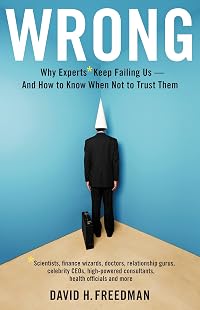
Wrong: Why experts* keep failing us--and how to know when not to trust them *Scientists, finance wizards, doctors, relationship gurus, celebrity CEOs, ... consultants, health officials and more
by David H. Freedman
On This Page
Description
Our investmeents are devastated, obesity is epidemic, blue-chip companies circle the drain, and popular medications turn out to be ineffective and even dangerous. What happened? Didn't we listen to the scientists, economists, and other experts who promised us that if we followed their advice all would be well?Actually, those experts are a big reason we're in this mess. Their expert counsel usually turns out to be wrong-often wildly so. Wrong reveals the dangerously distorted ways experts show more come up with their advice and why the most heavily flawed conclusions end up getting the most attention-all the more so in the online era. But there's hope: Wrong spells out the means by which every individual and organization can do a better job of unearthing the crucial bits of right within a vast avalanche of misleading pronouncements. show lessTags
Recommendations




Member Recommendations
Member Reviews
Медицината е супер важна дисциплина и милиарди всяка година се харчат за медицински изследвания - за да бъде изучено както човешкото тяло и неговите функции, така и действието на различните храни, вещества и лекарства върху него.
Супер много ме дразнят разните му там антиваксъри, конспиративни ненормалници и други дебили, които обявяват медицината за "корумпирана", че "големите корпорации" опорочили show more всичко, че имало измислено лекарство за рак, но "го крият, за да печелят от поддържащата терапия" и после предлагат да се лекуваме с кристали хомеопатия. Тази книга изобщо не е от тях.
Авторът е учен в най-добрия смисъл. Застъпник на строгия научен подход, безпристрасността и двойно слепите експерименти. Посветил е кариерата си на изследване на ... медицинските изследвания и това да открива къде те грешат, къде има човешки грешки в експериментите и изводите им.
Той всъщност е доста известен и уважаван в медицинската общност точно с това, защото безпардонното му придържане към научния протокол е неоспоримо, а резултатите от проучванията му... шокиращи.
Оказва се, че човешкият фактор при провеждането на медицински експерименти е доста голям, което доста ... изкривява резултатите. Дотолкова всъщност, че по-голямата част от резултатите на медицинските изследвания биват оборени в последствие. Дори т.н. златен стандарт, най-най-елитните, най-научни и сериозни изследвания, публикувани в най-реномираните медицински издания, авторът открива, не отговаря на научните критерии за експериментиране и интерпретация на данните в над 50% от случаите. Единствено т.н. платинен стандарт - не повече от 1000 изследвания които вече са най-най-най-най, имат само 25% грешка.
Това не е конспиративна, хипи книга, знаете ги тия. Това е строго научна книга за научния подход в медицината и като цяло в науката, която показва как учените не са непогрешими богове, а се влияят от собствените си мнения, предразсъдъци, а и личен интерес при извършването и публикуване на експерименти и интерпретиране на резултати. Един трезв поглед върху научната общност.
Книгата няма нищо общо с глобалното затопляне, но като я четях не можех да не правя паралели с това как личните интереси на учените за кариерно развитие, популярност и преследване на финансиране могат да изкривят резултатите и изследванията им в определена насока. show less
Супер много ме дразнят разните му там антиваксъри, конспиративни ненормалници и други дебили, които обявяват медицината за "корумпирана", че "големите корпорации" опорочили show more всичко, че имало измислено лекарство за рак, но "го крият, за да печелят от поддържащата терапия" и после предлагат да се лекуваме с кристали хомеопатия. Тази книга изобщо не е от тях.
Авторът е учен в най-добрия смисъл. Застъпник на строгия научен подход, безпристрасността и двойно слепите експерименти. Посветил е кариерата си на изследване на ... медицинските изследвания и това да открива къде те грешат, къде има човешки грешки в експериментите и изводите им.
Той всъщност е доста известен и уважаван в медицинската общност точно с това, защото безпардонното му придържане към научния протокол е неоспоримо, а резултатите от проучванията му... шокиращи.
Оказва се, че човешкият фактор при провеждането на медицински експерименти е доста голям, което доста ... изкривява резултатите. Дотолкова всъщност, че по-голямата част от резултатите на медицинските изследвания биват оборени в последствие. Дори т.н. златен стандарт, най-най-елитните, най-научни и сериозни изследвания, публикувани в най-реномираните медицински издания, авторът открива, не отговаря на научните критерии за експериментиране и интерпретация на данните в над 50% от случаите. Единствено т.н. платинен стандарт - не повече от 1000 изследвания които вече са най-най-най-най, имат само 25% грешка.
Това не е конспиративна, хипи книга, знаете ги тия. Това е строго научна книга за научния подход в медицината и като цяло в науката, която показва как учените не са непогрешими богове, а се влияят от собствените си мнения, предразсъдъци, а и личен интерес при извършването и публикуване на експерименти и интерпретиране на резултати. Един трезв поглед върху научната общност.
Книгата няма нищо общо с глобалното затопляне, но като я четях не можех да не правя паралели с това как личните интереси на учените за кариерно развитие, популярност и преследване на финансиране могат да изкривят резултатите и изследванията им в определена насока. show less
David Freedman’s thesis in Wrong is almost a flat-out pronouncement that all experts, advisors and gurus -- even the most prestigious and even those quoted in the most prominent sources -- are always wrong.
According to Freedman, everyone involved with expert advice is motivated by self-interest: experts are biased toward results that promote their careers; the media is biased toward flashy results and personalities that increase ratings; and the public is biased toward simple, sure-fire, actionable advice. Even today’s democratization of expertise (via blogs, rating/review sites, Google rankings) doesn't overcome these biases.
Freedman even dulls the shine on research’s gold standard (the randomized, double-blind controlled trial) show more by exploring how sloppy mistakes taint the data; how the pressures of academic tenure, lab funding, corporate profits and consultancy contracts drive fraud (data invention and falsification); and how little of this is caught through the peer review process.
This is an important topic and the book is accessibly written. But to be clear: it's very similar to the expert advice he skewers -- full of broad, sweeping statements and detailed examples biased toward his thesis. (Freedman acknowledges this late in the book and amends his thesis, but only to, “there is some reason to suspect that most experts are usually wrong.”) During my reading, frustration and pessimism grew into profound discouragement and then a spiraling hopelessness. There is no optimism here; even his chapter, “Eleven Simple Never-Fail Rules” -- a summary of red flags about advice -- is the height of irony with its (seemingly) sure-fire, actionable content.
And thus my advice (!): if this thesis is new to you and you want to know more, read this book but read it fast -- get in, get the overall picture, get out. Then decide how much of it you're going to fit into your worldview.
(Review based on an advance reading copy provided by the publisher.) show less
According to Freedman, everyone involved with expert advice is motivated by self-interest: experts are biased toward results that promote their careers; the media is biased toward flashy results and personalities that increase ratings; and the public is biased toward simple, sure-fire, actionable advice. Even today’s democratization of expertise (via blogs, rating/review sites, Google rankings) doesn't overcome these biases.
Freedman even dulls the shine on research’s gold standard (the randomized, double-blind controlled trial) show more by exploring how sloppy mistakes taint the data; how the pressures of academic tenure, lab funding, corporate profits and consultancy contracts drive fraud (data invention and falsification); and how little of this is caught through the peer review process.
This is an important topic and the book is accessibly written. But to be clear: it's very similar to the expert advice he skewers -- full of broad, sweeping statements and detailed examples biased toward his thesis. (Freedman acknowledges this late in the book and amends his thesis, but only to, “there is some reason to suspect that most experts are usually wrong.”) During my reading, frustration and pessimism grew into profound discouragement and then a spiraling hopelessness. There is no optimism here; even his chapter, “Eleven Simple Never-Fail Rules” -- a summary of red flags about advice -- is the height of irony with its (seemingly) sure-fire, actionable content.
And thus my advice (!): if this thesis is new to you and you want to know more, read this book but read it fast -- get in, get the overall picture, get out. Then decide how much of it you're going to fit into your worldview.
(Review based on an advance reading copy provided by the publisher.) show less
Like I would an over-compensating, insecure research paper that I wanted to mark up to reduce redundancy, rabbit trails, self-congratulation, and self-contradiction, I sort of enjoyed reading it, sometimes. Ultimately, I'm not convinced the emperor was appropriately clothed. I read/skimmed to the end because I though the book might do right by offering some insight or creative connection. I was wrong. (Ugh. Sorry for that.)
This book looks at many different types of research and expertise, from studies in research journals, to popular financial advisors, to celebrity spokespeople, to your local doctor. Freedman considers how and why their advice so often steers us in the wrong direction. He also considers why certain studies and certain gurus get so much attention when others, sometimes more reliable others, get ignored. It seems that people want dramatic results and easy-to-follow steps. Nuance and negative results are less interesting. And then there’s the whole problem of falsified data, which seems more common than most of us would like to think.
One of my favorite chapters, “The Idiocy of Crowds,” takes on the common notion that the best ideas show more arise from people working together. Freedman talks about how dominant personalities and groupthink can lead people who see a problem with the team’s solution to keep their mouths shut. Besides not always leading to the right answer, teamwork is also sometimes more inefficient than individual work. Interestingly, in a later chapter on technology, Freedman decries the lack of expert participation in collaborative online ventures, so there’s a tension in his argument. And that’s perhaps a good thing. Collaboration doesn’t have all the answers, but neither does working in isolation.
I loved Freedman’s skewering of management gurus and their TLAs (“three-letter acronyms”). I know I could make a long list of TLAs I’ve encountered (and used!) in my job. I bet many of you could, too. This chapter, “Experts and Organizations,” points out how ridiculous it is to think that a management book available at any airport would contain the secrets that would enable every company out there to be a winner. Jerker Denrell of Stanford’s business school points out that this is not unlike a swim coach saying that every swimmer who follows her advice will win at swim meets.
My only real problem with the book is a problem that I’ve found in a lot of books of this type—a piling on of examples. After a while, they do tend to become a blur. Maybe if I weren’t already inclined to accept Freedman’s main idea I would need all those anecdotes and examples, but he didn’t need to work quite so hard to convince me. Still, the examples are easy enough to understand, and the book’s accessible, journalistic style kept it from ever feeling like work to read.
Freedman does acknowledge the irony of presenting himself as an expert on expertise, and in the final appendix, he fesses up to the ways in which he might have massaged his findings to support his thesis. So maybe some of his examples wouldn’t stand up to scrutiny. His central ideas, though, are probably sound enough, based as they are on common sense. His main point seems to be not to accept everything you read at face value. It’s not advice a cynic like me needs all that much, I suppose, but I’m glad Freedman said it.
See my complete review at Shelf Love. show less
One of my favorite chapters, “The Idiocy of Crowds,” takes on the common notion that the best ideas show more arise from people working together. Freedman talks about how dominant personalities and groupthink can lead people who see a problem with the team’s solution to keep their mouths shut. Besides not always leading to the right answer, teamwork is also sometimes more inefficient than individual work. Interestingly, in a later chapter on technology, Freedman decries the lack of expert participation in collaborative online ventures, so there’s a tension in his argument. And that’s perhaps a good thing. Collaboration doesn’t have all the answers, but neither does working in isolation.
I loved Freedman’s skewering of management gurus and their TLAs (“three-letter acronyms”). I know I could make a long list of TLAs I’ve encountered (and used!) in my job. I bet many of you could, too. This chapter, “Experts and Organizations,” points out how ridiculous it is to think that a management book available at any airport would contain the secrets that would enable every company out there to be a winner. Jerker Denrell of Stanford’s business school points out that this is not unlike a swim coach saying that every swimmer who follows her advice will win at swim meets.
My only real problem with the book is a problem that I’ve found in a lot of books of this type—a piling on of examples. After a while, they do tend to become a blur. Maybe if I weren’t already inclined to accept Freedman’s main idea I would need all those anecdotes and examples, but he didn’t need to work quite so hard to convince me. Still, the examples are easy enough to understand, and the book’s accessible, journalistic style kept it from ever feeling like work to read.
Freedman does acknowledge the irony of presenting himself as an expert on expertise, and in the final appendix, he fesses up to the ways in which he might have massaged his findings to support his thesis. So maybe some of his examples wouldn’t stand up to scrutiny. His central ideas, though, are probably sound enough, based as they are on common sense. His main point seems to be not to accept everything you read at face value. It’s not advice a cynic like me needs all that much, I suppose, but I’m glad Freedman said it.
See my complete review at Shelf Love. show less
Freedman offers anecdotal evidence with a suggestion of "studies" that most expert opinions should not be considered as such. He tackles medicine, business practices, leadership, health among others. A bit repetitive but some entertaining insights, especially those relating to how involving more people in brainstorming and decision making do not improve the results.
I like this book because it sums up my position on many of the "science findings" that come out regularly in the media: be skeptical. Be very, very skeptical. That said, I found the book suffered from some flaws, such as using dubious studies to back up points that the author wanted to make, although he did mention that it's highly probable that his entire book could be flawed due to that very type of thing. Definitely worth a read if you're not used to thinking critically, or if you'd like some pointers in that direction.
It was an interesting read and readable once picked up but I did struggle to want to pick it up.
Mainly I think because its theme was so negative. I agree that a healthy dose of scepticism is needed in the modern world but this book would make you think that you cannot believe anybody or anything. And I don't think that's true.
Mainly I think because its theme was so negative. I agree that a healthy dose of scepticism is needed in the modern world but this book would make you think that you cannot believe anybody or anything. And I don't think that's true.
Members
- Recently Added By
Lists

Hachette Book Group
152 works; 6 members

The Great Courses: Your Deceptive Mind
60 works; 1 member

Books recommended by Calgary Public Library staff
1,588 works; 4 members
Author Information

13+ Works 1,269 Members
David H. Freedman is a journalist specializing in business and technology. He is a senior editor at Forbes ASAP, and his work has appeared in Inc., the Atlantic Mouthly, the New York Times, Wired, Science, and the Harvard Business Review
Classifications
Statistics
- Members
- 156
- Popularity
- 210,519
- Reviews
- 15
- Rating
- (3.35)
- Languages
- English, German, Spanish
- Media
- Paper, Audiobook, Ebook
- ISBNs
- 11
- ASINs
- 3