On This Page
Description
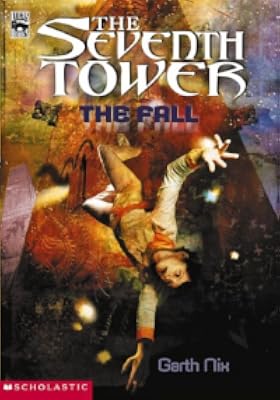
Tal falls into a strange and unknown world of warriors, iceships, and magic.Tags
Recommendations



Member Reviews
Teenage Tal lives within a sprawling castle in a world of constant darkness. Tal has a lot of problems: his father is missing, his mother is sick, and unknown enemies are trying to destroy his family. Solving these problems will require Tal to venture to the unknown outside world, and his survival will depend on a blood-pact with a girl who wants to kill him. Wacky hijinks ensue.
I really liked Nix's Old Kingdom trilogy, which featured courageous heroines, swashbuckling adventures, and zombies. (I am a sucker for the undead.) So when I found the full set of his Seventh Tower series at my Favorite Used Bookstore, I swooped down on the lot. Unfortunately, The Seventh Tower is obviously written for a very young audience. The writing is show more deliberately pedestrian; every subtlety is carefully explained in simple sentences and single-syllable words. There's some interesting ideas, especially in service to the light/dark motif -- the Castle's hierarchy is organized into seven levels, from lordly Violet to lowly Red (get it?); the Chosen have magical shape-shifting shadowguards -- and Tal's reluctant Icecarl ally, Milla, is an interesting character ("Tal saw it coming down and closed his eyes. Milla saw, too, but she kept her eyes open. Icecarls believed in facing death." [172]), but it all gets bogged down by the "no nuance left unturned" approach to writing for kids. show less
I really liked Nix's Old Kingdom trilogy, which featured courageous heroines, swashbuckling adventures, and zombies. (I am a sucker for the undead.) So when I found the full set of his Seventh Tower series at my Favorite Used Bookstore, I swooped down on the lot. Unfortunately, The Seventh Tower is obviously written for a very young audience. The writing is show more deliberately pedestrian; every subtlety is carefully explained in simple sentences and single-syllable words. There's some interesting ideas, especially in service to the light/dark motif -- the Castle's hierarchy is organized into seven levels, from lordly Violet to lowly Red (get it?); the Chosen have magical shape-shifting shadowguards -- and Tal's reluctant Icecarl ally, Milla, is an interesting character ("Tal saw it coming down and closed his eyes. Milla saw, too, but she kept her eyes open. Icecarls believed in facing death." [172]), but it all gets bogged down by the "no nuance left unturned" approach to writing for kids. show less
One of the elements of writing in this genre that Nix is particularly gifted at is creating original fantasies and worlds. This series is no exception. However, in comparison to some of his other works, especially The Abhorsen Trilogy, the exploration of this world and the characters within is weak at best.
The story is interesting because Nix presents the audience with a new mythology, but he rushes through the plot, circumnavigating what could be some really amazing explorations of the world he's created. As a result, it's more difficult to imagine this parallel universe and its characters and creatures, and it doesn't draw the reader in nearly as much as it could.
The story is interesting because Nix presents the audience with a new mythology, but he rushes through the plot, circumnavigating what could be some really amazing explorations of the world he's created. As a result, it's more difficult to imagine this parallel universe and its characters and creatures, and it doesn't draw the reader in nearly as much as it could.
Worldbuilding, fast action, compelling protagonist
- A little underwritten, shape of overall narrative not yet clear
This is the first of a 6-book series intended for younger readers. As such, the narrative seems a little thin from an adult perspective. However, Nix is able to evoke character, situation, and complexity even within these parameters, and without a condescending or cute tone. As usual, Nix’s worldbuilding is compelling, with a strong archetypal undertone. The alienness of protagonist Tal’s world does require more exposition than I would like in an adult fantasy novel, but I think it’s necessary here and relatively naturalistic. Nix embeds much of the explanatory matter by two means: Tal’s worried ruminations allow show more the reader to understand his sociocultural surround and explain his urgency, and encounters with Icecarls allow further elaboration on customs, history, and the pragmatics of the world in which the action takes place. Within a rather grand and novel environment, Nix’s characterization is spare but deft. Tal’s antagonists are Roald Dahl-like in their pleasure in thwarting him, and the reader quickly learns, with Tal, that these intimate obstructions occur in the context of a more ominous, Kafka-like social context.
The storyline from the vantage of the end of this first book seem rather picaresque, though this appears to be a mirror of Tal’s perceptions of the events; the reader understands that the hints of as-yet unrevealed background and history will be further elaborated as Tal continues on his quest. The series is presumably a coming-of-age narrative and hero story, and I expect that Tal's concerns will become less personal and more universal.
The completed series was published from 2000 through 2001, which should suggest relatively good continuity, unlike more meandering and occasional series such as Orson Scott Card's disappointing Alvin Maker books. show less
- A little underwritten, shape of overall narrative not yet clear
This is the first of a 6-book series intended for younger readers. As such, the narrative seems a little thin from an adult perspective. However, Nix is able to evoke character, situation, and complexity even within these parameters, and without a condescending or cute tone. As usual, Nix’s worldbuilding is compelling, with a strong archetypal undertone. The alienness of protagonist Tal’s world does require more exposition than I would like in an adult fantasy novel, but I think it’s necessary here and relatively naturalistic. Nix embeds much of the explanatory matter by two means: Tal’s worried ruminations allow show more the reader to understand his sociocultural surround and explain his urgency, and encounters with Icecarls allow further elaboration on customs, history, and the pragmatics of the world in which the action takes place. Within a rather grand and novel environment, Nix’s characterization is spare but deft. Tal’s antagonists are Roald Dahl-like in their pleasure in thwarting him, and the reader quickly learns, with Tal, that these intimate obstructions occur in the context of a more ominous, Kafka-like social context.
The storyline from the vantage of the end of this first book seem rather picaresque, though this appears to be a mirror of Tal’s perceptions of the events; the reader understands that the hints of as-yet unrevealed background and history will be further elaborated as Tal continues on his quest. The series is presumably a coming-of-age narrative and hero story, and I expect that Tal's concerns will become less personal and more universal.
The completed series was published from 2000 through 2001, which should suggest relatively good continuity, unlike more meandering and occasional series such as Orson Scott Card's disappointing Alvin Maker books. show less
One of the elements of writing in this genre that Nix is particularly gifted at is creating original fantasies and worlds. This series is no exception. However, in comparison to some of his other works, especially The Abhorsen Trilogy, the exploration of this world and the characters within is weak at best. The story is interesting because Nix presents the audience with a new mythology, but he rushes through the plot, circumnavigating what could be some really amazing explorations of the world he’s created. As a result, it’s more difficult to imagine this parallel universe and its characters and creatures, and it doesn’t draw the reader in nearly as much as it could.This series breaks one large story into several books, and since show more each of these is easily around the high 100s and low 200s in page length, Nix could have spent more time giving description, metaphors, and poetic/aesthetic language to flush this world out. This would make everything significantly more engaging for the readers, and ultimately, foster growth and interest in the books, the fantasy, the world, and the characters therein. Ultimately, there’s just nothing to bite into.-Lindsey Miller, www.lindseyslibrary.com show less
I think I've read this one before. It was simple, easy-to-follow, but layers of intrigue only hinted at by this book beckon. A star among children's books, good to stave away boredom on cold winter nights.
For readers like myself who find it difficult to become engaged in a story that is filled with abstract labels like "the Tower," "the Veil," and "the Chosen," the first book of the Seventh Tower series may prove to be an insurmountable citadel. Yet if such a reader allows for a bit of frustration and presses on through Chapter Zero and Chapter One, she might discover the satisfaction of having an unusually rich and intriguing new world unveil itself as the novel progresses.
Honestly I think this series has been overlooked by most, and that's a shame. I absolutely adored it when I was younger. Nix creates a unique and fantastic world. Alone, each book is relatively short and not especially satisfying, but the entire series is a wonderful adventure.
Members
- Recently Added By
Lists

al.vick-series
381 works; 2 members

Kindle Fantasy/Science Fiction
206 works; 1 member
Author Information

121+ Works 72,856 Members
Garth Nix was born in Melbourne, Australia on July 19, 1963. He graduated from the University of Canberra in 1986 and worked various jobs within the publishing industry until 1994. After a stint in public relations, he returned to books and took up writing as a career. He is the author of Blood Ties, Clariel, Newt's Emerald, the Old Kingdom show more series, The Seventh Tower series, and The Keys to the Kingdom series. In 1999, he received a Golden Duck Award for Australian Contribution to Children's Science Fiction. To Hold the Bridge was named Best Collection by the 2015 Aurealis Awards. His novella, By Frogsled and Lizardback to Outcast Venusian Lepers, was named Best Science Fiction Novella by the 2015 Aurealis Awards. In 2018, he won the 2017 Aurealis Award for the Best science-fiction short story. (Bowker Author Biography) show less
Series

Work Relationships
Is contained in
Common Knowledge
- Canonical title
- The Fall
- Original publication date
- 2000
- People/Characters
- Tal; Milla
- Dedication
- To my family and friends, with a particular thank you
to David Levithan, a very important architect in the
building of the Seventh Tower. - First words
- Tal stretched out his hand and pulled himself up onto the next out-thrust spike of the Tower.
- Last words
- (Click to show. Warning: May contain spoilers.)Tal was going home.
- Blurbers
- Lucas, George
Classifications
Statistics
- Members
- 1,565
- Popularity
- 14,679
- Reviews
- 24
- Rating
- (3.64)
- Languages
- 6 — Czech, English, German, Polish, Portuguese, Swedish
- Media
- Paper
- ISBNs
- 15
- ASINs
- 4