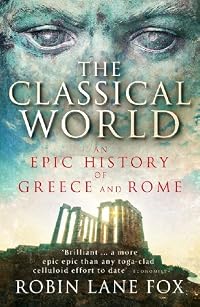
The Classical World: An Epic History from Homer to Hadrian
by Robin Lane Fox
On This Page
Description
In The Classical World, eminent classicist Robin Lane Fox brilliantly chronicles this vast sweep of history from Homer to the reign of Hadrian. From the Peloponnesian War through the creation of Athenian democracy, from the turbulent empire of Alexander the Great to the creation of the Roman Empire and the emergence of Christianity, Fox serves as our witty and trenchant guide. He introduces us to extraordinary heroes and horrific villains, great thinkers and blood-thirsty tyrants. Throughout show more this vivid tour of two of the greatest civilizations the world has ever known, we remain in the hands of a great master. show lessTags
Recommendations
















Member Reviews
This book is written in an engaging style and covers the key aspects of these great civilisations in a single volume, bravo! The author focuses his analysis on the historical developments with 3 themes: freedom, luxury & justice. Very insightful on how approaches and attitudes to these cultural aspects change over time especially in Greek democracy, Roman Republic and then Empire. Anyone looking to see the forest rather than the tress this is a worthwhile resource to enjoy.
As others have said, this is a bright and breezy dash through the more interesting bits of the ancient world. RLF is unapologetically selective in what he covers, so it feels a bit superficial when you come to an area of ancient history you already know something about, but it does a good job of showing you how the other bits fit together. I think this would make very useful preparatory reading for someone about to start a high school or undergraduate ancient history course and wanting to get a bit of perspective before plunging into the details. If you're using it in this way, you should be aware that he doesn't cover everything: we don't learn very much about what was going on outside the immediate Greek and Roman area, and the story show more starts with Homer and ends with the emperor Hadrian.
Where the book is really strong is in conveying the author's enthusiasm for the period, and particularly for his heroes — Herodotus, Thucydides, Tacitus and Suetonius are the real stars of this story, not Alexander the Great or Julius Caesar. I finished the book with a feeling that I ought to go back and read these authors (untouched since school) properly: I don't know whether I shall... show less
Where the book is really strong is in conveying the author's enthusiasm for the period, and particularly for his heroes — Herodotus, Thucydides, Tacitus and Suetonius are the real stars of this story, not Alexander the Great or Julius Caesar. I finished the book with a feeling that I ought to go back and read these authors (untouched since school) properly: I don't know whether I shall... show less
I bought this because I wanted to get a basic understanding of classical history, and it did the job extremely well. Organised in chronological order, it begins with life in the 8th century BC, seen through the themes of Homer's epic poetry, and charges confidently through the great age of Athens, the Roman republic, Julius Caesar and up to the first century AD (finishing round about the time of the eruption at Pompeii in 79 AD). Lane Fox is one of the most popular classical scholars around, and he writes clearly and simply. I suppose you might say that it's an example of traditional 'great men' history, but it also deals with economic and social trends. Besides, as a newcomer to the subject it makes sense to learn about the most famous show more figures and their contexts first. I'm sure there are many books to help you pick up the detail and the academic debate at a later point. This is a brilliant way in. show less
In my mind, there is no book that covers the period of Homer to Hadrian as well as this classic work. It is engaging; it is witty; it is erudite. It covers all the main subjects in just enough detail to ensure readers an overall introduction to the subject without bogging them down in too much detail. On the other hand, it includes the most fascinating 'trivia' that makes such histories page turners. This book is a 'page-turner'. I've just finished re-reading it on a trip around Greece and Italy; it's one of the two books I brought with me (the other is David Abulafia's history of the Mediterranean Sea) and I couldn't have chosen better. Neither can you. (Also available on Kindle if you're backpacking and short of space.)
This took me so long to finish! It was mostly well-written and kept me engaged, although some parts were less interesting than others (e.g. the stuff about the tax system). The best parts for me were the chapters focused on one specific person or other - the numerous Caesars, some of the Greek philosophers, that sort of thing. Plus I now have the chronology of things more clearly in my mind, I guess. On the down side, I found some of his remarks on the sexism and anti-Semitism of the ancient Greeks and Romans to be a little odd, in a kind of "the Greeks only allowed men to [do some thing or other], which some women these days might think is a bit sexist!" way. Possibly I was just in a bad mood when I read those parts, though.
Following a chronological sequence, the book is an epic of war and peace as the Mediterranean civilisations from Archaic Greece onwards expand and trade, found colonies, and fight for dominance. He gives full weight to the importance of war, describing for example the complete destruction of Carthage and the enslavement of it's people after the second Punic War.
As he says, he has had to make hard choices and say little in areas on which he knows the most, so some chapters are cramped for space (e.g. Alexander the Great), with less context making way for more information - but all the same, this serves to give a balanced view in time with equal emphasis on the long periods of relative peace that were such an important characteristic of show more the Roman Empire.
Western democracy has it's roots in Ancient Greece, and the faltering growth (and decline) of classical free speech, citizen voting, and trial by jury is a major theme of the book. He contrasts the early autocratic world of Homer with the experimental freedoms of the later Greek city states. As he says,"In 594 BC, again at Athens, a tyranny was within easy reach of Solon, another aristocrat. However Solon preferred to "call the people together", as the chief elected magistrate of that year, and then to write down wide ranging laws which regulated anything from boundary disputes to excessive display at weddings and funerals, provocative insults of a dead man's ancestors and the due sacrifices in the year's religious calendar."
He's not describing a modern democracy, but it was still a free debate among equal (if aristocratic) citizens,and thankfully Lane Fox avoids the trap of judging ancient societies by modern standards. He shows that this proto-democracy gained force, particularly in Athens, and was a viable alternative to dictatorships of various kinds with the combined Greek states proving capable of defeating a full scale Persian invasion in battles on sea and land (Salamis and Plataea).
He emphasises that the Greeks and later Romans didn't believe in an afterlife of Heaven or Hell, and aimed to make the most of the present with the help of their many capricious Gods.
They didn't force their religion on the different peoples comprising the initial Macedonian and later Roman Empire, and this, along with the Roman peace (Pax Romana), their judicial system and the incentive of Roman citizenship for prominent locals seemed to make the new opportunities in the provinces an acceptable gain in return for Roman land and poll taxes.
Alexander's conquest of Persia and the subsequent Roman Empire encompassing all the Mediterranean and reaching from the British Isles to the Black Sea first made Macedonia and later Rome enormously rich. This "luxury" aspect of the classical world is another of the book's themes with a constant tension between the Greek / Roman ideal of a simple rustic living citizen and the reality of elaborate marble villas, heated bathhouses, amphitheatres and forums. To some extent the question was resolved by the obligation on the rich to provide public entertainments and buildings on a grand scale. The Circus Maximus could accommodate an almost unbelievable 200.000 spectators for popular chariot races.
He shows Imperial Rome gaining it's emperors, but losing the Democratic free speech that Pericles or Cicero would have recognised. The senate became a pointless sycophantic association and Lane Fox sees the origin of the renewed dictatorships in Alexander's return to the Homeric ideal, and Julius Caesar's crossing of the Rubicon (the armed seizure of Rome).
I highly recommend this book. show less
As he says, he has had to make hard choices and say little in areas on which he knows the most, so some chapters are cramped for space (e.g. Alexander the Great), with less context making way for more information - but all the same, this serves to give a balanced view in time with equal emphasis on the long periods of relative peace that were such an important characteristic of show more the Roman Empire.
Western democracy has it's roots in Ancient Greece, and the faltering growth (and decline) of classical free speech, citizen voting, and trial by jury is a major theme of the book. He contrasts the early autocratic world of Homer with the experimental freedoms of the later Greek city states. As he says,"In 594 BC, again at Athens, a tyranny was within easy reach of Solon, another aristocrat. However Solon preferred to "call the people together", as the chief elected magistrate of that year, and then to write down wide ranging laws which regulated anything from boundary disputes to excessive display at weddings and funerals, provocative insults of a dead man's ancestors and the due sacrifices in the year's religious calendar."
He's not describing a modern democracy, but it was still a free debate among equal (if aristocratic) citizens,and thankfully Lane Fox avoids the trap of judging ancient societies by modern standards. He shows that this proto-democracy gained force, particularly in Athens, and was a viable alternative to dictatorships of various kinds with the combined Greek states proving capable of defeating a full scale Persian invasion in battles on sea and land (Salamis and Plataea).
He emphasises that the Greeks and later Romans didn't believe in an afterlife of Heaven or Hell, and aimed to make the most of the present with the help of their many capricious Gods.
They didn't force their religion on the different peoples comprising the initial Macedonian and later Roman Empire, and this, along with the Roman peace (Pax Romana), their judicial system and the incentive of Roman citizenship for prominent locals seemed to make the new opportunities in the provinces an acceptable gain in return for Roman land and poll taxes.
Alexander's conquest of Persia and the subsequent Roman Empire encompassing all the Mediterranean and reaching from the British Isles to the Black Sea first made Macedonia and later Rome enormously rich. This "luxury" aspect of the classical world is another of the book's themes with a constant tension between the Greek / Roman ideal of a simple rustic living citizen and the reality of elaborate marble villas, heated bathhouses, amphitheatres and forums. To some extent the question was resolved by the obligation on the rich to provide public entertainments and buildings on a grand scale. The Circus Maximus could accommodate an almost unbelievable 200.000 spectators for popular chariot races.
He shows Imperial Rome gaining it's emperors, but losing the Democratic free speech that Pericles or Cicero would have recognised. The senate became a pointless sycophantic association and Lane Fox sees the origin of the renewed dictatorships in Alexander's return to the Homeric ideal, and Julius Caesar's crossing of the Rubicon (the armed seizure of Rome).
I highly recommend this book. show less
The sub-title is "An Epic History of Greece and Rome" and so it is - all 600 pages of closely printed text. To be fair, there is quite a bit of history to cover from Homer to Hadrian. The author doesn't set out to tell it all, rather he picks themes on which to focus as he moves forward through time. But the end result is an awful lot of information. I felt at times that I was drowning in information. On balance, I found the result pleasing. My exposure to Greek and Roman history has been more through popular historical fiction than the real thing, and this book helps provide a sound background for the work of the more fanciful and creative authors.
So, good stuff, but dense. Read February 2014.
So, good stuff, but dense. Read February 2014.
Members
- Recently Added By
Author Information

29+ Works 7,323 Members
Robin Lane Fox is a university reader in ancient history and an emeritus fellow of New College, Oxford. The author of The Classical World and Alexander the Great, Fox lives in Oxford, England.
Awards and Honors
Awards
Series
Belongs to Publisher Series
Penguin Celebrations (35)
Common Knowledge
- Original title
- The Classical World: An Epic History of Greece and Rome
- Alternate titles
- The Classical World: An Epic History from Homer to Hadrian
- Original publication date
- 2005
- People/Characters
- Julius Caesar; Homer
- Important places
- Ancient Greece; Ancient Rome
- Epigraph
- He found his father alone in his well-ordered orchard
Digging round a plant: he was wearing a dirty tunic,
Patched and unseemly, and round his shins he had bound
Sew leather leg-guards, keeping off scratches,
A... (show all)nd he had gloves on his hands because of the thorns.
On his head he wore a goatskin cap, increasing his air of sorrow.
When noble, enduring Odysseus saw him
Worn by old age and with such great sadness in his heart,
He stood beneath a tall pear-tree and shed tears . . .
Odysseus returns to his father: Homer, Odyssey 24, 226–34
This tomb of well-sculpted metal
Covers the dad body of a great hero,
Zenodotus. But his soul is in heaven, where Orpheus is,
Where Plato is, and has found a holy seat, fit to receive a god.
For, he was a valia... (show all)nt cavalryman in the Emperor's service,
Famous, eloquent, god-like. In his speech
He was a copy of Socrates among the Italian people.
Leaving to his children his sound ancestral fortune,
He has died, a fit old man, leaving boundless sorrow
To his well-born friends, his city and its citizens.
Palatine Anthology 7.363, possibly composed by Hadrian himself. - Dedication
- For Martha
- First words
- The 'classical world' is the world of the ancient Greeks and Romans, some forty lifetimes before our own but still able to challenge us by a humanity shared with ours.
- Last words
- (Click to show. Warning: May contain spoilers.)But he had no idea that the Christians, whose harassment he regulated, would then overturn this world by antiquity's greatest realignment of freedom and justice: the 'underworld' would no longer be a garden-designer's fancy.
- Blurbers
- Tonkin, Boyd; Spivey, Nigel; Beard, Mary; Heather, Peter; Jones, Peter; Cartledge, Paul (show all 7); Pope, Maurice
- Original language
- English
Classifications
Statistics
- Members
- 1,951
- Popularity
- 10,819
- Reviews
- 29
- Rating
- (3.77)
- Languages
- 6 — Dutch, English, German, Italian, Spanish, Swedish
- Media
- Paper, Audiobook, Ebook
- ISBNs
- 24
- ASINs
- 18