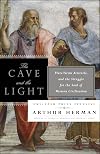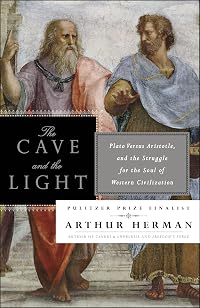
The Cave and the Light: Plato Versus Aristotle, and the Struggle for the Soul of Western Civilization
by Arthur Herman
On This Page
Description
Plato came from a wealthy, connected Athenian family and lived a comfortable upper-class lifestyle until he met an odd little man named Socrates, who showed him a new world of ideas and ideals. Socrates taught Plato that a man must use reason to attain wisdom, and that the life of a lover of wisdom, a philosopher, was the pinnacle of achievement. Plato dedicated himself to living that ideal and went on to create a school, his famed Academy, to teach others the path to enlightenment through show more contemplation. However, the same Academy that spread Plato's teachings also fostered his greatest rival. Born to a family of Greek physicians, Aristotle had learned early on the value of observation and hands-on experience. Rather than rely on pure contemplation, he insisted that the truest path to knowledge is through empirical discovery and exploration of the world around us. Aristotle, Plato's most brilliant pupil, thus settled on a philosophy very different from his instructor's and launched a rivalry with profound effects on Western culture. The two men disagreed on the fundamental purpose of the philosophy. For Plato, the image of the cave summed up man's destined path, emerging from the darkness of material existence to the light of a higher and more spiritual truth. Aristotle thought otherwise. Instead of rising above mundane reality, he insisted, the philosopher's job is to explain how the real world works, and how we can find our place in it. Aristotle set up a school in Athens to rival Plato's Academy: the Lyceum. The competition that ensued between the two schools, and between Plato and Aristotle, set the world on an intellectual adventure that lasted through the Middle Ages and Renaissance and that still continues today. From Martin Luther (who named Aristotle the third great enemy of true religion, after the devil and the Pope) to Karl Marx (whose utopian views rival Plato' s), heroes and villains of history have been inspired and incensed by these two master philosophers- but never outside their influence. Accessible, riveting, and eloquently written, The Cave and the Light provides a stunning new perspective on the Western world, certain to open eyes and stir debate. show lessTags
Recommendations

















Member Reviews
Wow, this is a book that someone has probably already used the word "magisterial" to describe; and it deserves it. This is a
This definitely goes in the 're-read' stack.
I was actually quite surprised to find out that Dr. Herman is a fellow at the Hudson Institute (look it up if you don't know), and this kind of leapt out in the last chapter. There are some conclusions drawn there that strike me as... dubious. (E.g. that the reason WWII ended the depression was because of pent of dynamism/productivity just waiting to be unleashed, and that post-New Deal government intervention had little or nothing to do with this, seemingly ignoring the glaring fact that government spending on the war effort was the biggest intervention of all; fan or show more not of such government activity, it seems a jarring misapprehension.)
That said, I learned a lot from the book, it has lead me to already buy several books referenced (Discourses, Nicomachean Ethics, etc.) and to put several more on my to-read list (I might actually get around to reading Road to Serfdom now.)
Also, there were a few garbled translations of physics (I forget exactly what... something re: elections) and the description of the formula for entropy (W is the number of states, not the probability of states. And it should be a lower-case k.) You, potential reader, will not suffer any loss from this; I care because physics is my area :) show less
This definitely goes in the 're-read' stack.
I was actually quite surprised to find out that Dr. Herman is a fellow at the Hudson Institute (look it up if you don't know), and this kind of leapt out in the last chapter. There are some conclusions drawn there that strike me as... dubious. (E.g. that the reason WWII ended the depression was because of pent of dynamism/productivity just waiting to be unleashed, and that post-New Deal government intervention had little or nothing to do with this, seemingly ignoring the glaring fact that government spending on the war effort was the biggest intervention of all; fan or show more not of such government activity, it seems a jarring misapprehension.)
That said, I learned a lot from the book, it has lead me to already buy several books referenced (Discourses, Nicomachean Ethics, etc.) and to put several more on my to-read list (I might actually get around to reading Road to Serfdom now.)
Also, there were a few garbled translations of physics (I forget exactly what... something re: elections) and the description of the formula for entropy (W is the number of states, not the probability of states. And it should be a lower-case k.) You, potential reader, will not suffer any loss from this; I care because physics is my area :) show less
Like many sweeping overviews of centuries of history, there is a lot of generalization in this book. Whole, complicated sections of history are reduced to this vs that black and white descriptions, which definitely becomes more noticeable as the book gets closer to modern times. That said, the framework provides an interesting way to think about both the ideas of Plato and Aristotle as well as how those ideas can be used to move humanity in directions both good and bad.
This is an impressive work that covers the span of western civilization’s foundations from Socrates to the current day. Arthur Herman has presented a historical tour that guides the reader through the in a back-and-forth between philosophy's two godfathers: Plato and Aristotle. The pure forms of thought by Plato versus the practical vision of Aristotle. The two have been in a back-and-forth influence throughout thousands of years of western history and he shows at every stage how they have shaped and guided our course of history I enjoyed the work because it brought to life many events of history in a way that was accessible, understandable, and interesting. Accessible for those without a philosophy or history background but it helps. show more I highly recommend. show less
I enjoyed this book, finding it interesting enough to wish to return to it, every time I put it down. The survey of western history as it related to the two philosophers evidenced a great deal of research which generated the ability to present a detailed overview, through time, of the influences the writing of the two men had in the West.
It lost one star from me because of the veering at the end of the book into American Triumphalism and some rather suspect contrasting of aspects of the American experience and the rest of the world. I would recommend this book highly to anyone interested in the intellectual history of the west.
It lost one star from me because of the veering at the end of the book into American Triumphalism and some rather suspect contrasting of aspects of the American experience and the rest of the world. I would recommend this book highly to anyone interested in the intellectual history of the west.
Up to Hegel and Marx, the book is wonderful. The right-wing tendencies of Mr. Herman then are unveiled and after that is a sliding path culminating with the apotheosis of Ayn Rand> I did not expect to have listed with Immanuel Kant and Hegel. Also, Marcuse was omitted. Too bad, the first 2/3 are very well written and generally balanced.
Despite the slightly pathetic mention on the cover “Pulitzer Prize finalist” which means he did NOT win a Pulitzer Prize this book is very interesting: well written and easily readable it give a great insight in the cultural struggles within Western civilizations since the time of the ancient Greeks. Although biased towards an American conservatism I enjoyed reading it and definitely recommend it.
I definitely am not the right audience for this book. I struggle with sweeping historical surveys at the best of times. I always want more context, more quotations from primary sources, more in-depth analysis than is realistic for a sweeping survey covering thousands of years of history in 700 pages. So you should take my reactions to this book with a grain of salt.
There are many aspects of Herman's book that are laudable. He has extensive endnotes to show that he has done thorough research in the history of Western philosophy. I tend to balk at premises such as his -- the conflict between Plato's championing of the ideal and Aristotle's focus on experience formed the foundation for much of Western thought through the 20th century -- show more but it is true that both Greek philosophers' influences have loomed large. Herman is also writing for a general audience, not for an audience of academics, and there's a good chance that his style and approach will attract many general readers, and in turn may lead them to more in-depth forays into Western philosophy.
In the end, though, in spite of these strengths, I was disappointed by this book. Herman does spend some time presenting limited historical context for the philosophers that he studies, but the context is quite limited and pales compared to the Plato versus Aristotle paradigm. This is likely my training as a social historian skewing my response, but I worry about reductive paradigms, and in the end the Plato versus Aristotle paradigm seems quite reductive to me unless it's balanced by an equal attention to how philosophers from past societies combined and transformed other influences as well. Again, Herman does this to some extent, but I would have liked to see much more of this.
Herman also tapped into some of my pet peeves in writing. He tends to end each chapter with a strong pronouncement along the lines of "Soon would come Philosopher X to {make some sweeping transformation in Western thought}." I know this is a typical approach to writing surveys -- have a juicy hook at the end of each chapter to prepare for the next one -- but I prefer more understatement. Also, Herman regularly presents physical descriptions of philosophers who are always running through their towns or pacing through studies and then beginning to write. Again, I know this is supposed to provide color and interest for general readers, to make them feel like they are in the presence of the philosophers, but since the descriptions don't go beyond appearances, I don't think they add much.
Readers who are quite familiar with Western philosophy are not the target audience for this book. They will likely be frustrated by the quick coverage of philosophers' writings and theories. I do think this is a book to which generalists and newcomers to philosophy will gravitate and enjoy. I hope that it leads them into more detailed studies in philosophy. show less
There are many aspects of Herman's book that are laudable. He has extensive endnotes to show that he has done thorough research in the history of Western philosophy. I tend to balk at premises such as his -- the conflict between Plato's championing of the ideal and Aristotle's focus on experience formed the foundation for much of Western thought through the 20th century -- show more but it is true that both Greek philosophers' influences have loomed large. Herman is also writing for a general audience, not for an audience of academics, and there's a good chance that his style and approach will attract many general readers, and in turn may lead them to more in-depth forays into Western philosophy.
In the end, though, in spite of these strengths, I was disappointed by this book. Herman does spend some time presenting limited historical context for the philosophers that he studies, but the context is quite limited and pales compared to the Plato versus Aristotle paradigm. This is likely my training as a social historian skewing my response, but I worry about reductive paradigms, and in the end the Plato versus Aristotle paradigm seems quite reductive to me unless it's balanced by an equal attention to how philosophers from past societies combined and transformed other influences as well. Again, Herman does this to some extent, but I would have liked to see much more of this.
Herman also tapped into some of my pet peeves in writing. He tends to end each chapter with a strong pronouncement along the lines of "Soon would come Philosopher X to {make some sweeping transformation in Western thought}." I know this is a typical approach to writing surveys -- have a juicy hook at the end of each chapter to prepare for the next one -- but I prefer more understatement. Also, Herman regularly presents physical descriptions of philosophers who are always running through their towns or pacing through studies and then beginning to write. Again, I know this is supposed to provide color and interest for general readers, to make them feel like they are in the presence of the philosophers, but since the descriptions don't go beyond appearances, I don't think they add much.
Readers who are quite familiar with Western philosophy are not the target audience for this book. They will likely be frustrated by the quick coverage of philosophers' writings and theories. I do think this is a book to which generalists and newcomers to philosophy will gravitate and enjoy. I hope that it leads them into more detailed studies in philosophy. show less
Members
- Recently Added By
Author Information

16+ Works 6,293 Members
Arthur Herman, PhD, is the author of the New York Times bestseller How the Scots Invented the Modern World, which has sold a half million copies worldwide, and Gandhi and Churchill, which was a finalist for the Pulitzer Prize. He is the author of six previous books and a senior fellow at the Hudson Institute in Washington, DC.
Classifications
- Genres
- Philosophy, History, Nonfiction, General Nonfiction
- DDC/MDS
- 909.09821 — History & geography History World history Other Geographic Classifications Other Classifications Ocean And Sea Basins The West; the Atlantic region
- LCC
- CB245 .H4286 — Auxiliary Sciences of History History of Civilization History of Civilization Civilization and race
- BISAC
Statistics
- Members
- 596
- Popularity
- 49,082
- Reviews
- 9
- Rating
- (4.03)
- Languages
- English
- Media
- Paper, Audiobook, Ebook
- ISBNs
- 6
- ASINs
- 4