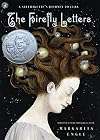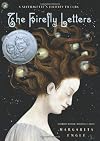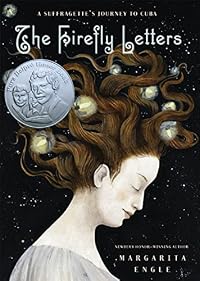
The Firefly Letters: A Suffragette's Journey to Cuba
by Margarita Engle
On This Page
Description
Draws on little-known Cuban history to tell a stirring story in poetry. Based on the diaries and letters of Swedish suffragist Fredrika Bremer, who spent three months in Cuba in 1851, the story focuses on oppressed women, the privileged as well as the enslaved, in three alternating free-verse narratives.Tags
Recommendations


Member Reviews
This was a beautifully written middle grade novel about life and slavery in Cuba, based on the writings of the real life Fredrika Bremer.
The story is told from four alternating viewpoints; Elana, Cecilia, Fredrika, and Beni.
-Elena is a plantation owners daughter, trapped within the walls of her own home, never allowed to go out and catch fireflies or walk beneath the moonlight.
“I sit alone in my room
at the ornately barred window,
embroidering curlicues
like the fancy ironwork
that separates me
from the rest of the world.”
-Cecilia is a fifteen-year old slave from Africa who was sold by her own father in exchange for a cow. She works on Elena’s family’s sugar plantation as a translator.
“If I had known
that my father would trade me
for show more a stolen cow,
I would have run away
into the forest
to live in a nest
made of dreams
and green leaves.”
-Fredrika is a rich man’s daughter, who gave up the aristocratic lifestyle to wander the world and be a writer.
“My sketchbook is bursting
with stories
told by dances,
stories about life on two shores…
two distant lands,
Africa and Cuba,
joined and also separated
by the endless flow
of ocean waves
that sound
like music…”
-Beni is Cecilia’s husband, chosen for her by Elena’s father. There are only a couple of pages told from Beni’s perspective, but I found it nice to see his thoughts on Cecilia and their marriage instead of just having her point of view.
Fredrika believes in a world of equality, not just between men and women, but also between the races. She goes to Cuba to write about slavery on the island in hopes of bringing about change.
Against all odds the three girls form a strong friendship filled with shared hope for a brighter future.
I found Engle’s writing to be very lyrical and beautiful. My only wish was that it would have lasted longer. show less
The story is told from four alternating viewpoints; Elana, Cecilia, Fredrika, and Beni.
-Elena is a plantation owners daughter, trapped within the walls of her own home, never allowed to go out and catch fireflies or walk beneath the moonlight.
“I sit alone in my room
at the ornately barred window,
embroidering curlicues
like the fancy ironwork
that separates me
from the rest of the world.”
-Cecilia is a fifteen-year old slave from Africa who was sold by her own father in exchange for a cow. She works on Elena’s family’s sugar plantation as a translator.
“If I had known
that my father would trade me
for show more a stolen cow,
I would have run away
into the forest
to live in a nest
made of dreams
and green leaves.”
-Fredrika is a rich man’s daughter, who gave up the aristocratic lifestyle to wander the world and be a writer.
“My sketchbook is bursting
with stories
told by dances,
stories about life on two shores…
two distant lands,
Africa and Cuba,
joined and also separated
by the endless flow
of ocean waves
that sound
like music…”
-Beni is Cecilia’s husband, chosen for her by Elena’s father. There are only a couple of pages told from Beni’s perspective, but I found it nice to see his thoughts on Cecilia and their marriage instead of just having her point of view.
Fredrika believes in a world of equality, not just between men and women, but also between the races. She goes to Cuba to write about slavery on the island in hopes of bringing about change.
Against all odds the three girls form a strong friendship filled with shared hope for a brighter future.
I found Engle’s writing to be very lyrical and beautiful. My only wish was that it would have lasted longer. show less
I read this slim little book twice yesterday--once on the ride to work, once on the ride back. It's a lovely little story about the visit Fredrika Bremmer, a real-life early feminist from Sweden, paid to Cuba in the mid-1800s. Her voice is interwoven with those of Cecelia, the real slave assigned to translate for her who becomes a good friend; Elena, the young daughter of Cecelia's owner, who's trapped in her own ways; and with a few interludes from Beni, Cecilia's assigned husband.
It's a delicate, beautiful little story told in blank verse--a children's introduction to slavery, much the way that a childhood favorite of mine, The Secret Cave is an introduction to the Shoah/Holocaust. Yes, some elements of the story are a bit show more simplistic, but there's so much depth and texture in such few words.
I was happy to see Cecilia and Beni calling out Fredrika and Elena, even if only in the privacy of the text, on their naive assumptions. At one point Fredrika rants in a schoolhouse about how girls only attend an hour a day; Cecilia's parting shot is to point out that an hour is more schooling than a slave girl will ever receive. Fredrika spends Sunday service in the back of the church with the slaves; Beni worries about how Cecilia will be able to continue living after Fredrika, her ticket to pseudo-freedom, leaves Cuba. At one point Elena admits that Cecilia is probably her best friend; Cecilia, the slave that she resents for being better with language and able to travel outside the house, who probably isn't even aware that Elena thinks of her as anything but property.
I'm glad I got to read this twice, because I definitely went into it too much the cynical adult. Yes, there's probably a great deal that can be criticized if you're going to take this as adult literature--but for a young reader, it's a great combination of wonderful female characters in the leading roles, early feminism, a fairy tale-like setting with dark shadows of history.
I would also argue that this is an important book because of the ages of two of the characters: Cecilia, who is a language whiz and pregnant by her master's choice of made at 15; and Elena, who at 12 is two years away from marriage. Adults these days spend so much energy underestimating children, what they can handle of the world, but just look at two examples of children who had to deal with so much more so early on.
Definitely worth a read, if you have an hour to spare. show less
It's a delicate, beautiful little story told in blank verse--a children's introduction to slavery, much the way that a childhood favorite of mine, The Secret Cave is an introduction to the Shoah/Holocaust. Yes, some elements of the story are a bit show more simplistic, but there's so much depth and texture in such few words.
I was happy to see Cecilia and Beni calling out Fredrika and Elena, even if only in the privacy of the text, on their naive assumptions. At one point Fredrika rants in a schoolhouse about how girls only attend an hour a day; Cecilia's parting shot is to point out that an hour is more schooling than a slave girl will ever receive. Fredrika spends Sunday service in the back of the church with the slaves; Beni worries about how Cecilia will be able to continue living after Fredrika, her ticket to pseudo-freedom, leaves Cuba. At one point Elena admits that Cecilia is probably her best friend; Cecilia, the slave that she resents for being better with language and able to travel outside the house, who probably isn't even aware that Elena thinks of her as anything but property.
I'm glad I got to read this twice, because I definitely went into it too much the cynical adult. Yes, there's probably a great deal that can be criticized if you're going to take this as adult literature--but for a young reader, it's a great combination of wonderful female characters in the leading roles, early feminism, a fairy tale-like setting with dark shadows of history.
I would also argue that this is an important book because of the ages of two of the characters: Cecilia, who is a language whiz and pregnant by her master's choice of made at 15; and Elena, who at 12 is two years away from marriage. Adults these days spend so much energy underestimating children, what they can handle of the world, but just look at two examples of children who had to deal with so much more so early on.
Definitely worth a read, if you have an hour to spare. show less
Fredrika Bremer was a Swedish suffragete that traveled the world writing books. She spent three months in Cuba and while she thought the country was beautiful, she felt it's beauty was very marred by slavery. The story's narration alternates between Fredrika, her translator Cecelia who is a slave and Elena the daughter of the Cecelia's owner.
The story is told in free verse and is absolutely beautiful and lyrical sounding. I think that this really brings home stark contrast of a beautiful country and and a horrible practice. The introspection into each characters thoughts give you a wonderful opportunity to see how Elena and Cecelia are changed by Fredrika's presence. Elena's change is particularly drastic, however it is a change for show more the better. Elena's eventual longing for freedom really made me feel for her. In many ways she is more trapped than Cecelia is, even though she is a free woman.
I also really appreciated the notes that the author included. Frederika Bremer was a real person and she really did have a translator named Cecelia when she was in Cuba. Elena was made up however I could easily someone being so changed by seeing another woman live with such freedom. All of the thoughts and dreams are made up as well however they really feel like they fit and I really enjoyed the book overall. show less
The story is told in free verse and is absolutely beautiful and lyrical sounding. I think that this really brings home stark contrast of a beautiful country and and a horrible practice. The introspection into each characters thoughts give you a wonderful opportunity to see how Elena and Cecelia are changed by Fredrika's presence. Elena's change is particularly drastic, however it is a change for show more the better. Elena's eventual longing for freedom really made me feel for her. In many ways she is more trapped than Cecelia is, even though she is a free woman.
I also really appreciated the notes that the author included. Frederika Bremer was a real person and she really did have a translator named Cecelia when she was in Cuba. Elena was made up however I could easily someone being so changed by seeing another woman live with such freedom. All of the thoughts and dreams are made up as well however they really feel like they fit and I really enjoyed the book overall. show less
Engle, Margarita. (2010). The Firefly Letters: A Suffragette’s Journey to Cuba. New York: Holt. 160 pp. ISBN 978-0-8050-9082-6 (Hard Cover); $16.99.
Swedish suffragist Fredrika Bremer visits Cuba and helps transform the life of Cuban slave, Cecilia. Elena is a privileged Cuban girl whose family owns slaves, including Cecilia. Bremer visits Cecilia’s family and requires the services of Cecilia to do the translating necessary for her work. In three very distinct voices readers learn of Bremer’s growing feminism, Cecilia’s yearning for freedom, and Elena’s very different (and surprising) perspective purchased by virtue of her gender and her families social status.
I hope readers don’t assume this book to be just another verse show more novel about Cuba! The weaving together of the three characters helps readers explore the same events in ways that reflect three very different points of view—a poetic triangulation. One can practically use Engle’s verse to navigate the uncharted waters of this little known historic event. This book is exceptional in the way that it treats both the time period and the cultural and the economic perspectives with verse that reads like verse and hits like verse. The fact that this verse novel has dramatic tension and a surprise ending only make it one of Engle’s better books and one that should be purchased by every middle school and high school library. Teachers should really latch onto and use Engle’s books, especially this one, to show the amazing versatility of poetry to tell an historical story that still has a very personal feel. show less
Swedish suffragist Fredrika Bremer visits Cuba and helps transform the life of Cuban slave, Cecilia. Elena is a privileged Cuban girl whose family owns slaves, including Cecilia. Bremer visits Cecilia’s family and requires the services of Cecilia to do the translating necessary for her work. In three very distinct voices readers learn of Bremer’s growing feminism, Cecilia’s yearning for freedom, and Elena’s very different (and surprising) perspective purchased by virtue of her gender and her families social status.
I hope readers don’t assume this book to be just another verse show more novel about Cuba! The weaving together of the three characters helps readers explore the same events in ways that reflect three very different points of view—a poetic triangulation. One can practically use Engle’s verse to navigate the uncharted waters of this little known historic event. This book is exceptional in the way that it treats both the time period and the cultural and the economic perspectives with verse that reads like verse and hits like verse. The fact that this verse novel has dramatic tension and a surprise ending only make it one of Engle’s better books and one that should be purchased by every middle school and high school library. Teachers should really latch onto and use Engle’s books, especially this one, to show the amazing versatility of poetry to tell an historical story that still has a very personal feel. show less
Swedish traveler Frederika Bremer, young slave Cecilia, and daughter of the Cuban gentry Elena, are three young women who have had their lives very specifically laid out in front of them by society’s expectations. Frederika and Elena, as girls brought up in wealthy families in the 1850s, have enjoyed the many privileges that their class offers, but have been constrained by the many restrictions and few opportunities available to women at the time. Frederika reacts to these restrictions by leaving her family and blazing her own path as a feminist and traveler, while Elena accepts her position without complaint or question. Cecilia, who was sold into slavery by her father as a child, has not accepted her circumstances, but has never had show more an opportunity to channel her anger and homesickness. They are brought together when Frederika leaves her home country of Sweden, traveling without a chaperone, to explore the Cuban countryside and tell the stories of the women and slaves in Cuba, in the hopes that “stories can lead to a change in laws” (pg. 27. Quoted from ARC – language is subject to change.)
Frederika and Cecilia are based on real people, and Engle has clearly used their real-life situations, feelings and conversations, as recorded in Frederika’s published diary, to inform and flesh out these characters. Frederika Bremer was a feminist and a traveler, and she spent three months exploring Cuba along with her real-life translator Cecilia. They are compelling women, and Engle’s spare free verse poetry mixes their current circumstances and memories from childhood in ways that illuminate both. Elena is the only major character who is not based on an actual person, and you can feel it. Her story, of an aristocratic young woman who at first fears and distrusts the strange feminist who comes to her house, but gradually comes to agree with her, is neither original nor especially well told. Elena eventually makes a choice that is lovely, but does not ring true – I did not feel that I had seen her character go through the growth that would be necessary to make that choice.
The short chapters alternate between the viewpoints of these three women, with a few brief interjections from Cecilia’s husband that did show another side of life in Cuba, but did not especially add to the story of Bremer’s visit. Engle is at her best when she stays close to the story of Frederika and Cecilia. It is the moments where these two women discover each others’ history that are most illuminating. Despite their wildly different circumstances, they forge a connection based not on similar life experiences, but on the similar feelings of loneliness and constraint that their experiences have engendered. Cecilia’s chapters, which are very straight-forward in their telling of her unimaginable life, are the most moving. The spare form, which did not allow Engle to fully show Elena’s transformation, is much more effective in telling Cecilia’s story, where the reader benefits from having time and space to consider Cecilia’s stories and make connections between them. When Cecilia’s chapter on her forced marriage and pregnancy is ended with a few short lines imagining that she is free of all her attachments, the simplicity of the poetry allows her thoughts to shine through and lets the reader to feel their resonance.
This short novel in verse is a very quick read and would make a great choice for reluctant readers doing historical fiction projects. But it’s a carefully constructed story that will also appeal to curious readers who will want to follow this story’s characters and themes further – it has certainly inspired me to learn more about the life of Frederika Bremer. Several books about Frederika’s life and Cuba in the 1800s are listed in a welcome reference section, although it would have been nice to include some materials in this list that are more accessible to middle grade readers. show less
Frederika and Cecilia are based on real people, and Engle has clearly used their real-life situations, feelings and conversations, as recorded in Frederika’s published diary, to inform and flesh out these characters. Frederika Bremer was a feminist and a traveler, and she spent three months exploring Cuba along with her real-life translator Cecilia. They are compelling women, and Engle’s spare free verse poetry mixes their current circumstances and memories from childhood in ways that illuminate both. Elena is the only major character who is not based on an actual person, and you can feel it. Her story, of an aristocratic young woman who at first fears and distrusts the strange feminist who comes to her house, but gradually comes to agree with her, is neither original nor especially well told. Elena eventually makes a choice that is lovely, but does not ring true – I did not feel that I had seen her character go through the growth that would be necessary to make that choice.
The short chapters alternate between the viewpoints of these three women, with a few brief interjections from Cecilia’s husband that did show another side of life in Cuba, but did not especially add to the story of Bremer’s visit. Engle is at her best when she stays close to the story of Frederika and Cecilia. It is the moments where these two women discover each others’ history that are most illuminating. Despite their wildly different circumstances, they forge a connection based not on similar life experiences, but on the similar feelings of loneliness and constraint that their experiences have engendered. Cecilia’s chapters, which are very straight-forward in their telling of her unimaginable life, are the most moving. The spare form, which did not allow Engle to fully show Elena’s transformation, is much more effective in telling Cecilia’s story, where the reader benefits from having time and space to consider Cecilia’s stories and make connections between them. When Cecilia’s chapter on her forced marriage and pregnancy is ended with a few short lines imagining that she is free of all her attachments, the simplicity of the poetry allows her thoughts to shine through and lets the reader to feel their resonance.
This short novel in verse is a very quick read and would make a great choice for reluctant readers doing historical fiction projects. But it’s a carefully constructed story that will also appeal to curious readers who will want to follow this story’s characters and themes further – it has certainly inspired me to learn more about the life of Frederika Bremer. Several books about Frederika’s life and Cuba in the 1800s are listed in a welcome reference section, although it would have been nice to include some materials in this list that are more accessible to middle grade readers. show less
In 1851, an iconoclastic aristocrat from Sweden traveled to Cuba in order to evangelize on the topic of women's rights. While in Cuba, this woman--a real-life suffragette named Frederika Bremmer--made friends with the 12-year-old daughter of her host family as well as their slave girl, a pregnant 15-year-old abducted as a child from her native Congo and forced to marry a near stranger. United by Frederika's vision and persistence, the two become fast friends.
Told through free-verse poetry, this humble and lyrical story is told from the perspective of four characters: Elena, the host family's daughter, Cecelia, their slave, Beni, her husband, and Frederika herself. Each short chapter (usually only a page and a half in length) is titled show more with the narrator's name, making it easier for readers to distinguish between characters' voices. While she uses little figurative language or other poetic devices, Engle still manages to create a hauntingly beautiful tale, enhanced by each narrator's description of his or her homeland. Throughout the novel, fireflies (or cocuyos) are used as metaphors for freedom and imprisonment, and the moon is a symbol of independent thinking. Despite the understated beauty of the language, Engle's story is still very much rooted in reality--Cecelia has an incurable disease and Elena will marry at 14 whether she wants to or not. The story doesn't end with Frederika saving the day, although with Elena's help, they manage to ameliorate Cecelia's suffering and bring her hope for the future. The subject matter is handled delicately enough that younger teens will grasp what is going on without being unduly shaken, and older teens will still appreciate the story for its lyricism and grace. Recommended for grades 7 through 10. show less
Told through free-verse poetry, this humble and lyrical story is told from the perspective of four characters: Elena, the host family's daughter, Cecelia, their slave, Beni, her husband, and Frederika herself. Each short chapter (usually only a page and a half in length) is titled show more with the narrator's name, making it easier for readers to distinguish between characters' voices. While she uses little figurative language or other poetic devices, Engle still manages to create a hauntingly beautiful tale, enhanced by each narrator's description of his or her homeland. Throughout the novel, fireflies (or cocuyos) are used as metaphors for freedom and imprisonment, and the moon is a symbol of independent thinking. Despite the understated beauty of the language, Engle's story is still very much rooted in reality--Cecelia has an incurable disease and Elena will marry at 14 whether she wants to or not. The story doesn't end with Frederika saving the day, although with Elena's help, they manage to ameliorate Cecelia's suffering and bring her hope for the future. The subject matter is handled delicately enough that younger teens will grasp what is going on without being unduly shaken, and older teens will still appreciate the story for its lyricism and grace. Recommended for grades 7 through 10. show less
The Firefly Letters is a collection of poems written by Engle that vacillate between Fredrika, Elena, and Cecilia; at first, I was apprehensive of the slim book, but quickly I was drawn into the simply written but very compelling poetry.
Fredrika sets off for Cuba in a fit of wanderlust, throwing off the chains of expectations placed on women during that time and spending her days writing and sketching. Her main concerns are women’s rights, and while she is amazed at the beauty of Cuba, she is appalled at the conditions of slavery and women’s rights in the supposed paradise. Even the daughter of her rich host, Elena, is subject to strict regulations, as Elena is set to marry a man chosen by her parents.
Cecilia is the house slave, show more valuable thanks to her translation skills; she is pregnant and married at the age of fifteen to a man she calls a stranger. The three women find ties that bind them together as they explore the island with Fredrika, and both Elena and Cecilia find inner strength they never knew they possessed. Fireflies become a metaphor for the plight of the women, as the lovely and delicate creatures are constantly captured and even de-winged by Cuban natives; the ladies take it upon themselves to go nightly to free the fireflies.
A lovely work, with many springboards for historical research into Cuban history, women’s suffrage, and language arts, The Firefly Letters is definitely worth reading, either in one sitting or in small bites. show less
Fredrika sets off for Cuba in a fit of wanderlust, throwing off the chains of expectations placed on women during that time and spending her days writing and sketching. Her main concerns are women’s rights, and while she is amazed at the beauty of Cuba, she is appalled at the conditions of slavery and women’s rights in the supposed paradise. Even the daughter of her rich host, Elena, is subject to strict regulations, as Elena is set to marry a man chosen by her parents.
Cecilia is the house slave, show more valuable thanks to her translation skills; she is pregnant and married at the age of fifteen to a man she calls a stranger. The three women find ties that bind them together as they explore the island with Fredrika, and both Elena and Cecilia find inner strength they never knew they possessed. Fireflies become a metaphor for the plight of the women, as the lovely and delicate creatures are constantly captured and even de-winged by Cuban natives; the ladies take it upon themselves to go nightly to free the fireflies.
A lovely work, with many springboards for historical research into Cuban history, women’s suffrage, and language arts, The Firefly Letters is definitely worth reading, either in one sitting or in small bites. show less
Members
- Recently Added By
Author Information

57+ Works 7,154 Members
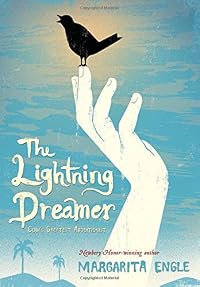
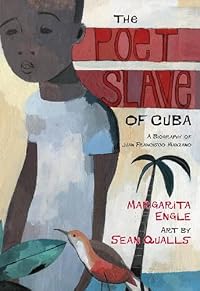
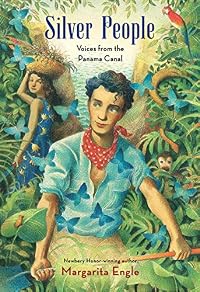
Margarita Engle is a Cuban-American poet and novelist. Her books include The Wild Book, Tropical Secrets, The Firefly Letters, The Lightning Dreamer, When You Wander, Mountain Dog, and Silver People. She has received several awards including the Jane Addams Children's Book Award, the Pura Belpré Award, the Américas Award, and the Claudia Lewis show more Poetry Award for The Surrender Tree and the Pura Belpré Award and the Américas Award for The Poet Slave of Cuba. (Bowker Author Biography) show less
All Editions
Awards and Honors
Awards
Distinctions
Notable Lists
Common Knowledge
- Important places
- Cuba
Classifications
Statistics
- Members
- 287
- Popularity
- 111,664
- Reviews
- 26
- Rating
- (4.04)
- Languages
- English
- Media
- Paper, Ebook
- ISBNs
- 4
- ASINs
- 3