
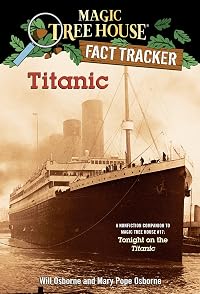
Titanic: A Nonfiction Companion to Tonight on the Titanic
by Mary Pope Osborne, Will Osborne
Magic Tree House: Fact Tracker (17), Magic Tree House (Research Guides — RG 07)
On This Page
Description
Explores the history of the steamship Titanic, from Thomas Andrews' plans for "the safest ship on the ocean" to the lingering questions concerning its disastrous maiden voyage in 1912.Tags
Recommendations






Member Reviews
In my opinion this is a good book. I liked that this book is nonfiction and that it makes sure that its information is correct. It also gives the reader at the end of the book more sources that the reader can visit if they are interested in learning more about the Titanic. I also really enjoyed the illustrations and photos that are used all about the book. In the first few pages, there is a four paged diagram of everything that was put into and how the ship was organized so the reader can see the whole ship. Thirdly, I liked the writing of this because it is all well organized and flows from one chapter to another. The book just moves from the creation of the boat and then finally ends on looking at after the sinking and the excursions show more to revisit what is left of the ship in its areas that it finally settled in its resting place. I believe that the main point of this book was to inform the reader about everything involving the Titanic. show less
I like this book for 3 reasons. First, as a nonfiction companion to an actual Magic Tree House adventure, this book is informational, but it reads like a story. It introduces a lot of unknown facts and is very interesting even for adults. Second, this is a transitional chapter book with illustrations and photographs breaking up the text. The book is visually pleasing, not overwhelming, and has a great combination of text features throughout the book. This includes: Jack and Annie’s heads on the sides of the pages giving explanations or definitions; chapter headings and subheadings; maps of the inside of the ship with labels or the route of the ship; diagrams to aid understanding; “fact files” to answer questions and show more misconceptions; and a “Titanic Timetable” to sum up all of the events. Third, this book is written in a way that children can relate. It is not too sad or serious for children to read. It highlights real passengers and heroes on the Titanic, and stops to summarize at different points in the story to ensure that children are following the content. Overall, the big picture of this book is to teach about the Titanic. show less
I like this book for 3 reasons. First, as a nonfiction companion to an actual Magic Tree House adventure, this book is informational, but it reads like a story. It introduces a lot of unknown facts and is very interesting even for adults. Second, this is a transitional chapter book with illustrations and photographs breaking up the text. The book is visually pleasing, not overwhelming, and has a great combination of text features throughout the book. This includes: Jack and Annie’s heads on the sides of the pages giving explanations or definitions; chapter headings and subheadings; maps of the inside of the ship with labels or the route of the ship; diagrams to aid understanding; “fact files” to answer questions and show more misconceptions; and a “Titanic Timetable” to sum up all of the events. Third, this book is written in a way that children can relate. It is not too sad or serious for children to read. It highlights real passengers and heroes on the Titanic, and stops to summarize at different points in the story to ensure that children are following the content. Overall, the big picture of this book is to teach about the Titanic. show less
I enjoyed reading this informational chapter book for many reasons. The first reason was because I liked how organized it was. When you first open the book, a table of contents is provided which is helpful for the reader. I also liked how the author provided side note definitions and pictures for the reader. By doing this, the reader is able to get a better understanding of the information. For example on pages 22-25, the author provides a picture of the titanic and labels the parts of the ship. Another reason I liked this book was because of the language and how descriptive it was. It was very easy to read and understand especially for young readers. The message of this book is to inform readers about the history of the Titanic.
I really enjoyed reading this book for a few reasons. The books primary purpose was to inform children about the Titanic. I like the fact that Magic Tree House has the ability to write a totally non-fiction book while keeping the interest of young readers. I liked the pages of illustrations that helped the reader visualize what was described on the pages before or after. There are also diagrams and flow charts that explain the parts of the boat and what went wrong. This is yet another way to attract diverse readers who need the pictorial representation to fully comprehend the story. I also like the flow of the book. It goes from beginning to end. It starts with the construction of the boat, and ends with the sinking. I think the main show more point of the book is to inform young readers about what the time of the Titanic and the tragic story that surrounds it show less
This book parallels Tonight on the Titanic. The Magic Tree House book are fiction, but they include some elements that are true. Titanic is a nonfiction book that describes the facts of this horrible disaster. I absolutely love that Mary Pope Osborne created this book because it allows students to understand what truly happened on that horrible night. The book is told in a way that captures the attention of children and allows them to better understand the story of the Titanic. The book discusses how the ship was built, people aboard the ship, heroes of the disaster, and much more. Even I learned some new things that I didn’t know before!
Fact Tracker: Titanic
The Magic Tree House “Fast Tracker: Titanic” by Will and Mary Pope Osborne, is a wonderful informational book for young readers to learn from. The book has descriptive language, but handles a historical topic by using language that readers can easily understand. “Captain Smith also ordered his look-outs in the crow’s nest to keep a careful watch. If they saw any ice, they were to call the bridge at once.” When there is language that the reader may not be familiar with, there is a notation on the side defining the term. In that sentence, “bridge” is defined on the side as “the room from which the captain and his officers steer the ship”. The writing is organized and tells the history of the titanic show more in a chronological sequence. The book begins with the building of the titanic and follows through to when the ship sinks. Another great feature of this book is the illustrations. There are real pictures on board the titanic and of artifacts found on the bottom of the ocean. Additionally, there are photographs and a description of several passengers on board the titanic. For example, “John Jacob Astor was one of the richest men in the world. He was on his way home from his honeymoon in Europe and Egypt with his new wife, Madeleine.” Finally, at the back of the book a “doing more research” section is included. This provides readers with books, dvds, and websites they can use to learn more about the history of the Titanic. The big idea of this book is to educate the reader about the history of the Titanic! show less
The Magic Tree House “Fast Tracker: Titanic” by Will and Mary Pope Osborne, is a wonderful informational book for young readers to learn from. The book has descriptive language, but handles a historical topic by using language that readers can easily understand. “Captain Smith also ordered his look-outs in the crow’s nest to keep a careful watch. If they saw any ice, they were to call the bridge at once.” When there is language that the reader may not be familiar with, there is a notation on the side defining the term. In that sentence, “bridge” is defined on the side as “the room from which the captain and his officers steer the ship”. The writing is organized and tells the history of the titanic show more in a chronological sequence. The book begins with the building of the titanic and follows through to when the ship sinks. Another great feature of this book is the illustrations. There are real pictures on board the titanic and of artifacts found on the bottom of the ocean. Additionally, there are photographs and a description of several passengers on board the titanic. For example, “John Jacob Astor was one of the richest men in the world. He was on his way home from his honeymoon in Europe and Egypt with his new wife, Madeleine.” Finally, at the back of the book a “doing more research” section is included. This provides readers with books, dvds, and websites they can use to learn more about the history of the Titanic. The big idea of this book is to educate the reader about the history of the Titanic! show less
Members
- Recently Added By
Lists

SYES Library Wishlist
1,080 works; 4 members
Author Information

482+ Works 370,587 Members
Mary Pope Osborne was born in Fort Sill, Oklahoma on May 20, 1949. She grew up in a military family, and by the time she was 15 she had lived in Oklahoma, Austria, Florida, and four different army posts in Virginia and North Carolina. She attended the University of North Carolina at Chapel Hill where she majored in religion. After graduation, she show more traveled around Europe and Asia. Before becoming an author, she worked as a window dresser, a medical assistant, a Russian travel consultant, a waitress, an acting teacher, a bartender, and an assistant editor for a children's magazine. Her first book, Run, Run as Fast as You Can, was published in 1982. She is the author of the Magic Tree House series and the Merlin Missions series. Her husband, actor Will Osborne, helps her write the nonfiction companion series, Magic Tree House Research Guides. Her other books include The Deadly Power of Medusa, Jason and the Argonauts, Haunted Waters, and Moonhorse. (Bowker Author Biography) show less

13+ Works 14,483 Members
Series


Work Relationships
Reference guide/companion to
Common Knowledge
- Canonical title
- Titanic: A Nonfiction Companion to Tonight on the Titanic
- Alternate titles
- 2002-08-27
- Important places
- Atlantic Ocean; North Atlantic Ocean; Titanic
- Important events
- Gilded Age; Sinking of the Titanic (1912-04-14 | 1912-04-15); Discovery of the Titanic (1985-09-01)
Classifications
- Genre
- Nonfiction
- DDC/MDS
- 910.91634 — History & geography Geography & travel modified standard subdivisions of Geography and travel Explorers & Travelers Geography of and travel in areas, regions, places in general Air And Water Atlantic Ocean
- LCC
- G530 .T6 .O82 — Geography, Anthropology and Recreation Geography (General) Adventures, shipwrecks, buried treasure, etc.
- BISAC
Statistics
- Members
- 1,967
- Popularity
- 10,718
- Reviews
- 15
- Rating
- (3.97)
- Languages
- English, Polish
- Media
- Paper, Ebook
- ISBNs
- 21
- UPCs
- 1
- ASINs
- 7