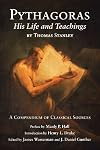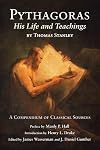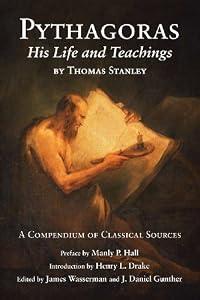
Pythagoras
by Thomas Stanley
On This Page
Description
The timeless brilliance of this exhaustive survey of the best classical writers of antiquity on Pythagoras was first published in 1687 in Thomas Stanley's massive tome, The History of Philosophy. It remains as contemporary today as it was over three hundred years ago. The text of the 1687 book has been reset and modernized to make it more accessible to the modern reader. Spelling has been regularized, obsolete words not found in a modern dictionary have been replaced, and contemporary show more conventions of punctuation have been used. Biographical sketches of Thomas Stanley and Pythagoras by Manly Palmer Hall, founder of the Philosophical Research Society, have been included, along with a profound overview of Pythagorean philosophy by Platonic scholar Dr. Henry L. Drake. The extensive Greek language references throughout the text have been corrected and contextualized, and reset in a modern Greek font. Each quotation has been verified with the source document in Greek. An extensive annotated appendix of these classical sources is included. A complete bibliography details all the reference works utilized, and a small Glossary defines a number of terms, especially those from musical theory, which may be unfamiliar to the non-technical reader. show lessTags
Recommendations



















Member Reviews
A step at a time (other than when evolution makes a leap). Behold! Mr. Chimp. Mr. Chimp can demonstrate atomic theory to humans so that they will understand everything (the essential components that encapsulate the Atom). However, Mr. Chimp refuses to learn human language (says it's a primitive language that users insufficient body language to express good emotions like sex (Mr. Chimp is a bonobo chimpanzee).
Pythagoras was first inspired to study math because of strings. He and his team's work on harmony and (untampered) pure modes was what led to geometry, and the study of observed number relationships. The hammer weight story is wrong. The team used strings attached to measured boards for their experimental study.
Take an oscilloscope show more and just look at string waves when plucked vs when bowed with horse hair, and see a pure wave vs a ragged coastline-style wave. See brass-instrument waves, almost pure but with a single disruption caused by crossing lips. The wave shapes on the oscilloscopes sure look to me like extra dimensions are easily viewable. Do string-theorists play music instruments?
Maybe the extra energy which string theory says is transferring to the extra dimensions is like the feelings you get when a band is flopping and everybody feels awkward and wants to leave, or when a band is wailing and ripping and everybody dances hard!
We are standing looking up at gravitational waves, string theory, and other phenomena in the same way Greeks of their time looked at the stars. They were desperate to understand but did not have the equipment to search for answers. We are touching on theories and wish we had more understanding because we know this is monumental knowledge, if only we could find out more.
Ridiculous theory more like. How can the universe be fundamentally made up of strings? Surely rope theory would be more of a robust theory? Vibration my atoms. What a load of atomic noise and silence. Stars and black holes my not Adams ample. If evolution was real there would be billions of people not believing in anything. Why would you need to if you understood your thoughts? show less
Pythagoras was first inspired to study math because of strings. He and his team's work on harmony and (untampered) pure modes was what led to geometry, and the study of observed number relationships. The hammer weight story is wrong. The team used strings attached to measured boards for their experimental study.
Take an oscilloscope show more and just look at string waves when plucked vs when bowed with horse hair, and see a pure wave vs a ragged coastline-style wave. See brass-instrument waves, almost pure but with a single disruption caused by crossing lips. The wave shapes on the oscilloscopes sure look to me like extra dimensions are easily viewable. Do string-theorists play music instruments?
Maybe the extra energy which string theory says is transferring to the extra dimensions is like the feelings you get when a band is flopping and everybody feels awkward and wants to leave, or when a band is wailing and ripping and everybody dances hard!
We are standing looking up at gravitational waves, string theory, and other phenomena in the same way Greeks of their time looked at the stars. They were desperate to understand but did not have the equipment to search for answers. We are touching on theories and wish we had more understanding because we know this is monumental knowledge, if only we could find out more.
Ridiculous theory more like. How can the universe be fundamentally made up of strings? Surely rope theory would be more of a robust theory? Vibration my atoms. What a load of atomic noise and silence. Stars and black holes my not Adams ample. If evolution was real there would be billions of people not believing in anything. Why would you need to if you understood your thoughts? show less
PYTHAGORAS
ROREWORD
It is now generally acknowledged that Thomas Stanley
was the first English historian of philosophy. He had
an orderly but versatile mind and gained distinction
during his own lifetime, as a poet and a translator of
poetical works. His father Sir Thomas Stanley was the
author of some prose and poetical fragments, but never
attained the recognition that came to his illustrious son.
The Thomas Stanley, with whom we are directly
concerned, was born in Hertfordshire, England, in
1625. His early education was under the personal
direction of William Fairfax, son of the translator of
Tasso, the 16th Century Italian poet. While still young,
Stanley became a good classical scholar, with fluency
French, Italian and Spanish languages.
When show more Stanley went to Pembroke Hall, Cambridge,
Fairfax accompanied him. Stanley graduated from
Cambridge with the degree of Master of Arts in 1641,
and took up residence in the Middle Temple, where
he combined the practice of law with his studies of
philosophy and the classics, and the composition of
poetry. During the Civil War he apparently considered
it discreet to travel on the continent, where he devoted
himself principally to his literary projects. Stanley died
in London on April 12, 1678
If it seems extraordinary that Thomas Stanley could
have studied in both Cambridge and Oxford and
graduated at the age of sixteen, it should be noted that he
entered Cambridge in his fourteenth year, apparently
having received most of his fundamental education by
private tutoring. Actually, he issued the first volume of
The History of Philosophy in 1655, when he was only
thirty years old. The engraved frontispiece shows
Stanley as a young and handsome man, with long hair
hanging on his shoulders. His son of the same name was
also educated at Pembroke Hall and at the age of... show less
ROREWORD
It is now generally acknowledged that Thomas Stanley
was the first English historian of philosophy. He had
an orderly but versatile mind and gained distinction
during his own lifetime, as a poet and a translator of
poetical works. His father Sir Thomas Stanley was the
author of some prose and poetical fragments, but never
attained the recognition that came to his illustrious son.
The Thomas Stanley, with whom we are directly
concerned, was born in Hertfordshire, England, in
1625. His early education was under the personal
direction of William Fairfax, son of the translator of
Tasso, the 16th Century Italian poet. While still young,
Stanley became a good classical scholar, with fluency
French, Italian and Spanish languages.
When show more Stanley went to Pembroke Hall, Cambridge,
Fairfax accompanied him. Stanley graduated from
Cambridge with the degree of Master of Arts in 1641,
and took up residence in the Middle Temple, where
he combined the practice of law with his studies of
philosophy and the classics, and the composition of
poetry. During the Civil War he apparently considered
it discreet to travel on the continent, where he devoted
himself principally to his literary projects. Stanley died
in London on April 12, 1678
If it seems extraordinary that Thomas Stanley could
have studied in both Cambridge and Oxford and
graduated at the age of sixteen, it should be noted that he
entered Cambridge in his fourteenth year, apparently
having received most of his fundamental education by
private tutoring. Actually, he issued the first volume of
The History of Philosophy in 1655, when he was only
thirty years old. The engraved frontispiece shows
Stanley as a young and handsome man, with long hair
hanging on his shoulders. His son of the same name was
also educated at Pembroke Hall and at the age of... show less
Jan 21, 2019Spanish
Ratings
Members
- Recently Added By
Lists

Ancient/Classical World
34 works; 1 member
Author Information
6+ Works 89 Members
Common Knowledge
- Canonical title
- Pythagoras
- Original publication date
- 1687
- First words
- The Italic Sect was different from the Ionic, in respect of the author, place, discipline and doctrine.
- Last words
- (Click to show. Warning: May contain spoilers.)He infuses soul into all men, and being infused takes it away-and being taken away , restores it, when and as often as he pleases.
Classifications
- Genres
- Nonfiction, Philosophy, Religion & Spirituality, Biography & Memoir, Science & Nature, History
- DDC/MDS
- 182.2 — Philosophy and Psychology Ancient, medieval & eastern philosophy Pre-Socratic Greek philosophies Italic or Pythagorean
- LCC
- B243 .S67 — Philosophy, Psychology and Religion Philosophy (General) By period Ancient
- BISAC
Statistics
- Members
- 64
- Popularity
- 484,037
- Reviews
- 2
- Rating
- (4.00)
- Languages
- English
- Media
- Paper, Ebook
- ISBNs
- 3
- ASINs
- 1