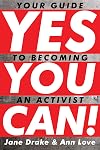
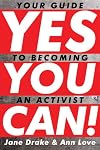
Yes You Can!: Your Guide to Becoming an Activist
by Jane Drake
On This Page
Description
Guides readers through nine steps to social change and discusses strategies on running an effective meeting, writing a petition, and lobbying governments.Tags
Recommendations















Member Reviews
In 2010 I found myself thinking about social activism more than ever, so when this book became available through the ER program, I jumped at a chance to read it. I didn't realize that it was marketed for a teen audience. That wasn't a detriment, however, as most of the information in the book is applicable to a wider-audience.
This slim volume is well organized and packed with information. The chapters, or "steps" as the authors call them, tackle one issue each. They include an inspirational background story (for example, the beginnings of Greenpeace, or a short history of Gandhi), a section on useful strategies and tips for skill development, and finally conclude with a timeline of milestones and setbacks of a particular movement. show more Regardless of whether your area social activism is at the neighbourhood or global level, this book has helpful information, inspiration and advice to get you moving on your chosen cause. The writing is clear and concise and doesn't condescend to the audience. I also appreciate that the publisher included a useful index.
Recommended for: anyone who is interesting in getting involved in social change, whatever their age. Basic information and inspiration for the beginner, and not someone who is already an activist. show less
This slim volume is well organized and packed with information. The chapters, or "steps" as the authors call them, tackle one issue each. They include an inspirational background story (for example, the beginnings of Greenpeace, or a short history of Gandhi), a section on useful strategies and tips for skill development, and finally conclude with a timeline of milestones and setbacks of a particular movement. show more Regardless of whether your area social activism is at the neighbourhood or global level, this book has helpful information, inspiration and advice to get you moving on your chosen cause. The writing is clear and concise and doesn't condescend to the audience. I also appreciate that the publisher included a useful index.
Recommended for: anyone who is interesting in getting involved in social change, whatever their age. Basic information and inspiration for the beginner, and not someone who is already an activist. show less
 This review was written for LibraryThing Early Reviewers.
The book jacket reads "A step-by-step guide to successful social change." I don't quite know if that's accurate. While this book offers a look at the process activism usually follows, there are less direct strategies and more stories of activists. There are a few helpful exercises, however. I liked that the book did not seem to be pushing one agenda, though the authors seemed to hint at discussing smoker's rights vs. non smokers rights and then only discussed the latter. There are some interesting nuggets about how much the U.S.A. sucks at environmental policy, but they are only facts in time lines, nothing pushy. All in all, this book offers an interesting look at how change is affected, and it does make me want to do something show more worthwhile in my community. I sense that this accomplishes the authors' true purpose. show less
This review was written for LibraryThing Early Reviewers.This is a very thin book, and a lot of it is still filler. A good 20% consists of timelines of significant events in categories like American Civil Rights or Air and Water Pollution. Even worse, these timelines don’t contain enough information to make the reader appreciate or care about the events listed. For example, one entry reads “A.D. 1978, United States: Governments evacuate hundreds of families from a subdivision in Niagara Falls, New York, constructed on toxic waste, used to fill in an old man-made waterway called the Love Canal.” I still remember vividly how horrified I was after reading about Love Canal for the first time in my ninth grade geography class, more than a decade ago. The bland statement in this book evoked show more none of that emotion.
Another major part of the book consists of more in-depth discussions of particular topics, like Rosa Parks or smoking laws. These 3-5 page sections were probably my favourite, because they actually provided interesting information in a readable format. They were only marginally related to the supposed topic of the book, though: this is supposed to be “a step-by-step guide to successful social change”. But there’s a huge gulf between reading about the progress that has been made by others (in the case of the smoking laws, it’s not at all clear how regular individuals made a contribution) and knowing how to bring about that progress ourselves.
The book does contain sections about how to be an activist, but I found them less than helpful. The advice dealt with questions like how to run a formal meeting and how to give an interview to a reporter. This is all well and good, but there’s an earlier stage that seemed to be missing. How do you build up interest so that people actually come to your formal meeting? How do you attract the interests of journalists so that they contact you for an interview? I would have liked to see a much greater focus on how to get started from nothing. What are some small initial steps that can be taken immediately to work toward the change we care about?
Ultimately, I don’t think I learned a lot from this book. It also took me forever to read, because it didn’t hold my attention. I’m glad I’m finally done with it. show less
Another major part of the book consists of more in-depth discussions of particular topics, like Rosa Parks or smoking laws. These 3-5 page sections were probably my favourite, because they actually provided interesting information in a readable format. They were only marginally related to the supposed topic of the book, though: this is supposed to be “a step-by-step guide to successful social change”. But there’s a huge gulf between reading about the progress that has been made by others (in the case of the smoking laws, it’s not at all clear how regular individuals made a contribution) and knowing how to bring about that progress ourselves.
The book does contain sections about how to be an activist, but I found them less than helpful. The advice dealt with questions like how to run a formal meeting and how to give an interview to a reporter. This is all well and good, but there’s an earlier stage that seemed to be missing. How do you build up interest so that people actually come to your formal meeting? How do you attract the interests of journalists so that they contact you for an interview? I would have liked to see a much greater focus on how to get started from nothing. What are some small initial steps that can be taken immediately to work toward the change we care about?
Ultimately, I don’t think I learned a lot from this book. It also took me forever to read, because it didn’t hold my attention. I’m glad I’m finally done with it. show less
This review was written for LibraryThing Early Reviewers.Right away I have to say I wouldn't have classified this as "juvenile" literature. The language might be a little simplistic, definitely geared toward young adults, but the message is something we should all sit up and take notice of no matter what our age: if the world around you makes you sick do something. It's the age-old promise, "you CAN make a difference!" But first you have to DO something.
Yes You Can is a how-to manual of sorts. Each chapter covers a different step to becoming an activist including an example of someone taking that particular step. The histories of organizations such as Amnesty International and Save the Children illustrate what can happen if the right steps are taken successfully. For every chapter there is a show more section on the historical time line of that step in action. There is also a section on the accomplishments as well as the challenges called, "Milestones and Setbacks" which put everything into perspective. Almost like a textbook there is a checklist to test what the reader has (or hasn't learned). My favorite piece of advice was "know your cause inside and out." The ability to see both sides of any argument can go a long way in the effort to sway opinion or make a change. show less
Yes You Can is a how-to manual of sorts. Each chapter covers a different step to becoming an activist including an example of someone taking that particular step. The histories of organizations such as Amnesty International and Save the Children illustrate what can happen if the right steps are taken successfully. For every chapter there is a show more section on the historical time line of that step in action. There is also a section on the accomplishments as well as the challenges called, "Milestones and Setbacks" which put everything into perspective. Almost like a textbook there is a checklist to test what the reader has (or hasn't learned). My favorite piece of advice was "know your cause inside and out." The ability to see both sides of any argument can go a long way in the effort to sway opinion or make a change. show less
This review was written for LibraryThing Early Reviewers.This is a well-written book; an easy read. I read the entire book in one setting, but it's worth keeping around. It was evidently written for a juvenile audience, but may be more useful for adults.
It's a step-by-step manual for taking on an issue, and getting something done about that issue. The chapters are well-organized and the method is clear. The authors use great examples, and it's clear that they have some personal connection with some of the examples given.
It's an excellent book, and I'll be keeping it in my library, and occasionally recommending it to people. However, it's missing a couple of things that would have made it a much better book.
First, unless you know who Jane Drake and Ann Love are, the authors come without show more credentials, and they fail to present their credentials. It would be helpful for the authors to explain to their audience how they came by this knowlege. If they have personal experience as activists (and it appears that they have), that would add credibility.
The other missing item in the book is an awareness of faith-based activism, or even an awareness of faith. For example, one list of notable documents that set social standards starts with the Code of Hammurabi, but ignores the commandments of the Old Testament, the New Testament and the Koran. The authors use Ghandi as an example, but don't even nod to the religious basis of his activism.
Particularly in a book for young people, and particularly in a book that encourages people to act on their beliefs, it would be helpful to recognize that some of those beliefs are religious, as well as political, environmental or social.
That said, it is still a good book, and well worth keeping on the shelf. It is as suitable for adults as for juveniles, and if it is successful as such, may mark a bit of a change in their writing career. show less
It's a step-by-step manual for taking on an issue, and getting something done about that issue. The chapters are well-organized and the method is clear. The authors use great examples, and it's clear that they have some personal connection with some of the examples given.
It's an excellent book, and I'll be keeping it in my library, and occasionally recommending it to people. However, it's missing a couple of things that would have made it a much better book.
First, unless you know who Jane Drake and Ann Love are, the authors come without show more credentials, and they fail to present their credentials. It would be helpful for the authors to explain to their audience how they came by this knowlege. If they have personal experience as activists (and it appears that they have), that would add credibility.
The other missing item in the book is an awareness of faith-based activism, or even an awareness of faith. For example, one list of notable documents that set social standards starts with the Code of Hammurabi, but ignores the commandments of the Old Testament, the New Testament and the Koran. The authors use Ghandi as an example, but don't even nod to the religious basis of his activism.
Particularly in a book for young people, and particularly in a book that encourages people to act on their beliefs, it would be helpful to recognize that some of those beliefs are religious, as well as political, environmental or social.
That said, it is still a good book, and well worth keeping on the shelf. It is as suitable for adults as for juveniles, and if it is successful as such, may mark a bit of a change in their writing career. show less
This review was written for LibraryThing Early Reviewers.I'm a community organizer by trade, and very passionate about what I do. And since I'm entering my "golden years" and seeing the need to pass-on what I've learned I was very excited to get this book.
I read through it the first day, and put it down, very disappointed. There is no doubt that the book is well-meaning, and well-written, but it had so little connection to my experience that it seemed to come from another world. But then (northern ?) Canada is a world away from inner city Bronx where I've worked.
The format of the book was disjointed. It was less a guidebook than a history of causes. I also think the focus on "big ticket" organizations like Greenpeace, Red Cross, and Save the Children removed it very far from a beginning show more activists' reality. And there was not enough time paid to the admittedly transferable skills, usable by a beginner. It just didn't relate.
So I gave the book to my 13-year old niece. She liked the parts about this history of organizations and movements, but barely noticed the "nuts and bolts"
So I left the book for a few weeks and then read it again and unfortunately (because we need books like this very badly, I have to conclude that this book - while being a decent history of change-making organizations, fails at exactly what it bills itself as - a guidebook. show less
I read through it the first day, and put it down, very disappointed. There is no doubt that the book is well-meaning, and well-written, but it had so little connection to my experience that it seemed to come from another world. But then (northern ?) Canada is a world away from inner city Bronx where I've worked.
The format of the book was disjointed. It was less a guidebook than a history of causes. I also think the focus on "big ticket" organizations like Greenpeace, Red Cross, and Save the Children removed it very far from a beginning show more activists' reality. And there was not enough time paid to the admittedly transferable skills, usable by a beginner. It just didn't relate.
So I gave the book to my 13-year old niece. She liked the parts about this history of organizations and movements, but barely noticed the "nuts and bolts"
So I left the book for a few weeks and then read it again and unfortunately (because we need books like this very badly, I have to conclude that this book - while being a decent history of change-making organizations, fails at exactly what it bills itself as - a guidebook. show less
This review was written for LibraryThing Early Reviewers.The subtitle of this book is, Your Guide to Becoming an Activist, and I think that if the book is geared to people who are not yet activists, this will not be the book that jump starts them. The focus on very large organizations would be overwhelming to someone who is just considering "doing something", and the history of those organizations would not be that exciting. For those reasons, this is not the book I would be reaching for to encourage a young person who wanted to start making a difference.
This review was written for LibraryThing Early Reviewers.Members
- Recently Added By
Lists

Dishonourable Mentions of 2013
189 works; 63 members

Books recommended by Calgary Public Library staff
1,588 works; 4 members
Author Information
27+ Works 561 Members
Classifications
Statistics
- Members
- 37
- Popularity
- 781,223
- Reviews
- 10
- Rating
- (3.58)
- Languages
- English
- Media
- Paper, Ebook
- ISBNs
- 4
- ASINs
- 1