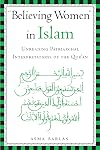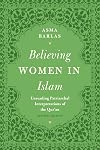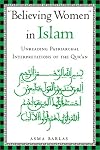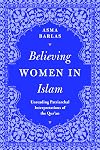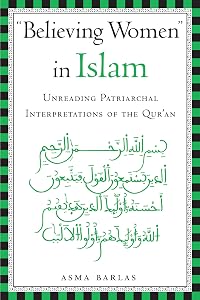
"Believing Women" in Islam: Unreading Patriarchal Interpretations of the Qur'an
by Asma Barlas
On This Page
Description
Is women ?s inequality supported by the Qur ?an? Do men have the exclusive right to interpret Islam ?s holy scripture? In her best-selling book Believing Women in Islam: Unreading Patriarchal Interpretations of the Qur ?an, Asma Barlas argues that, far from supporting male privilege, the Qur ?an actually encourages the full equality of women and men. She explains why a handful of verses have been interpreted to favor men and shows how these same verses can be read in an egalitarian way that show more is fully supported by the text itself and compatible with the Qur ?an ?s message that it is complete and self-consistent. A Brief Introduction presents the arguments of Believing Women in a simplified way that will be accessible and inviting to general readers and undergraduate students. The authors focus primarily on the Qur ?an ?s teachings about women and patriarchy. They show how traditional teachings about women ?s inferiority are not supported by the Qur ?an but were products of patriarchal societies that used it to justify their existing religious and social structures. The authors ? hope is that by understanding how patriarchal traditionalists have come to exercise so much authority in today ?s Islam, as well as by rereading some of the Qur ?an ?s most controversial verses, adherents of the faith will learn to question patriarchal dogma and see that an egalitarian reading of the Qur ?an is equally possible and, for myriad reasons, more plausible. show lessTags
Recommendations








Member Reviews
I initially wanted to give this book 4 stars but then I ended up giving an extra because I must have given 5 if I was women. This is an excellent all-encompassing text and not just another feminist reading of the Quran. Barlas makes an extremely strong case for unreading patriarchical readings of scripture by principally moving the onus of (mis)reading from the Quran to the reader who is interacting with the text through his own subjectivities. In my view, the work achieves a two dimensional success; one, against the misogynist and predominantly male oriented interpretations and two, against those modernist theories which blames the text itself for its misreading.
Ratings
Members
- Recently Added By
Lists

Women in Islam
120 works; 8 members

Books on Islamic Feminism
43 works; 1 member
Author Information
6+ Works 190 Members
Asma Barlas is a professor of politics at Ithaca College in Ithaca, New York, Her books include Re-understanding Islam: A Double Critique and Islam, Muslims, and the US: Essays on Religion and Politics.
Common Knowledge
- First words
- This work reflects my ongoing engagement with two questions that have both theoretical significance and real-life consequences for Muslims, especially women: First, does Islam's Scripture, the Qur'ān, teach or condone sexual... (show all) inequality or oppression? Is it, as critics allege, a patriarchal and even sexist and misogynistic text?
- Quotations
- [...] descriptions of Islam as a religious patriarchy that allegedly has "God on its side" confuses the Qur'ān with a specific reading if it, ignoring that all texts, including the Qur'ān, can be read in multiple modes, inc... (show all)luding egalitarian ones.
And I do want to make a more specific, if also more controversial, claim (in dialogue with recent Muslim and feminist scholarship) which is that the Qur'ān is egalitarian and antipatriarchal.
Classifications
- Genres
- Religion & Spirituality, Nonfiction, Sexuality and Gender Studies, General Nonfiction
- DDC/MDS
- 297.1 — Religion Other religions Islam Textual Sources
- LCC
- BP173.4 .B35 — Philosophy, Psychology and Religion Islam. Bahaism. Theosophy, etc. Islam. Bahai Faith. Theosophy, etc. Relation of Islam to other religions
- BISAC
Statistics
- Members
- 183
- Popularity
- 178,378
- Reviews
- 3
- Rating
- (4.31)
- Languages
- English
- Media
- Paper, Ebook
- ISBNs
- 12