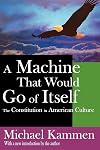
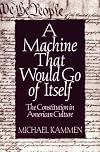
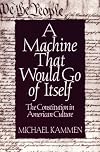
A Machine That Would Go of Itself: The Constitution in American Culture
by Michael Kammen
On This Page
Description
In this volume, Pulitzer Prize-winning historian Michael Kammen explores the U.S. Constitution's place in the public consciousness and its role as a symbol in American life, from ratification in 1788 to our own time. As he examines what the Constitution has meant to the American people (perceptions and misperceptions, uses and abuses, knowledge and ignorance), Kammen shows that although there are recurrent declarations of reverence most of us neither know nor fully understand our show more Constitution. How did this gap between ideal and reality come about? To explain it, Kammen examines the complex and contradictory feelings about the Constitution that emerged during its preparation and that have been with us ever since. He begins with our confusion as to the kind of Union we created, especially with regard to how much sovereignty the states actually surrendered to the central government. This confusion is the source of the constitutional crisis that led to the Civil War and its aftermath. Kammen also describes and analyzes changing perceptions of the differences and similarities between the British and American constitutions; turn-of-the-century debates about states' rights versus national authority; and disagreements about how easy or difficult it ought to be to amend the Constitution. Moving into the twentieth century, he notes the development of a "cult of the Constitution" following World War I, and the conflict over policy issues that persisted despite a shared commitment to the Constitution. show lessTags
Recommendations












Member Reviews
Those of us who revere the Constitution and particularly the Bill of Rights realize how subversive a document it can be. We all pay it lip service but many really don't understand what it means, or perhaps understand only too well. Michael Kammen in A Machine That Would Go Of Itself describes how Louis D. Oaks, the Los Angeles Chief of Police, had Upton Sinclair arrested in 1923 for reading the first three amendments to the Constitution in public. He was "kidnapped" by the police, moved to different station houses to confuse his lawyers, and held incommunicado. Re was charged with "discussing, arguing, orating, and debating certain thoughts and theories, which thoughts and theories were contemptuous of the constitution of the state of show more California, calculated to cause hatred and contempt of the government of the United States of America." ! One suspects Chief Oakes was not fluent in the meaning of the Constitution when he took his oath.
Sinclair was released only because a subordinate of the Chief secretly phoned an associate of Sinclair's so his lawyers could prepare a writ to get him out. Sinclair continued his meetings and helped found the Southern California branch of the American Civil Liberties Union. Chief Oakes was fired about a month later after being discovered in his car at night with a woman and a jug of whiskey. show less
Sinclair was released only because a subordinate of the Chief secretly phoned an associate of Sinclair's so his lawyers could prepare a writ to get him out. Sinclair continued his meetings and helped found the Southern California branch of the American Civil Liberties Union. Chief Oakes was fired about a month later after being discovered in his car at night with a woman and a jug of whiskey. show less
Ratings
Members
- Recently Added By
Author Information

32+ Works 1,591 Members
Michael Gedaliah Kammen was born in Rochester, New York on October 25, 1936. He received a bachelor's degree in history from George Washington University and master's and doctoral degrees in history from Harvard University. He was a professor of American history and culture at Cornell University since 1965. He wrote numerous books including A show more Season of Youth, A Machine That Would Go of Itself, Mystic Chords of Memory: The Transformation of Tradition in American Culture, Visual Shock, and Digging Up the Dead: A History of Notable American Reburials. He received the 1973 Pulitzer Prize for history for People of Paradox: An Inquiry Concerning the Origins of American Civilization. He died on November 29, 2013 at the age of 77. (Bowker Author Biography) show less
Awards and Honors
Awards
Distinctions
Common Knowledge
- Canonical title
- A Machine That Would Go of Itself: The Constitution in American Culture
- Original publication date
- 1986 (1st edition) (1st edition)
- Important places
- USA
- Original language
- English
- Disambiguation notice
- Full title (1986): A machine that would go of itself : the Constitution in American culture / Michael Kammen
Classifications
- Genres
- Politics and Government, Nonfiction, History, General Nonfiction
- DDC/MDS
- 342.73 — Society, government, & culture Law U.S. Constitution - Bill of Rights, Amendments North America Constitutional law--United States
- LCC
- JK31 .K34 — Political Science Political institutions and public administration (United States) Political institutions and public administration United States
- BISAC
Statistics
- Members
- 180
- Popularity
- 181,432
- Reviews
- 1
- Rating
- (3.83)
- Languages
- English
- Media
- Paper, Ebook
- ISBNs
- 6
- ASINs
- 3