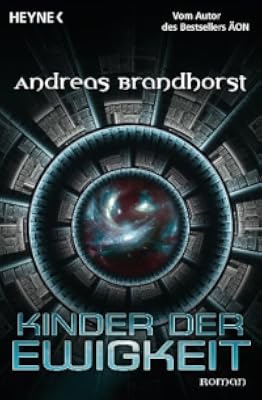
Kinder der Ewigkeit: Roman
by Andreas Brandhorst
On This Page
Tags
Recommendations































Member Reviews
I don't regularly read German books, for a number of reasons. This has as a consequence that it can be hard to understand it all. Which was the case here.
This was my first encounter with Brandhorst's own work. He's also known for having translated a.o. [a:Terry Pratchett|1654|Terry Pratchett|https://images.gr-assets.com/authors/1235562205p2/1654.jpg]'s Discworld-novels into German.
This story here in 'Kinder der Ewigkeit' is about Esebian, a man with a crimibal past (murderer, assassin). To escape prison, he changed his identity and in at least one case, even his sex. But all these personalities continued to live on in his mind. This made me think of [a:Brandon Sanderson|38550|Brandon show more Sanderson|https://images.gr-assets.com/authors/1394044556p2/38550.jpg]'s [b:Legion|25925238|Legion (Legion, #1)|Brandon Sanderson|https://images.gr-assets.com/books/1437118169s/25925238.jpg|18978261]. Like in this story, these personalities are consulted whenever necessary.
Oh yes, it's a hard sci-fi story with bio-engineering (hence also the regeneration of the human body, enhancing them with multifunctional chips that reinforce the senses, etc.), a vast space (in which I had a hard time imagining the setting, the planets, the filigree networks / roads / circuits, ...), a collective of AI's governing it all, and more.
But it seems not everyone is happy with the current political situation and thus seek to take control. Those people are the Immortal ones, the Enlightened. To become an Enlightened, you have to earn and collect merits through your job or certain tasks. But people who have the Taint (whatever it is, because it is not explained at all!) can not rise to the level of immortality. It is almost like the Indian caste-system.
Esebian can reach immortality, but has to play the assassin one last time, despite him having sworn many years ago to lead a normal, peaceful life. He has to kill the leader of the Directorate. But not all goes according to plan or even Esebian's plan. This collective wants to lead a control-free life and wants to overthrow the governing Magisters (Masters, the AI).
In other words, Esebian is used as a tool on a political scheme, but finds out only very late. In addition, there is a certain Leandra, a mentalist, who will severely influence his course of actions, for better or for worse.
As I wrote in the beginning, I found it hard to understand or follow the story. Maybe Brandhorst's style has something to do with it (my knowledge of the German language is not on a C1- or C2-level = mother-tongue) or maybe it is because the story has holes or lacks some coherence. It is definitely not a perfect stpry; it has its flaws. One review I agree with on that part - although this reader is more positive about the book than I am - is this one: click here .
It is, all in all, not a bad story. Brandhorst threw in some interesting ideas (immortality, but what are the consequences? Why not for everyone? AI governing?), but failed to explain some things. The happenings take place in a biiiig world, of which little is known, thus making it hard to properly form an image of it, or I must have overlooked it, which I don't think I have.
Final remark: This could have done with /- 100-200 pages less. No, really.
There are other Brandhorst novels on my wish list (click here), but I am currently (!) not that eager to read them after this first encounter. I do welcome any Brandhorst specialists to offer their insight into his books to make me give him the benefit of the doubt. 🙂 show less
This was my first encounter with Brandhorst's own work. He's also known for having translated a.o. [a:Terry Pratchett|1654|Terry Pratchett|https://images.gr-assets.com/authors/1235562205p2/1654.jpg]'s Discworld-novels into German.
This story here in 'Kinder der Ewigkeit' is about Esebian, a man with a crimibal past (murderer, assassin). To escape prison, he changed his identity and in at least one case, even his sex. But all these personalities continued to live on in his mind. This made me think of [a:Brandon Sanderson|38550|Brandon show more Sanderson|https://images.gr-assets.com/authors/1394044556p2/38550.jpg]'s [b:Legion|25925238|Legion (Legion, #1)|Brandon Sanderson|https://images.gr-assets.com/books/1437118169s/25925238.jpg|18978261]. Like in this story, these personalities are consulted whenever necessary.
Oh yes, it's a hard sci-fi story with bio-engineering (hence also the regeneration of the human body, enhancing them with multifunctional chips that reinforce the senses, etc.), a vast space (in which I had a hard time imagining the setting, the planets, the filigree networks / roads / circuits, ...), a collective of AI's governing it all, and more.
But it seems not everyone is happy with the current political situation and thus seek to take control. Those people are the Immortal ones, the Enlightened. To become an Enlightened, you have to earn and collect merits through your job or certain tasks. But people who have the Taint (whatever it is, because it is not explained at all!) can not rise to the level of immortality. It is almost like the Indian caste-system.
Esebian can reach immortality, but has to play the assassin one last time, despite him having sworn many years ago to lead a normal, peaceful life. He has to kill the leader of the Directorate. But not all goes according to plan or even Esebian's plan. This collective wants to lead a control-free life and wants to overthrow the governing Magisters (Masters, the AI).
In other words, Esebian is used as a tool on a political scheme, but finds out only very late. In addition, there is a certain Leandra, a mentalist, who will severely influence his course of actions, for better or for worse.
As I wrote in the beginning, I found it hard to understand or follow the story. Maybe Brandhorst's style has something to do with it (my knowledge of the German language is not on a C1- or C2-level = mother-tongue) or maybe it is because the story has holes or lacks some coherence. It is definitely not a perfect stpry; it has its flaws. One review I agree with on that part - although this reader is more positive about the book than I am - is this one: click here .
It is, all in all, not a bad story. Brandhorst threw in some interesting ideas (immortality, but what are the consequences? Why not for everyone? AI governing?), but failed to explain some things. The happenings take place in a biiiig world, of which little is known, thus making it hard to properly form an image of it, or I must have overlooked it, which I don't think I have.
Final remark: This could have done with /- 100-200 pages less. No, really.
There are other Brandhorst novels on my wish list (click here), but I am currently (!) not that eager to read them after this first encounter. I do welcome any Brandhorst specialists to offer their insight into his books to make me give him the benefit of the doubt. 🙂 show less
Ganz knapp an den 5 Sternen vorbeigeschrappt. Guter SF-Roman.
Ratings
Members
- Recently Added By
Author Information
84+ Works 765 Members
Common Knowledge
- Canonical title*
- Kinder der Ewigkeit
*Some information comes from Common Knowledge in other languages. Click "Edit" for more information.
Classifications
- Genres
- Fiction and Literature, Science Fiction
- DDC/MDS
- 830 — Literature & rhetoric German & related literatures German literature and literatures of related languages
- LCC
- PT2662 .R247 — Language and Literature German, Dutch and Scandinavian literatures German literature Individual authors or works 1961-2000
Statistics
- Members
- 38
- Popularity
- 746,562
- Reviews
- 2
- Rating
- (3.70)
- Languages
- English, German, Italian
- Media
- Paper, Ebook
- ISBNs
- 4
- ASINs
- 1