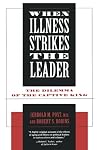
When Illness Strikes the Leader: The Dilemma of the Captive King
by Jerrold M. Post, Robert S. Robins
19 Members (3.00)
On This Page
Description
The illness or disability of a world leader can change the course of history. When Lenin became too infirm to remove Stalin from a position of power, when the shah of Iran's terminal cancer was kept secret from fellow Iranians and foreign supporters until Ayatollah Khomeini's Islamic revolution had succeeded, the political consequences were monumental. In this absorbing book, two experts in political psychology reveal how the infirmities of leaders have affected their own societies and the show more broader course of world events. Drawing on a wide range of examples, including Mad King Ludwig of Bavaria, Woodrow Wilson, Adolf Hitler, Idi Amin, Deng Xiao-peng, Ferdinand Marcos, Franklin Delano Roosevelt, and Menachem Begin, Dr. Jerrold M. Post and Robert S. Robins explore the impact of physical and mental illness on political leadership. Post and Robins investigate the effects of illness on the leader, his inner circle, his followers, and the political system itself. They discuss such thought-provoking topics as: --how the nature of the illness affects decisionmaking; --how mortal illness can make a leader more determined to make his mark on history; --how a leader's disability can be hidden from the public in every political system; --the effects of prescribed drugs and substance abuse on leadership behavior; --the conflicted role and ethical dilemmas of physicians who care for the powerful; --and how the demands and privileges of high office compromise the quality of medical care. In closed societies where there is no clear mechanism of succession, say the authors, the ailing or aging leader and his close advisers can become locked in a fatal embrace, each dependent upon the other for survival: a captive king and his captive court. In the absence of clear rules for determining when a leader is disabled and should be replaced and how a successor will be chosen, illness in high office can be highly destabilizing. Post and Robins's book will be engrossing--and timely--reading for all those interested in leadership, history, and the political process. show lessTags
Member Reviews
Members
- Recently Added By
Author Information

15+ Works 264 Members
Jerrold Morton Post was an American psychiatrist, born on February 8, 1934 in New Haven, Connecticut. He was a graduate of Yale in 1956 and Yale School of Medicine in 1960. He completed his residency at Harvard Medical School and had a two-year fellowship at St. Elizabeth's, a psychiatric hospital in Washington. He was the inventor of political show more psychology. He worked as an analyst for the Central Intelligence Agency and founded the Center for the Analysis of Personality and Political Behavior. He was the author of 14 books and numerous medical articles. His last book, written with Stephanie Doucette, was Dangerous Charisma: The Political Psychology of Donald Trump and his Followers. Jerrold M. Post died on November 22, 2020. He was 86. (Bowker Author Biography) show less
2 Works 62 Members
Common Knowledge
- Blurbers
- Tucker, Robert C.
Classifications
- Genres
- Nonfiction, Politics and Government, History, Biography & Memoir
- DDC/MDS
- 351.007 — Social sciences Public administration & military science Public administration
- LCC
- JF1525 .D4 .P68 — Political Science Political institutions and public administration Political institutions and public administration Public administration
- BISAC
Statistics
- Members
- 19
- Popularity
- 1,326,710
- Rating
- (3.00)
- Languages
- English
- Media
- Paper, Ebook
- ISBNs
- 3