
The Foucault Reader
by Michel Foucault
On This Page
Description
Michael Foucault's writing has shaped the teaching of half a dozen disciplines, ranging from literary criticism to the history of criminology. But none of his books offers a satisfactory introduction to the entire complex body of his work. The Foucault Reader precisely serves that purpose. It contains selections from each area of Foucault's thought, a wealth of previously unpublished writings, and an interview with Foucault during which he discusses his philosophy with unprecedented candor.Tags
Recommendations





























Member Reviews
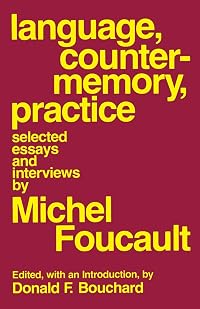
For anybody with more than a superficial interest in Foucault's thought, I would strongly suggest not buying this volume. Buy Discipline and Punish, The History of Sexuality, Vol. 1, the three volume Essential Foucault, The Order of Things, and Language, Counter-memory, Practice instead. I bought this for a graduate seminar on Foucault and was a bit peeved to see how much it overlapped with books I already owned or was going to have to buy soon thereafter.
This book is intended as an accessible introduction and overview of Foucault's main ideas. I would recommend this book to anyone, but especially undergrad students, who want to get a grasp of Foucauldian theory which can otherwise be a bit overwhelming at first if read straight from the man himself. As another reviewer has said though, it probably won't include much for those that are already familiar with Foucault's work. Personally, I always found it very useful in helping to remind me of certain terms and concepts.
A selection of pieces from Foucault's entire body of work. In addition to philosophy, the book contains essays on the history of ideas and other fields. This serves as an excellent introduction to the ideas of this significant thinker of the 20th century.
This is a compilation of some of Foucault's most interesting or important writings. This is designed to give the reader a cross-section, a sense of Foucault's body of work in general.
A good collection of some of Foucault's best known pieces.
Michel Foucault was one of the most influential thinkers in the contemporary world, someone whose work has affected the teaching of half a dozen disciplines ranging from literary criticism to the history of criminology. But of his many books, not one offers a satisfactory introduction to the entire complex body of his work. The Foucault Reader was commissioned precisely to serve that purpose. Source: GoodReads
Michel Foucault was one of the most influential thinkers in the contemporary world, someone whose work has affected the teaching of half a dozen disciplines ranging from literary criticism to the history of criminology. But of his many books, not one offers a satisfactory introduction to the entire complex body of his work. The show more Foucault Reader was commissioned precisely to serve that purpose. The Reader contains selections from each area of Foucault's work as well as a wealth of previously unpublished writings, including important material written especially for this volume, the preface to the long-awaited second volume of The History of Sexuality, and interviews with Foucault himself, in the course of which he discussed his philosophy at first hand and with unprecedented candor. This philosophy comprises an astonishing intellectual enterprise: a minute and ongoing investigation of the nature of power in society. Foucault's analyses of this power as it manifests itself in society, schools, hospitals, factories, homes, families, and other forms of organized society are brought together in The Foucault Reader to create an overview of this theme and of the broad social and political vision that underlies it.
Source: Publisher per www.books.google.com show less
Michel Foucault was one of the most influential thinkers in the contemporary world, someone whose work has affected the teaching of half a dozen disciplines ranging from literary criticism to the history of criminology. But of his many books, not one offers a satisfactory introduction to the entire complex body of his work. The show more Foucault Reader was commissioned precisely to serve that purpose. The Reader contains selections from each area of Foucault's work as well as a wealth of previously unpublished writings, including important material written especially for this volume, the preface to the long-awaited second volume of The History of Sexuality, and interviews with Foucault himself, in the course of which he discussed his philosophy at first hand and with unprecedented candor. This philosophy comprises an astonishing intellectual enterprise: a minute and ongoing investigation of the nature of power in society. Foucault's analyses of this power as it manifests itself in society, schools, hospitals, factories, homes, families, and other forms of organized society are brought together in The Foucault Reader to create an overview of this theme and of the broad social and political vision that underlies it.
Source: Publisher per www.books.google.com show less
Excerpts from essential Foucault texts, organized into sections on Truth and Method (What is Enlightenment; Truth and Power; Nietzsche, Geneaology, History; What is An Author?), and Practices and Knowledge (Madness and Civilization, Disciplines and Sciences of the Individual, Bio-Power, Sex and Truth, and Practices and Sciences of the Self).
Members
- Recently Added By
Lists

Reading LIst
648 works; 1 member
Author Information

362+ Works 50,026 Members
Michel Foucault was born on October 15, 1926, in Poitiers, France, and was educated at the Sorbonne, in Paris. He taught at colleges all across Europe, including the Universities of Lill, Uppsala, Hamburg, and Warsaw, before returning to France. There he taught at the University of Paris and the College of France, where he served as the chairman show more of History of Systems of Thought until his death. Regarded as one of the great French thinkers of the twentieth century, Foucault's interest was in the human sciences, areas such as psychiatry, language, literature, and intellectual history. He made significant contributions not just to the fields themselves, but to the way these areas are studied, and is particularly known for his work on the development of twentieth-century attitudes toward knowledge, sexuality, illness, and madness. Foucault's initial study of these subjects used an archaeological method, which involved sifting through seemingly unrelated scholarly minutia of a certain time period in order to reconstruct, analyze, and classify the age according to the types of knowledge that were possible during that time. This approach was used in Madness and Civilization: A History of Insanity in the Age of Reason, for which Foucault received a medal from France's Center of Scientific Research in 1961, The Birth of the Clinic, The Order of Things, and The Archaeology of Knowledge. Foucault also wrote Discipline and Punishment: The Birth of the Prison, a study of the ways that society's views of crime and punishment have developed, and The History of Sexuality, which was intended to be a six-volume series. Before he could begin the final two volumes, however, Foucault died of a neurological disorder in 1984. (Bowker Author Biography) An outstanding philosopher and intellectual figure on the contemporary scene, Foucault has been influential in both philosophy and the recent interpretation of literature. Trained in philosophy and psychology, he was named to a chair at the College de France in 1970. He also taught in various departments of French literature as a visiting professor in the United States. Until 1968 he was a major figure in the critical movement known as structuralism, a method of intellectual inquiry based on the idea that all human behavior and achievement arises from an innate ability to organize, or "structure," human experiences. In both The Order of Things (1966) and The Archaeology of Knowledge (1969) he was interested in the organization of human knowledge and in the transformations of intellectual categories. His influential history of the prison, Discipline and Punish (1975), contributed to the study of the relationship of power and various forms of knowledge, as did the several volumes of an unfinished History of Sexuality published just before his death. (Bowker Author Biography) show less
All Editions
Common Knowledge
- Original title
- The Foucault Reader
- Original publication date
- 1984
- People/Characters
- Michel Foucault
Classifications
- Genres
- Philosophy, Nonfiction, Sociology, Literature Studies and Criticism, General Nonfiction, History
- DDC/MDS
- 194 — Philosophy & psychology Modern western philosophy Philosophy of France
- LCC
- B2430 .F721 — Philosophy, Psychology and Religion Philosophy (General) By period Modern By region or country
- BISAC
Statistics
- Members
- 2,087
- Popularity
- 9,920
- Reviews
- 9
- Rating
- (3.69)
- Languages
- English
- Media
- Paper
- ISBNs
- 5
- UPCs
- 1
- ASINs
- 8