
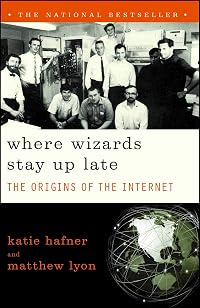
Where Wizards Stay Up Late: The Origins Of The Internet
by Katie Hafner (Author)  , Matthew Lyon (Author)
On This Page
Description
Twenty five years ago, it didn't exist. Today, twenty million people worldwide are surfing the Net. Where Wizards Stay Up Late is the exciting story of the pioneers responsible for creating the most talked about, most influential, and most far-reaching communications breakthrough since the invention of the telephone. In the 1960's, when computers where regarded as mere giant calculators, J.C.R. Licklider at MIT saw them as the ultimate communications devices. With Defense Department funds, show more he and a band of visionary computer whizzes began work on a nationwide, interlocking network of computers. Taking readers behind the scenes, Where Wizards Stay Up Late captures the hard work, genius, and happy accidents of their daring, stunningly successful venture. show lessTags
Recommendations




Member Reviews
This book is recognized as one of the seminal histories of the early Internet, and deservedly so. Starting with the origins of the Advanced Research Projects Agency (ARPA) in Eisenhower's Defense Department and walking through the Sixties and Seventies as the ARPANet is built, grows, and eventually dismantled. Interviews with many of the pioneers make this book as entertaining as it is informative.
"Where Wizards Stay Up Late" is focused on the engineers, academics and government bureaucrats that built the machines that connect together. It is less about the human connections built as the Internet grew.
I could go on, but if you have any interest in this topic, this book should be at the top of your list.
"Where Wizards Stay Up Late" is focused on the engineers, academics and government bureaucrats that built the machines that connect together. It is less about the human connections built as the Internet grew.
I could go on, but if you have any interest in this topic, this book should be at the top of your list.
Of all the books I’ve read so far this year, Where Wizards Stay up Late, a history of the development of the Internet, was the toughest to read. Not unpleasant like Twilight was, just very dense and sprawling. That sounds like a contradiction, but it wasn’t. The genesis came about from a congruence of computer theory, technological advances, government agencies, private sector research groups, universities, and programmers. The book tried to cover everything, and to its credit, it did. But in covering everything, there was lack of a common narrative thread. It was really more like a historical monograph than a work of popular fiction. This isn’t to say I didn’t like it; I did. But if I didn’t have a background in computer show more networking I would have given up on it very quickly. In other words, if I hadn’t been a nerd to begin with.
For more mainstream readers, the authors were careful to give real-world analogies for the concepts, such as how digital information – bits and bytes, zeroes and ones –"packaged" in a TCP/IP cargo container and sent off to its destination. Some of these analogies I remember from school. They worked then, and they still work, even though 22 years have passed since the book’s publication. I would have liked to see a sample of the source code, and though it wouldn't have told me anything because I'm not a coder, it would have helped me understand the complexity. The way coding was presented in the book was as a kind of magic, deliberately, going by the book's title.
Though I did wind up feeling edified at the end, I have to say I didn't exactly look forward to reading it each day. I could only digest it a half hour at a time. I had the feeling the authors were squeezing in every little thing they researched and didn't want to waste a bit of it. To my mind the book would have been readable if it were narrower in focus, like concentrating on the MIT/Boston crowd of developers, or the Pentagon/ARPA one, or the UCLA one. It was hard to keep all the managers, programmers, and debuggers straight. There were a lot of acronyms as well, not only the protocols but also names of businesses and college campuses. This also made the reading best in small doses. A glossary would have helped.
The book ended in 1994 and was published in 1996, a time when the Internet was shiny and new, so new that mass-market services like AOL and Compuserve (remember them?) weren't even mentioned. Neither were newsgroups, chats, or BBS forums. I'm guessed all that was outside the scope. The book’s final chapters were very innocent in how they presented the benefits of online connection. I remember that time in the mid-1990s, and indeed, it was very Utopian. But from a viewpoint of today, 2018, I can’t help feeling the technology has escaped from us somehow, to go on its own lurching, crunching rampage like a Frankenstein’s monster escaped from the lab.
And some of this, I found from reading, actually came from the personalities of the people who worked on it. In the late 1960s and early 1970s, computer science WAS a freewheeling, eccentric culture, valuing open communication and share of ideas, and casual approach to the exchange of those ideas. Which led, inevitably, to Flame Wars (remember those?) and Open Source. And actually a few times in the Internet’s history things could have developed more differently. For example, at one point AT&T might have purchased the proprietary code and technology. Or it might have never have been commercialized, which happened in 1991. It could have remained something only found on college campuses and large business.
I can’t rate the book too highly, because it was, as I’ve explained, too sprawling. But by god did it make me think. show less
For more mainstream readers, the authors were careful to give real-world analogies for the concepts, such as how digital information – bits and bytes, zeroes and ones –"packaged" in a TCP/IP cargo container and sent off to its destination. Some of these analogies I remember from school. They worked then, and they still work, even though 22 years have passed since the book’s publication. I would have liked to see a sample of the source code, and though it wouldn't have told me anything because I'm not a coder, it would have helped me understand the complexity. The way coding was presented in the book was as a kind of magic, deliberately, going by the book's title.
Though I did wind up feeling edified at the end, I have to say I didn't exactly look forward to reading it each day. I could only digest it a half hour at a time. I had the feeling the authors were squeezing in every little thing they researched and didn't want to waste a bit of it. To my mind the book would have been readable if it were narrower in focus, like concentrating on the MIT/Boston crowd of developers, or the Pentagon/ARPA one, or the UCLA one. It was hard to keep all the managers, programmers, and debuggers straight. There were a lot of acronyms as well, not only the protocols but also names of businesses and college campuses. This also made the reading best in small doses. A glossary would have helped.
The book ended in 1994 and was published in 1996, a time when the Internet was shiny and new, so new that mass-market services like AOL and Compuserve (remember them?) weren't even mentioned. Neither were newsgroups, chats, or BBS forums. I'm guessed all that was outside the scope. The book’s final chapters were very innocent in how they presented the benefits of online connection. I remember that time in the mid-1990s, and indeed, it was very Utopian. But from a viewpoint of today, 2018, I can’t help feeling the technology has escaped from us somehow, to go on its own lurching, crunching rampage like a Frankenstein’s monster escaped from the lab.
And some of this, I found from reading, actually came from the personalities of the people who worked on it. In the late 1960s and early 1970s, computer science WAS a freewheeling, eccentric culture, valuing open communication and share of ideas, and casual approach to the exchange of those ideas. Which led, inevitably, to Flame Wars (remember those?) and Open Source. And actually a few times in the Internet’s history things could have developed more differently. For example, at one point AT&T might have purchased the proprietary code and technology. Or it might have never have been commercialized, which happened in 1991. It could have remained something only found on college campuses and large business.
I can’t rate the book too highly, because it was, as I’ve explained, too sprawling. But by god did it make me think. show less
Not having had a proper introduction to the history of the internet and computing in general, this book was a fascinating look at how the Internet found its beginnings. Watching as the services many of us have come to know and love were slowly brought to life was actually fun. While certainly not riveting from cover to cover; it was informative and enjoyable.
Awesome history of the invention of Internet up to about 1989. It probably will appeal more to the engineer as it requires some level of conceptual background about the technology, but wow what a great story. I knew some of it in bits and pieces through legends passed around but having it in a chronological narrative everything now fits in place. Although this book was first published in 1996, I read it for the first time in 2014 almost 20 years later and it hasn't lost much, this is a classic history.
On a recent trip, I finally finished "Where Wizards Stay Up Late: The Origins of the Internet". Most times, I'll wade through historical nonfiction, and it seems unfamiliar, difficult to engage with. I've abandoned even well written books like "The Power Broker" and "Team of Rivals" because it just wasn't enjoyable to keep on reading. I may finally have discovered what I've been doing wrong. In short, read what you know. Although broadening your interests is a worthy goal, you have to build on your current knowledge and understanding and branch out from there. Case in point: This book deals with the history of the internet, email, telnet, FTP, chat, all topics near to my heart, and that made this book a great departure point for me.
Most show more of the technologies discussed in this book are so well established that their RFC (requests for coment) are commandments, well understood and inviolable. In this book, these RFCs are brought to life as the product of careful thought, ongoing and fierce debate, and even trial and error. In short, the technology we take for granted was crafted by sharp minds and strong personalities working through their differences and the inevitable technical hurdles. Most of us don't get to make this big a difference (connecting billions of people with each other), but their success should inspire us to try anyway.
Given how much I enjoyed this, I think it may finally be time to read up on the history of Computer Science a bit more, perhaps with a biography of Turing... show less
Most show more of the technologies discussed in this book are so well established that their RFC (requests for coment) are commandments, well understood and inviolable. In this book, these RFCs are brought to life as the product of careful thought, ongoing and fierce debate, and even trial and error. In short, the technology we take for granted was crafted by sharp minds and strong personalities working through their differences and the inevitable technical hurdles. Most of us don't get to make this big a difference (connecting billions of people with each other), but their success should inspire us to try anyway.
Given how much I enjoyed this, I think it may finally be time to read up on the history of Computer Science a bit more, perhaps with a biography of Turing... show less
Very good history on the men (yes, only men) and events behind the origins of what we now know as the Internet. As a network engineer myself, it was interesting to read about the guys who thought up the tools and protocols that I now work with every day.
we discussed this book in class tonight, and are moving on to other topics. I I think I'm going to need to come back to this book when I have a slower time to read it... I had to skim for the main points and didn't really get to dig in the way I might have wanted to. I do like that this was a character-driven portrayal of the start of the Internet. Which is easy to take for granted.
Members
- Recently Added By
Author Information

Katie Hafner has been writing about technology since 1983. She was the news editor of Data Communications Magazine, a reporter for the San Diego Union, a technology correspondent for Business Week and a contributing editor at Newsweek, covering technology and computers. In addition, she has contributed articles to journals such as Wired, The New show more Republic, Esquire and Working Woman. Hafner is co-author of Cyberpunk: Outlaws and Hackers on the Computer Frontier (1991, with John Markoff), and Where Wizards Stay Up Late: The Origins of the Internet (1996, with husband Matthew Lyon). In 1995, she wrote The House at the Bridge: A Story of Modern Germany, which grew out of an interest she developed in college while studying with novelist and playwright Rheinhard Lettau. (Bowker Author Biography) show less
Katie Hafner is a LibraryThing Author, an author who lists their personal library on LibraryThing.
Some Editions
Awards and Honors
Notable Lists
Common Knowledge
- Canonical title*
- ARPA Kadabra oder die Geschichte des Internet
- Original title
- Where wizards stay up late
- Original publication date
- 1996
- People/Characters
- Paul Baran; Ben Barker; Vint Cerf; Bernie Cosell; Dave Crocker; Steve Crocker (show all 19); Will Crowther; Donald Watts Davies; Dwight D. Eisenhower; Dave Farber; Frank Heart; Bob Kahn; Leonard Kleinrock; Joseph Carl Robnett Licklider; Alex McKenzie; Jon Postel; Larry Roberts; Bob Taylor; Dave Walden
- Important places
- Massachusetts Institute of Technology; Cambridge, Massachusetts, USA
- Original language*
- Anglais (Etats-Unis) (Etats-Unis)
*Some information comes from Common Knowledge in other languages. Click "Edit" for more information.
Classifications
- Genres
- Technology, History, Nonfiction, General Nonfiction, Science & Nature
- DDC/MDS
- 004.67 — Computer science, information & general works Computer science, knowledge & systems Computer science Interfacing and communications (including networking) Wide-Area Networks
- LCC
- TK5105.875 .I57 .H338 — Technology Electrical engineering. Electronics. Nuclear engineering Electrical engineering. Electronics. Nuclear Telecommunication
- BISAC
Statistics
- Members
- 1,427
- Popularity
- 16,465
- Reviews
- 17
- Rating
- (3.94)
- Languages
- 5 — Chinese, English, French, German, Italian
- Media
- Paper, Audiobook, Ebook
- ISBNs
- 13
- ASINs
- 9
