Lesser Hippias
by Plato, Richard Fletcher (Editor), Karen Marta (Editor), Sarah Ruden (Translator)
On This Page
Description
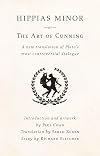
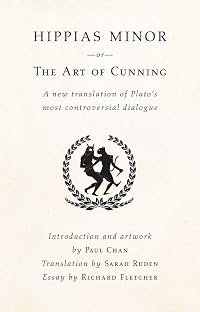
One of Plato's most controversial dialogues, Hippias Minor details Socrates' claims that there is no difference between a person who tells the truth and one who lies, and that the good man is the one who willingly makes mistakes and does wrong. But what if Socrates wasn't merely championing the act of lying--as the dialogue has been traditionally interpreted--but, rather, advocating the power of the creative act? In this new translation by Sarah Ruden, Hippias Minor is rendered anew as a show more provocative dialogue about how art is a form of wrongdoing. The accompanying introduction by artist Paul Chan and essay by classicist Richard Fletcher argue that an understanding of the dialogue makes life more ethical by paradoxically teaching one to be more cunning. show lessTags
Recommendations









Member Reviews
But it's my constant habit, whenever anybody states anything, to apply my mind, especially whenever the speaker seems to me to be intelligent. And since I'm eager to learn what he means, I question him searchingly and backtrack in my ponderings and see whether what's been said is consistent, so that I can learn. But if the speaker seems to me to be useless, I don't ask those persistent questions, and I don't care what he says. And you'll know by this which people I consider to be intelligent. You'll find me, in fact, relentless about what such a man says, questioning him in order to learn something that will be helpful to me.
Not extraordinary.
Worth a skip.
Worth a skip.
Ratings
Members
- Recently Added By
Author Information

2,731+ Works 100,710 Members
Plato was born c. 427 B.C. in Athens, Greece, to an aristocratic family very much involved in political government. Pericles, famous ruler of Athens during its golden age, was Plato's stepfather. Plato was well educated and studied under Socrates, with whom he developed a close friendship. When Socrates was publically executed in 399 B.C., Plato show more finally distanced himself from a career in Athenian politics, instead becoming one of the greatest philosophers of Western civilization. Plato extended Socrates's inquiries to his students, one of the most famous being Aristotle. Plato's The Republic is an enduring work, discussing justice, the importance of education, and the qualities needed for rulers to succeed. Plato felt governors must be philosophers so they may govern wisely and effectively. Plato founded the Academy, an educational institution dedicated to pursuing philosophic truth. The Academy lasted well into the 6th century A.D., and is the model for all western universities. Its formation is along the lines Plato laid out in The Republic. Many of Plato's essays and writings survive to this day. Plato died in 347 B.C. at the age of 80. (Bowker Author Biography) show less


Sarah Ruden was educated at the University of Michigan, Johns Hopkins, and Harvard. She has translated five books of classical literature, among them The Aeneid, and is the author of Other Places, a book of poetry. She is a visiting Scholar at Wesleyan University in Middletown, Connecticut, where she lives.
Some Editions
Work Relationships
Is contained in
Platon. Sämtliche Werke Bd. 1: Apologie des Sokrates, Kriton, Ion, Hippias II, Theages, Alkibiades I, Laches, Charmides, Euthyphron, Protagoras, Gorgias, Menon, Hippias I, Euthydemos, Menexenos. Übers. v. Friedrich Schleiermacher. by Plato
Diálogos I by Platón
Common Knowledge
- Canonical title*
- Hippias minor
- Alternate titles
- Hippias Minor
- Original publication date
- c. 400 B.C.
*Some information comes from Common Knowledge in other languages. Click "Edit" for more information.
Classifications
- Genres
- Philosophy, Nonfiction
- DDC/MDS
- 121.68 — Philosophy & psychology Epistemology (how do you know what you know?) Epistemology (Theory of knowledge) Belief Meaning, interpretation, hermeneutics
- LCC
- PA4279 .P718 — Language and Literature Greek language and literature. Latin language and literature Greek literature Individual authors Plato
- BISAC
Statistics
- Members
- 55
- Popularity
- 555,349
- Reviews
- 2
- Rating
- (3.17)
- Languages
- English, Finnish, Spanish
- Media
- Paper, Ebook
- ISBNs
- 9
- ASINs
- 4