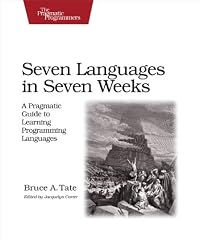
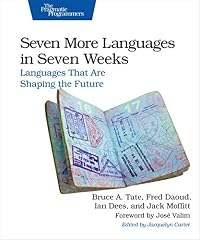
Seven Languages in Seven Weeks: A Pragmatic Guide to Learning Programming Languages
by Bruce A. Tate
On This Page
Description
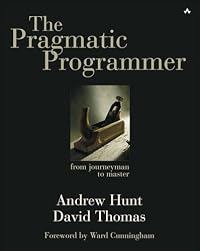
You should learn a programming language every year, as recommended by The Pragmatic Programmer . But if one per year is good, how about Seven Languages in Seven Weeks ? In this book you'll get a hands-on tour of Clojure, Haskell, Io, Prolog, Scala, Erlang, and Ruby. Whether or not your favorite language is on that list, you'll broaden your perspective of programming by examining these languages side-by-side. You'll learn something new from each, and best of all, you'll learn how to learn a show more language quickly. show lessTags
Recommendations
Member Reviews
Instead of seven weeks, it took me about two years. I would read a chapter on one language and do the exercises, then get distracted by other things and not come back to it for several months. I finally forced myself to run through the final three languages during my Christmas vacation since I was sick and didn't want to leave the house.
Overall, this is an excellent book that will expose you to different ways of thinking as a programmer. I enjoyed all seven languages and I plan to dive deeper with a couple of them (Erlang and Clojure). Tate does a good job of balancing breadth and depth with each language and really gets to the core of what makes each language unique, and points out the strengths and weaknesses of each. My one complaint show more is with the final section of the final language in which he covers "monads" in the Haskell language. He points out at the beginning of that section that he dreaded writing about such a difficult concept, and unfortunately, I don't think he succeeded in explaining it very well. But that remains the only flaw in this book in my opinion. I think it is well worth the time of any serious programmer to read through this book, whether it takes seven weeks or seven years. show less
Overall, this is an excellent book that will expose you to different ways of thinking as a programmer. I enjoyed all seven languages and I plan to dive deeper with a couple of them (Erlang and Clojure). Tate does a good job of balancing breadth and depth with each language and really gets to the core of what makes each language unique, and points out the strengths and weaknesses of each. My one complaint show more is with the final section of the final language in which he covers "monads" in the Haskell language. He points out at the beginning of that section that he dreaded writing about such a difficult concept, and unfortunately, I don't think he succeeded in explaining it very well. But that remains the only flaw in this book in my opinion. I think it is well worth the time of any serious programmer to read through this book, whether it takes seven weeks or seven years. show less
An excellent survey course on a variety of programming languages and concepts. Don't expect to become more than conversant with the ideas in a particular language after reading about it here, though- three days a pop doesn't get you the ability to Get Stuff Done. Instead, you'll get the most out of this book if you treat it one or both of two ways:
1) A buffet of samples: try a bit of each language and see if any intrigue you enough to dive in further. I bought a copy of Clojure Programming after reading the Clojure chapter.
2) Mind-expansion: focus on the new ideas introduced by the languages rather than the languages themselves- what problems are solved by pattern matching, immutable state, actors, etc? I'd particularly recommend this show more if you're a professional who's only worked with one or two languages in anger, particularly Java or C# type languages. show less
1) A buffet of samples: try a bit of each language and see if any intrigue you enough to dive in further. I bought a copy of Clojure Programming after reading the Clojure chapter.
2) Mind-expansion: focus on the new ideas introduced by the languages rather than the languages themselves- what problems are solved by pattern matching, immutable state, actors, etc? I'd particularly recommend this show more if you're a professional who's only worked with one or two languages in anger, particularly Java or C# type languages. show less
So I skipped the chapters on IO and Ruby. I already read a book on Ruby and after working through Haskell, Clojure, Prolog, Erlang, and Scala, I was wiped out mentally. Very good introduction to these languages. I can ee myself continuing with Clojure and Scala. Haskell seems like far too much of a commitment to learn, though I would like to understand monads more. This book obviously didn't dive deep enough into any language, but that's where language specific books come into play. It's a good taste of multiple programming paradigms that I wasn't exposed to in my procedural language job.
A great introduction to different languages. I would have rather seen JavaScript than Io but oh well. At the end I felt like the whole book was a lead up to showing Clojure and Haskell. For once I wasn't completely intimidated when I went to try some Haskell out. I like the functional concepts and would be interested in looking further into Erlang, Clojure (Because of it's JVM and CLR support) and Haskell.
An unusually in-depth overview of seven programming languages representing seven different programming models. It turned me on to Clojure, a lisp built on top of the JVM, something that will fit well in my toolbox.
Nice book to get a quick insight into 7 very different programming languages. You may also skim it an jump directly to the "wrap up" ending chapters to get an overview of each language.
computers, programming, computer languages, Ruby, Prolog, Scala, Erlang, Clojure, Haskell
Members
- Recently Added By
Author Information
15+ Works 1,110 Members
Bruce Tate has 14 years' experience at IBM and at a startup, half of this time as an Internet architect. He is the author of two other computer books and he lives in Austin, Texas
Series
Belongs to Publisher Series
Common Knowledge
- Canonical title
- Seven Languages in Seven Weeks: A Pragmatic Guide to Learning Programming Languages
- Quotations
- As we spent our last week together, person after person would come through her room devastated at the thought of losing their teacher, but Mom would tell the perfect joke or offer the right word of kindness, comforting those ... (show all)who came to comfort her. I got to meet the human canvases who had been put right by the master and gone on to do great things.
. . . every new language can shape the way you think.
Classifications
- Genres
- Technology, Nonfiction, General Nonfiction
- DDC/MDS
- 005.13 — Computer science, information & general works Computer science, knowledge & systems Software development, software, data, security Software development Computer programming
- LCC
- QA76.7 .T38 — Science Mathematics Mathematics Instruments and machines Calculating machines Electronic computers. Computer science
- BISAC
Statistics
- Members
- 390
- Popularity
- 79,501
- Reviews
- 7
- Rating
- (3.96)
- Languages
- English, German
- Media
- Paper, Ebook
- ISBNs
- 7
- ASINs
- 4