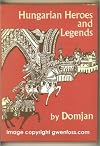
Hungarian Heroes and Legends
by Joseph Domjan
On This Page
Tags
Member Reviews
Beginning with the legendary King Nimrod (Nimrud), Joseph Domjan tells the story of the Hungarian people, from ancient times to the then present-day (this was first released in Hungarian in 1957, and then revised and reprinted in a 1963 English edition) in Hungarian Heroes and Legends, working in both folklore and fact, and addressing himself to political, as well as cultural achievements. The legend of the miraculous Stag which led Nimrod's sons, Hunor and Magor westward (also retold by Kate Seredy in her Newbery Medal-winning children's novel, The White Stag), the founding of the Hungarian nation by Árpád, King of the Magyars (descendants of Magor), and the christianization of the people by King St. István (Stephen I), are all show more discussed.
Medieval monarchs, such as: Queen Gisella (wife of István), who created the sumptuous robe that would be used in subsequent Hungarian coronations; King St. László (Ladislaus I), the subject of many legends; King Kálmán the Learned and his code of law; King Béla III, who expanded Hungarian territory; and King Endre II, who signed the Golden Bulla (a legal document similar to the Magna Carta) confirming the rights of Hungary's nobles; are all given a page or two in Domjan's book, accompanied by the author/artist's beautiful woodcut illustrations. The Tartar invasion and occupation; the deeds of saints (such as St. Erzsébet, or Elizabeth, and St. Margit); the building of great structures, like the Church of Ják; the Dozsa, or Peasant Uprising; the incorporation of Hungary into the Austro-Hungarian Empire; and the Revolution of 1848, are all included as well.
The second half of the book concentrates on Hungarians in America, particularly the role of Hungarian officers in the Civil War, and on the cultural achievements of the Hungarian people, in literature, music, and visual arts. Great poets like Sándor Petőfi, and composers like Ferenc Liszt and Béla Bartók, are mentioned (as is Zoltán Kodály, whose Háry János Suite is one of my favorite pieces of music!). Given the importance of the name "Kossuth" in the Hungarian tradition, I found myself wondering if American conceptual artist Joseph Kosuth (whose work I find intriguing) is also of Hungarian ancestry. He's not mentioned by Domjan, of course, but he was just an art student at the time this was being published.
I learned a great deal about Hungarian history and culture from this book, and also greatly enjoyed the woodcut artwork. I might have rated in higher, in fact, were it not for my frustration at its limitations. It's important to remember that this is is a folk history, and like other such works - Seumas MacManus' The Story of the Irish Race: A Popular History of Ireland, which begins its narrative with the stuff of Irish epic, for instance - it includes quite a bit of unverifiable material in its early chapters. This isn't necessarily a bad thing, as long as the reader keeps the fact that it is a mytho-historical account in mind.
What is less easy to overlook, unfortunately, is the uncritical nationalism that seems to color many such accounts. I understand that Domjan is trying to pen a tribute to his people here, and I sympathize, to a certain extent. But I also found myself getting impatient with his narrative, which seemed to glide by anything that was less than admirable. The loss of Hungarian territory and sovereignty, whether to the the Turks or the Austrians, is portrayed as tragic, but Hungarian conquest of new lands (whether Hungary proper, by the incoming Magyars, or the contested Transylvania) is accepted without question. The Hungarian choice to ally themselves with the West is portrayed as heroic - a blow for "civilization," as opposed (one presumes) to the barbarity of the East. "István sided with Western Christianity and civilization," writes Domjan, an irony, considering the ancestral homeland of the Magyars.
No real discussion of the negative impact of monarchy and christianization - the concentration of land ownership, and the impoverishment of much of the Magyar population - occurs. Nor, I am sorry to say, does Domjan devote any time to Hungary's behavior during the second world war, perhaps because he knew there was nothing positive to be said for it. Given his insistence on seeing Hungarian history as one long heroic struggle for freedom and civilization, however, these omissions are rather telling. Of course, with a title like Hungarian Heroes and Legends, one should be prepared for a heroic narrative, and by and large, I was satisfied with what I got. I found much of the information presented here, irregardless of the flaws in the presentation itself, absolutely fascinating! Now, to find a "real" history of Hungary... show less
Medieval monarchs, such as: Queen Gisella (wife of István), who created the sumptuous robe that would be used in subsequent Hungarian coronations; King St. László (Ladislaus I), the subject of many legends; King Kálmán the Learned and his code of law; King Béla III, who expanded Hungarian territory; and King Endre II, who signed the Golden Bulla (a legal document similar to the Magna Carta) confirming the rights of Hungary's nobles; are all given a page or two in Domjan's book, accompanied by the author/artist's beautiful woodcut illustrations. The Tartar invasion and occupation; the deeds of saints (such as St. Erzsébet, or Elizabeth, and St. Margit); the building of great structures, like the Church of Ják; the Dozsa, or Peasant Uprising; the incorporation of Hungary into the Austro-Hungarian Empire; and the Revolution of 1848, are all included as well.
The second half of the book concentrates on Hungarians in America, particularly the role of Hungarian officers in the Civil War, and on the cultural achievements of the Hungarian people, in literature, music, and visual arts. Great poets like Sándor Petőfi, and composers like Ferenc Liszt and Béla Bartók, are mentioned (as is Zoltán Kodály, whose Háry János Suite is one of my favorite pieces of music!). Given the importance of the name "Kossuth" in the Hungarian tradition, I found myself wondering if American conceptual artist Joseph Kosuth (whose work I find intriguing) is also of Hungarian ancestry. He's not mentioned by Domjan, of course, but he was just an art student at the time this was being published.
I learned a great deal about Hungarian history and culture from this book, and also greatly enjoyed the woodcut artwork. I might have rated in higher, in fact, were it not for my frustration at its limitations. It's important to remember that this is is a folk history, and like other such works - Seumas MacManus' The Story of the Irish Race: A Popular History of Ireland, which begins its narrative with the stuff of Irish epic, for instance - it includes quite a bit of unverifiable material in its early chapters. This isn't necessarily a bad thing, as long as the reader keeps the fact that it is a mytho-historical account in mind.
What is less easy to overlook, unfortunately, is the uncritical nationalism that seems to color many such accounts. I understand that Domjan is trying to pen a tribute to his people here, and I sympathize, to a certain extent. But I also found myself getting impatient with his narrative, which seemed to glide by anything that was less than admirable. The loss of Hungarian territory and sovereignty, whether to the the Turks or the Austrians, is portrayed as tragic, but Hungarian conquest of new lands (whether Hungary proper, by the incoming Magyars, or the contested Transylvania) is accepted without question. The Hungarian choice to ally themselves with the West is portrayed as heroic - a blow for "civilization," as opposed (one presumes) to the barbarity of the East. "István sided with Western Christianity and civilization," writes Domjan, an irony, considering the ancestral homeland of the Magyars.
No real discussion of the negative impact of monarchy and christianization - the concentration of land ownership, and the impoverishment of much of the Magyar population - occurs. Nor, I am sorry to say, does Domjan devote any time to Hungary's behavior during the second world war, perhaps because he knew there was nothing positive to be said for it. Given his insistence on seeing Hungarian history as one long heroic struggle for freedom and civilization, however, these omissions are rather telling. Of course, with a title like Hungarian Heroes and Legends, one should be prepared for a heroic narrative, and by and large, I was satisfied with what I got. I found much of the information presented here, irregardless of the flaws in the presentation itself, absolutely fascinating! Now, to find a "real" history of Hungary... show less
Members
- Recently Added By
Lists

A Child's Book Tour of Hungary
29 works; 2 members
Author Information
13 Works 55 Members
Classifications
- Genres
- Nonfiction, History
- DDC/MDS
- 943.9 — History & geography History of Europe Central Europe: Germany, Austria, Switzerland, Czech, Poland, Hungary Hungary
- LCC
- DB925.3 .D613 — History of Europe, Asia, Africa and Oceania Austria – Liechtenstein – Hungary – Czechoslovakia History of Austria. Liechtenstein. Hungary. Czechoslovakia Hungary History
Statistics
- Members
- 5
- Popularity
- 3,437,128
- Reviews
- 1
- Rating
- (3.00)
- Media
- Paper
- ASINs
- 2