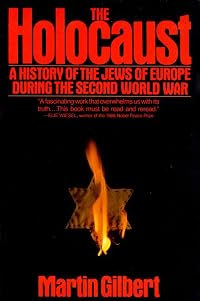
The Holocaust: A History of the Jews of Europe During the Second World War
by Martin Gilbert
On This Page
Description
Rich with eye-witness accounts, incisive interviews, and first-hand source materials including documentation from the Eichmann and Nuremberg war crime trials, master historian Martin Gilbert weaves a detailed, immediate account of the Holocaust from Hitler's rise to power to the final defeat of the Nazis in 1945. This sweeping narrative begins with an in-depth historical analysis of the origins of anti-Semitism in Europe, and tracks the systematic brutality of Hitler's "Final show more Solution" in unflinching detail. It brings to light new source materials documenting M show lessTags
Recommendations

























Member Reviews
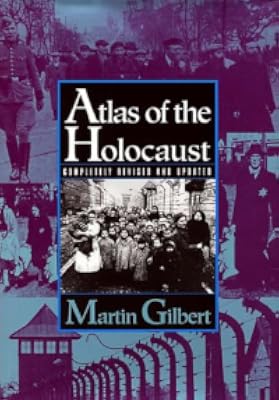
Very well-written account of the Nazi regime and the cultures and peoples they devastated. This book is very informative; I'd never read a Holocaust atlas before, and after seeing the many different types of information presented, I don't know why books like this aren't more common. I could see specific figures and statistics by country; I saw maps showing the locations of camps, ghettos, and uprisings; some maps showed the journeys of specific people, e.g. Anne Frank and Kitty Hart; some maps showed the popular routes followed by thousands trying to escape persecution. There were also many many photographs, sobering and horrifying. Everyone should read this book.
This is a tour-de-force of history. Martin Gilbert had an ambitious project -- cover the whole Holocaust from the pre-Hitler days to after the war, all over Europe -- but he was able to accomplish his ends without either glossing over anything or making it too long. I was dizzied by the number of sources he quoted. The guy really knows how to write, too, and put his sources together into one coherent narrative.
Two caveats: Gilbert transliterates proper names strangely. For example, Tuvia Bielsky is called "Tobias Belsky." Also, the book was written over 25 years ago and is a little dated as a result; a lot of research has been done since then. I wish he'd put out a second edition. In the meantime, Martin Gilbert is my new superhero.
Two caveats: Gilbert transliterates proper names strangely. For example, Tuvia Bielsky is called "Tobias Belsky." Also, the book was written over 25 years ago and is a little dated as a result; a lot of research has been done since then. I wish he'd put out a second edition. In the meantime, Martin Gilbert is my new superhero.
This is not a book you will enjoy reading, but its a must-read nevertheless. This is a relentless pounding with figures, page after page of number, each number representing a human life lost in the worst crime of the 20th century if not all history. Individual names appear and then disappear, the fate of every Jew from even the most obscure villages all over Europe recounted in calm emotionleess tones. This is not a book screaming with anger or seeking revenge, it is a book for proving, with slow relentless logic, that this unspeakable crime actually happened. As I said this is not a book you will enjoy, it will make you squirm, it will make you weep, it will make you boil with rage, but you will remember. That's its purpose and it show more achieves it admirably show less
I read every word of this exquisitely painful book, a testament without parallel. What a work of history, of documentation, of witness. To present this overwhelming human tragedy, in such detail--I do not really have words to describe how it has affected me, nor how grateful I am for it. Please, everyone, read it.
I feel callous giving this book only 3.5 stars, but I attribute this to it not being what I expected. What I was hoping for was something akin to Anne Applebaum's Gulag: a one-volume history of what happened, how it happened, why it happened, and how it was dealt with when it was over. This book is certainly not that.
Instead, Gilbert has taken an enormous amount of first-hand experiences and arranged them chronologically to tell an almost day-by-day account of the unfathomable brutality experienced by European Jewry. To weave this all together in such a way is masterful, but it only tells a part of the story. I assume that was his goal, but it leaves me wanting more.
Every paragraph has some episode that is unforgettable. It easy to show more lose sight of the fact that the 6 million murders took place, as Judith Miller says, "one by one by one." This book makes sure you'll never think of the Holocaust that way again. What Gilbert neglects to cover in much detail is the Nazi part of the story. Of course they are front and center as the perpetrators, but little is covered about what ordinary Germans knew. Or how the German culture was ripe ground for this evil to blossom. Or what the millions of valuables stolen were used for. Or how the manpower and resources expended in this psychopathic venture affected the overall war effort. Or what role, outside of Eichmann, those at the top of the Nazi command played. Again, Gilbert obviously wasn't trying to tell that part of the story, but I still can't say I have a true understanding of the Holocaust beside the unbelievable cruelty so many suffered.
And, this makes me angry at myself, at 828 pages, after a while, you become numb to it all. I stopped being shocked by what I read. I think this is unfortunate, but natural. A topic like this is so ghastly that, the further we get from WWII, the less people will know about it. In our comfortable American lives, people don't want to remember these awful events of the past. It's why, in my opinion, the moral component of American foreign policy is under attack. If Saddam Hussein was committing mass murder in 1958 I cannot believe there would have been any meaningful debate in the US about our responsibility to remove him and end the genocide. In 2008, after hundreds of thousands have been discovered in mass graves in Iraq, it's a story we never heard about, and think about even less.
Two quotes sum it all up for the book: one tells the utter desperation of an entire culture, the other the unyielding faith that so many held until the very end:
There is no strength left to cry, steady and continued weeping leads finally to silence. At first there is screaming; then wailing; and at last a bottomless sigh that does not leave even an echo. - Chaim Kaplan, p. 105
I have seen them, the dregs of human misery, and I know that through mankind flows a stream of eternity greater and more powerful than individual deaths. - Lena Berg, p. 622 show less
Instead, Gilbert has taken an enormous amount of first-hand experiences and arranged them chronologically to tell an almost day-by-day account of the unfathomable brutality experienced by European Jewry. To weave this all together in such a way is masterful, but it only tells a part of the story. I assume that was his goal, but it leaves me wanting more.
Every paragraph has some episode that is unforgettable. It easy to show more lose sight of the fact that the 6 million murders took place, as Judith Miller says, "one by one by one." This book makes sure you'll never think of the Holocaust that way again. What Gilbert neglects to cover in much detail is the Nazi part of the story. Of course they are front and center as the perpetrators, but little is covered about what ordinary Germans knew. Or how the German culture was ripe ground for this evil to blossom. Or what the millions of valuables stolen were used for. Or how the manpower and resources expended in this psychopathic venture affected the overall war effort. Or what role, outside of Eichmann, those at the top of the Nazi command played. Again, Gilbert obviously wasn't trying to tell that part of the story, but I still can't say I have a true understanding of the Holocaust beside the unbelievable cruelty so many suffered.
And, this makes me angry at myself, at 828 pages, after a while, you become numb to it all. I stopped being shocked by what I read. I think this is unfortunate, but natural. A topic like this is so ghastly that, the further we get from WWII, the less people will know about it. In our comfortable American lives, people don't want to remember these awful events of the past. It's why, in my opinion, the moral component of American foreign policy is under attack. If Saddam Hussein was committing mass murder in 1958 I cannot believe there would have been any meaningful debate in the US about our responsibility to remove him and end the genocide. In 2008, after hundreds of thousands have been discovered in mass graves in Iraq, it's a story we never heard about, and think about even less.
Two quotes sum it all up for the book: one tells the utter desperation of an entire culture, the other the unyielding faith that so many held until the very end:
There is no strength left to cry, steady and continued weeping leads finally to silence. At first there is screaming; then wailing; and at last a bottomless sigh that does not leave even an echo. - Chaim Kaplan, p. 105
I have seen them, the dregs of human misery, and I know that through mankind flows a stream of eternity greater and more powerful than individual deaths. - Lena Berg, p. 622 show less
I find this work a good reference book when reading other books about the holocaust, because events and people appear chronologically, and the author refrains from analysis. Read as a whole, the accumulation of facts show how raw and incomprehensibly cruel it all was, and yet how true.
This is an excellent book and very well researched, an in depth study of the Holocaust.
Members
- Recently Added By
Published Reviews
ThingScore 100
This book must be read and reread. It will be painful to you, but you must read it anyway. To know? No. To understand? No, not that either. But simply to remember all those whom the world, once upon a time, tried to forget.
added by ArrowStead
It is [the victims'] testimonies, culled from archives in many countries, from personal interviews and from an enormous literature in several languages, that give this book its immediacy and overwhelming impact....It is Mr. Gilbert's impressive achievement to remind us of ordinary human beings living and suffering behind the mass anonymity of statistics...
added by ArrowStead
An impressive achievement of reconstructing the details of the darkest, as well as the most elusive event in modern Jewish history.
added by ArrowStead
Lists

501 Must-Read Books
529 works; 72 members

All Things Germany
321 works; 4 members

r/History Recommended Reading List
603 works; 12 members

r/AskHistorians' Recommended Books
1,068 works; 19 members

The Burned Letter Book List
56 works; 1 member
Author Information

190+ Works 16,735 Members
Martin Gilbert was born in London, England on October 25, 1936. He was sent to Canada during World War II, but returned on a liner bringing American troops to Britain in preparation for D-day. After national service in the intelligence corps, he was educated at Magdalen College at Oxford. He graduated from Oxford in 1960 and wrote his first book show more entitled The Appeasers. In 1961, after a year of research and writing, he was asked to join a team of researchers working for Winston Churchill. At the age of 25, he was formally inducted into the team, doing all of his own research. Gilbert became known as Churchill's official biographer, but he also wrote books on the Holocaust, the first and second world wars, and Jewish history. During his lifetime, he wrote over 80 books including Winston Churchill, Auschwitz and the Allies, The Holocaust: The Jewish Tragedy, The Jews of Hope: The Plight of Soviet Jewry Today, Shcharansky: Hero of Our Time, Letters to Auntie Fori: The 5,000-Year History of the Jewish People and Their Faith, and In Search of Churchill. He died after a long illness on February 3, 2015 at the age of 78. (Bowker Author Biography) show less
Awards and Honors
Notable Lists
Common Knowledge
- Alternate titles
- The Holocaust: A History of the Jews of Europe During the Second World War (USA) (USA)
- Original publication date
- 1985
- Important events
- Holocaust
- Dedication
- Dedicated to Professor Alexander Lerner, two of whose daughters, aged five and three, were killed by the Nazis in 1941, and whose own sixteen-year struggle to leave the Soviet Union for Israel is now successfully concluded.
- First words
- [Preface] In the late summer of 1959, accompanied by a Polish friend, a non-Jew, I travelled by car to the River Bug near Malkinia junction, on the Warsaw-Leningrad railway.
For many centuries, primitive Christian Europe had regarded the Jew as the 'Christ-killer': an enemy and a threat to be converted and so be 'saved', or to be killed; to be expelled, or to be put to death with sword and fire. - Last words
- (Click to show. Warning: May contain spoilers.)Simply to survive was a victory of the human spirit.
- Canonical DDC/MDS
- 940.531503924
Classifications
- Genres
- History, Nonfiction, General Nonfiction, Religion & Spirituality
- DDC/MDS
- 940.531503924 — History & geography History of Europe History of Europe 1918- World War II, 1939-1945 Social, political, economic history; Holocaust
- LCC
- D810 .J4 .G522 — History of Europe, Asia, Africa and Oceania History (General) World War II (1939-1945)
- BISAC
Statistics
- Members
- 1,113
- Popularity
- 22,839
- Reviews
- 12
- Rating
- (4.33)
- Languages
- Dutch, English, Portuguese
- Media
- Paper, Ebook
- ISBNs
- 16
- ASINs
- 12