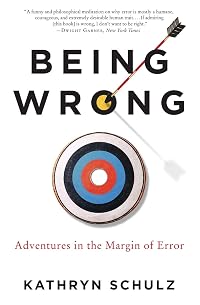
Being Wrong: Adventures in the Margin of Error
by Kathryn Schulz
On This Page
Description
Journalist "explores why we find it so gratifying to be right and so maddening to be mistaken, and how this attitude toward error corrodes relationships." She claims that "error is both a given and a gift -- one that can transform our worldviews, our relationships, and, most profoundly, ourselves."Tags
Recommendations




Member Reviews
I may be wrong about this, but Being Wrong is a very good book. Kathryn Schulz uses personal stories from a variety of sources, such as a wrongfully identified criminal, people losing their religion, and more trivial instances of mistakes, to explain just what is so humiliating about being wrong, and why it is so darn satisfying to be right. And she does all this with a consistently conversational tone, friendly and funny but not too funny when the more serious stories are being told.
In addition to intriguing stories, Schulz provides a very good potted introduction to philosophy by quoting from many major philosophers to illustrate the varying perspectives on "wrongness" and error. Most people nowadays would probably consider error to show more be something humiliating, that doesn't happen very often. But it does, all the time. Schulz argues that, where possible, we should try to see the positive side of error. It can stimulate creativity, broaden the mind or even change our lives for the better. show less
In addition to intriguing stories, Schulz provides a very good potted introduction to philosophy by quoting from many major philosophers to illustrate the varying perspectives on "wrongness" and error. Most people nowadays would probably consider error to show more be something humiliating, that doesn't happen very often. But it does, all the time. Schulz argues that, where possible, we should try to see the positive side of error. It can stimulate creativity, broaden the mind or even change our lives for the better. show less
This book is an exploration of what the author calls "Wrongology": the ways in which we get things wrong, how we feel when realize we were mistaken, how we deal (or fail to deal) with our mistakes, and how we might benefit from accepting or even embracing our own capacity for error.
I've read a number of books on similar subjects, but this one has a somewhat different feel to it. It's less focused on psychological experiments and the exact ways in which our neurons misrepresent the world or our minds leap to irrational conclusions (although there is some of that), but instead takes a somewhat more philosophical tone. Schulz does still keep things fairly well grounded, though, in part by including detailed and interesting examples of show more people being wrong in various ways. It's also very engagingly written, with wit, intelligence, and heart. Definitely worth a look for, well, anybody who's ever been wrong about anything. show less
I've read a number of books on similar subjects, but this one has a somewhat different feel to it. It's less focused on psychological experiments and the exact ways in which our neurons misrepresent the world or our minds leap to irrational conclusions (although there is some of that), but instead takes a somewhat more philosophical tone. Schulz does still keep things fairly well grounded, though, in part by including detailed and interesting examples of show more people being wrong in various ways. It's also very engagingly written, with wit, intelligence, and heart. Definitely worth a look for, well, anybody who's ever been wrong about anything. show less
I just finished Chapter 1 and already I am finding things wrong!
That sounded more dramatic than I intended because I also am really enjoying this book. It begins with the notion that no one ever believes they are wrong about anything. This presumes that there is no such thing as inner conflict, or, in the current parlance, that we aren't made up of "parts."
The concept of parts has been a staple of psychodrama, gestalt therapy, IFS (Internal Family Systems), Focusing, and likely several other models of the self. It allows one part of us to believe something true while another part doubts it or believes it false. I, your reviewer, am often insecure about many of my beliefs. That is, I am not confident in their rightness. (One belief I show more have, though, is that confidence isn't necessarily a good thing.) I have encounted others who fit Ms Schultz's premise in that they are always sure they are right and I try and steer clear of them.
Furthermore, as a blitz chess player, I am quite often confronted with a move whose rightness I believed in moments before immediately countered with a demonstration of its shortcomings (and have had the pleasure of giving that experience to my opponents).
Chapter one quotes John Updike's observation on writing book reviews; it is “almost impossible to…avoid the tone of being wonderfully right.” In so far as I have failed in this regard, let me admit in advance to being wrong so as to therefore be less so.
. . .
I had forgotten I was reading this book until I came across the partially written review above. I decided to start it up again (I'm now about 25% into it) It wasn't long before I found something else wrong. She discusses the Sally-Anne test and "Theory of Mind" and says that autistics lack it. Suspicious, I googled and discovered this is a commonly believed myth lacking empirical evidence. Perhaps less controversial is the author's description of 26 out of 525 (women at Harvard Law in 1967) as "just over 5 percent," when google calculates it as just UNDER 5%. Still, I'm enjoying reading this book. At the moment, I want to give it 5 stars despite its errors.
I'm now about 2/3 through the book and, of course, I've found other "errors" (which I put in quotes because they are more differing perspectives in which I have a preference for my own (which I believe better because it explains, or even CONTAINS theirs). The most recent is the characterization of one's self as having separate parts as "just a metaphor" whereas I think of all conceptualization as metaphoric and that dismissing metaphor is the delusion that there's anything non-metaphoric in our conceptual understandings.
It turns out I was WRONG about the 2/3 throughness because almost a third of the book is footnotes, references, and sources. This is an important feature in a book on wrongness though I won't be reading that part.
This book made me wonder if there is a graininess to thought--that it is composed of discreet quanta each of which is sure its right. We would be digital then, every idea a 1 or 0. Shades of gray would then always be a matter of parts which never actually mix but argue forever with their opposite halves. Maybe maintaining such a balance acts as a hedge against wrongness, but (on the other hand) can also be seen as a refusal to take a stand, a fear of risk leading to a depressive standoff. show less
That sounded more dramatic than I intended because I also am really enjoying this book. It begins with the notion that no one ever believes they are wrong about anything. This presumes that there is no such thing as inner conflict, or, in the current parlance, that we aren't made up of "parts."
The concept of parts has been a staple of psychodrama, gestalt therapy, IFS (Internal Family Systems), Focusing, and likely several other models of the self. It allows one part of us to believe something true while another part doubts it or believes it false. I, your reviewer, am often insecure about many of my beliefs. That is, I am not confident in their rightness. (One belief I show more have, though, is that confidence isn't necessarily a good thing.) I have encounted others who fit Ms Schultz's premise in that they are always sure they are right and I try and steer clear of them.
Furthermore, as a blitz chess player, I am quite often confronted with a move whose rightness I believed in moments before immediately countered with a demonstration of its shortcomings (and have had the pleasure of giving that experience to my opponents).
Chapter one quotes John Updike's observation on writing book reviews; it is “almost impossible to…avoid the tone of being wonderfully right.” In so far as I have failed in this regard, let me admit in advance to being wrong so as to therefore be less so.
. . .
I had forgotten I was reading this book until I came across the partially written review above. I decided to start it up again (I'm now about 25% into it) It wasn't long before I found something else wrong. She discusses the Sally-Anne test and "Theory of Mind" and says that autistics lack it. Suspicious, I googled and discovered this is a commonly believed myth lacking empirical evidence. Perhaps less controversial is the author's description of 26 out of 525 (women at Harvard Law in 1967) as "just over 5 percent," when google calculates it as just UNDER 5%. Still, I'm enjoying reading this book. At the moment, I want to give it 5 stars despite its errors.
I'm now about 2/3 through the book and, of course, I've found other "errors" (which I put in quotes because they are more differing perspectives in which I have a preference for my own (which I believe better because it explains, or even CONTAINS theirs). The most recent is the characterization of one's self as having separate parts as "just a metaphor" whereas I think of all conceptualization as metaphoric and that dismissing metaphor is the delusion that there's anything non-metaphoric in our conceptual understandings.
It turns out I was WRONG about the 2/3 throughness because almost a third of the book is footnotes, references, and sources. This is an important feature in a book on wrongness though I won't be reading that part.
This book made me wonder if there is a graininess to thought--that it is composed of discreet quanta each of which is sure its right. We would be digital then, every idea a 1 or 0. Shades of gray would then always be a matter of parts which never actually mix but argue forever with their opposite halves. Maybe maintaining such a balance acts as a hedge against wrongness, but (on the other hand) can also be seen as a refusal to take a stand, a fear of risk leading to a depressive standoff. show less
Ok, I'm not done yet, and I will finish, but I've struggled with one of Schulz's major premises and in order to be able to read the rest of the book I have to say now: One cannot be wrong" about *opinions.* for example: I may get a divorce from the man I fell in love with 10 years ago, but I was not "wrong" to have spent those years with him. Regret won't get me anywhere - it's irrelevant. Instead it makes much more sense to say "I've changed my mind." Or: I may believe that people who believe in a God and a Heaven & Hell are naive, but I cannot say they're "wrong." I have no specific evidence to say that some version of what they believe can't be true after all (no matter how I personally "know" otherwise). Or: we all believe, and show more know, that abortion is wrong, but those of us who are pro-choice know that it is less wrong than restricting a woman's right to make decisions for her own body. Nor are political choices "wrong" - we vote for representatives and leaders who seem sympathetic with our priorities, ie education vs war, or, more universal health care vs loss of some free-market manueverability for the industry.
My point is that "wrongs" of these types are easy to cope with for anybody who is thoughtful enough to read this book. Those people don't need to read it. However, those others who paint the world in "right vs wrong" and "black vs white" in the realm of *opinion* will *not* read this book. Which in my opinion is unfortunate; they're the ones who need to.
I'd hoped, when I entered to win this, that I'd get help with how to cope more sanely/ effectively with each discovery that I'm wrong about something *factual.* So far not so much but we'll see when I get to the concluding chapters. Then again, I already use care, and until I've fact-checked with other conclusive sources, I do say, "To the best of my knowledge...." or, "Based on the information I have...." or, "In my considered opinion...." or, "Speaking for myself...." or at least, "I see often that...."
-----------------------------------
ETA: I'm done. I tried really hard to appreciate Schulz's effort, despite our disagreement about what the word "wrong" means. Iow, I decided to accept that she was using it very inclusively. But, I still don't think it's a very good book. She really doesn't say much she couldn't say in a thoughtful essay. It was much more philosophical than scientific, which *could* have been good *if* she'd presented it that way.
Basically, she espouses that we stop thinking of wrong as bad, and embrace errors as the basis for further learning and growth, for creativity, science, art, and comedy, for effective relationships, and for a healthy dose of humility. And, maybe because she's young, and/ or a New Yorker, and/or a journalist, she assumes she needs a whole book that took her a long time to write to be able to tell us those things. Problem is, she is a journalist etc. I'm older and I'd've appreciated a little more care, a little more of a scientific approach. She kept falling victim to the error-generating strategies she was alerting us to - for example saying "we" all the time as if every one of her readers is just as pig-headed and scatter-brained as she admits to being!
(Same problem I had with *Traffic* - lots of research and scientific citations, but neither writer actually used a rigorous approach to the arguments.)
It does have lots of interesting anecdotes and bits culled from research, and a few insights I can use to feel more empathetic to the frustrated & frustrating people around me.
Those of us who already know how to learn from our mistakes, laugh at ourselves when we err, think creatively by reading science fiction or playing social games, and have friends and family members with differing political or religious perspectives don't need to read this. And those of us who haven't learned how to be ok with being wrong aren't likely to read this. So, I recommend it only to fans of pop psychology who have several extra hours to kill." show less
My point is that "wrongs" of these types are easy to cope with for anybody who is thoughtful enough to read this book. Those people don't need to read it. However, those others who paint the world in "right vs wrong" and "black vs white" in the realm of *opinion* will *not* read this book. Which in my opinion is unfortunate; they're the ones who need to.
I'd hoped, when I entered to win this, that I'd get help with how to cope more sanely/ effectively with each discovery that I'm wrong about something *factual.* So far not so much but we'll see when I get to the concluding chapters. Then again, I already use care, and until I've fact-checked with other conclusive sources, I do say, "To the best of my knowledge...." or, "Based on the information I have...." or, "In my considered opinion...." or, "Speaking for myself...." or at least, "I see often that...."
-----------------------------------
ETA: I'm done. I tried really hard to appreciate Schulz's effort, despite our disagreement about what the word "wrong" means. Iow, I decided to accept that she was using it very inclusively. But, I still don't think it's a very good book. She really doesn't say much she couldn't say in a thoughtful essay. It was much more philosophical than scientific, which *could* have been good *if* she'd presented it that way.
Basically, she espouses that we stop thinking of wrong as bad, and embrace errors as the basis for further learning and growth, for creativity, science, art, and comedy, for effective relationships, and for a healthy dose of humility. And, maybe because she's young, and/ or a New Yorker, and/or a journalist, she assumes she needs a whole book that took her a long time to write to be able to tell us those things. Problem is, she is a journalist etc. I'm older and I'd've appreciated a little more care, a little more of a scientific approach. She kept falling victim to the error-generating strategies she was alerting us to - for example saying "we" all the time as if every one of her readers is just as pig-headed and scatter-brained as she admits to being!
(Same problem I had with *Traffic* - lots of research and scientific citations, but neither writer actually used a rigorous approach to the arguments.)
It does have lots of interesting anecdotes and bits culled from research, and a few insights I can use to feel more empathetic to the frustrated & frustrating people around me.
Those of us who already know how to learn from our mistakes, laugh at ourselves when we err, think creatively by reading science fiction or playing social games, and have friends and family members with differing political or religious perspectives don't need to read this. And those of us who haven't learned how to be ok with being wrong aren't likely to read this. So, I recommend it only to fans of pop psychology who have several extra hours to kill." show less
Being Wrong turns the camera inward to our own personal experience of error. Kathryn Schulz writes that we relish being right: “Our steady state seems to be one of unconsciously assuming that we are very close to omniscient. […But of] all the things we are wrong about, […] error might well top the list. It is our meta-mistake: we are wrong about what it means to be wrong. […] it is ultimately wrongness, not rightness, that can teach us who we are.”
In a gentle, leisurely narrative filled with curiosity and even humor, Schulz explores philosophy, psychology, history, and the personal experiences of people being wrong (lovers, explorers, crime victims and economists, among others). Over four sections, she 1) defines error; 2) show more investigates how we get there (e.g. our senses, memories, beliefs, the data at hand); 3) examines our reactions to being wrong; and 4) encourages us to embrace error. Extensive endnotes and an index complete the book.
She’s adamant that error isn’t an intellectual inferiority or moral flaw but rather something beneficial, a way of learning and becoming -- where, quoting the philosopher Foucault, “The main interest in life and work is to become someone else that you were not in the beginning.” Schulz writes, “When you were a little kid, you were fabulously wrong about things all the time”; she suggests that when we seek new experiences it is a way of plunging ourselves back into the childhood experience of not-knowing, where error leads to rapid learning.
She also suggests that there is no actual state of “being” wrong -- we believe we’re right and then we discover we were wrong and we transition to a new state of being right. And it’s those “hinge moments” of awareness that provoke the revelatory shifts that change us; it’s also our reluctance to acknowledge error and complete those transitions that keeps us stuck in painful life situations.
It's an intelligent and deeply researched book, highly readable and highly recommended. show less
In a gentle, leisurely narrative filled with curiosity and even humor, Schulz explores philosophy, psychology, history, and the personal experiences of people being wrong (lovers, explorers, crime victims and economists, among others). Over four sections, she 1) defines error; 2) show more investigates how we get there (e.g. our senses, memories, beliefs, the data at hand); 3) examines our reactions to being wrong; and 4) encourages us to embrace error. Extensive endnotes and an index complete the book.
She’s adamant that error isn’t an intellectual inferiority or moral flaw but rather something beneficial, a way of learning and becoming -- where, quoting the philosopher Foucault, “The main interest in life and work is to become someone else that you were not in the beginning.” Schulz writes, “When you were a little kid, you were fabulously wrong about things all the time”; she suggests that when we seek new experiences it is a way of plunging ourselves back into the childhood experience of not-knowing, where error leads to rapid learning.
She also suggests that there is no actual state of “being” wrong -- we believe we’re right and then we discover we were wrong and we transition to a new state of being right. And it’s those “hinge moments” of awareness that provoke the revelatory shifts that change us; it’s also our reluctance to acknowledge error and complete those transitions that keeps us stuck in painful life situations.
It's an intelligent and deeply researched book, highly readable and highly recommended. show less
This book was brought to my attention by the New York Times Book Review interview with Drew Gilpin Faust, who recommended it as a book all incoming freshman should read. The book is in four parts:
Part I: The Idea of Error (ch. 1-2)
Part II: The Origins of Error (ch. 3-8)
Part III: The Experience of Error (ch. 9-13)
Part IV: Embracing Error (ch. 14-15)
In the first part, "The Idea of Error," Schulz makes the point that "the capacity to err is crucial to human cognition" and that "wrongness is a vital part of how we learn and change." She also begins to examine and unpack our ideas about knowledge, beliefs, and rightness. We tend to view error as negative, but Schultz proposes an optimistic model of wrongness as an alternative: taking the show more Scientific Method as an example, she writes, "errors do not lead us away from the truth. Instead, they edge us incrementally toward it."
In Part II, "The Origins of Error," Schulz examines how we go wrong. She uses optical illusions to demonstrate how easily our senses can fail us, as well as how sometimes we can enjoy our own failure; the way we perceive the world is not always the way the world is. She addresses the way that memories are stored and recalled: "Since we can't sense our minds reconstructing memories from across multiple regions of our brain, we run into the same problem with memory that we had with perception. We can't feel the process, so we can't feel the places in that process where distortions and errors can creep in."
Schulz also addresses the difference between knowledge and belief: "...the idea of knowledge and the idea of error are fundamentally incompatible. When we claim to know something, we are essentially saying that we can't be wrong. If we want to contend with the possibility that we could be wrong, then the idea of knowledge won't serve us; we need to embrace the idea of belief instead....It is by far the broader, more complex, and more interesting category....If we want to understand how we err, we need to look how we believe." Beliefs, then, are what we have instead of knowledge, but we also have beliefs in the traditional sense of the word, such as believing in gravity or believing in God. These kinds of beliefs are "inextricable from our identities," which is "one reason why being wrong can so easily wound our sense of self."
In Chapter Six, "Evidence," Schulz introduces the concept of inductive reasoning (reasoning based on evidence). Inductive reasoning is paradoxical, however, because "although small amounts of evidence are sufficient to make us draw conclusions, they are seldom sufficient to make us revise them."
In the next chapter, the author shifted the focus from the individual to society and community. "We often form our beliefs on the basis of our communities," she writes. "We also form our communities on the basis of our beliefs." Thus, communities are "dangerously effective at bolstering our conviction that we are right and shielding us from the possibility that we are wrong." Within our communities - geographic, educational, political, etc. - "We are underexposed to sources that challenge our ideas....most of us are supremely unmotivated to educate ourselves about beliefs with which we disagree." (Do you read The New York Times or the Wall Street Journal? Watch MSNBC or Fox?)
Thus do our beliefs solidify; our communities reinforce them until they feel so right we say "I know" instead of "I believe." Certainty, however, "is toxic to a shift in perspective. If imagination is what enables us to conceive of and enjoy stories other than our own, and if empathy is the act of taking other people's stories seriously, certainty deadens or destroys both qualities." Certainty that allows no possibility for other beliefs, Schulz points out, "can be a moral catastrophe waiting to happen." The flip side of certainty is doubt, although humans tend to be credulous first and skeptical later ("Doubt comes after belief." -Ludwig Wittgenstein). In order to doubt, we must be emotionally capable of tolerating a degree of uncertainty.
Part III, "The Experience of Error," kicks off with chapter nine, "Being Wrong," in which psychoanalyst Irna Gadd reinforces this point: "Our capacity to tolerate error depends on our capacity to tolerate emotion." Being wrong, Schulz concludes, "is fundamentally an emotional experience," as we face error, realize we have been wrong, and must question our communities, our beliefs, and ultimately ourselves.
Once we have faced up to the fact that we have been mistaken, we begin to assess - to ask, "How Wrong?" We might admit that we were wrong, but this admission is rarely a complete statement; more often, we say, "I was wrong, but..." This, Schulz writes, "reflects our urge to explain everything in the world - an urge that extends, emphatically, to our own mistakes. This desire to account for why we were wrong is not a bad thing." Once we've emotionally faced our mistakes, we can begin to assess how and why we made them.
Of course, it's difficult to admit error and face wrongdoing (or wrongness). Denial is a popular strategy, used by everyone from kindergarteners to politicians. Because of the emotional difficulty of facing error, we employ denial: "Freud defined denial as the refusal to recognize the existence or truth of unwelcome facts, and classified it among the defense mechanisms we unconsciously employ to protect ourselves from anxiety or distress."
Chapter twelve, "Heartbreak," is about when we are wrong in matters of the heart. Schulz writes, "This is the thing about intimate relationships: we sign up to share our lives with someone else, and sooner or later we realize that we are also living with another person's reality." Once again, there is a gap between the world as we perceive it (our reality) and the world as another person perceives it (their reality). Schulz puts it rather beautifully: "We spend our lives trying to overcome this fundamental separation, but we can never entirely surmount it. Try as we might, we can't gain direct access to other people's inner worlds - to their thoughts and feelings, their private histories, their secret desires, their deepest beliefs. Nor can we grant them direct access to our own. As...close as we can be to other people, there always remains, between us and them, an enduring margin of mystery. And, just as the gap between us and everything else means that we can be wrong about facts, memories, convictions, and predictions, it means that we can be wrong about one another." In a relationship, we must accept someone else's reality alongside our own, which, couples counselor Harville Hendrix says, means "People have to learn to listen and listen and listen."
Chapter thirteen, "Transformation," is about how error leads to change. Here we come back to the optimistic model of wrongness, where being wrong helps us to formulate new theories about the world, change our minds, and become more compassionate people. Schulz writes, "For all of us, our own private history - like the history of science, like the history of humankind - is littered with discarded theories." And she quotes Foucault: "The main interest in life and work is to become someone else that you were not in the beginning."
In the final chapter of the book, Schulz concentrates on the other good results that can come from error: not just personal transformation, but comedy and art. Artists, she notes, are often more comfortable with wrongness than the rest of us, for "if error is a kind of accidental stumbling into the gap between representation and reality, art is an intentional journey to the same place." Comedy, likewise, is also often about the "gap between the world as it is and the world as we think it is" - the gap between what is expected and what actually happens.
*
This is an incredibly rewarding book. Schulz is a gifted writer in the way she weaves together ideas from across several disciplines, provides illustrative examples from many sources, quotes experts from different fields, and builds a cohesive and powerful model - the "Optimistic Meta-Induction" (to counter the Pessimistic Meta-Induction). Though the ideas and theories in the book are meaty, the writing is accessible and personable. Highly recommended. show less
Part I: The Idea of Error (ch. 1-2)
Part II: The Origins of Error (ch. 3-8)
Part III: The Experience of Error (ch. 9-13)
Part IV: Embracing Error (ch. 14-15)
In the first part, "The Idea of Error," Schulz makes the point that "the capacity to err is crucial to human cognition" and that "wrongness is a vital part of how we learn and change." She also begins to examine and unpack our ideas about knowledge, beliefs, and rightness. We tend to view error as negative, but Schultz proposes an optimistic model of wrongness as an alternative: taking the show more Scientific Method as an example, she writes, "errors do not lead us away from the truth. Instead, they edge us incrementally toward it."
In Part II, "The Origins of Error," Schulz examines how we go wrong. She uses optical illusions to demonstrate how easily our senses can fail us, as well as how sometimes we can enjoy our own failure; the way we perceive the world is not always the way the world is. She addresses the way that memories are stored and recalled: "Since we can't sense our minds reconstructing memories from across multiple regions of our brain, we run into the same problem with memory that we had with perception. We can't feel the process, so we can't feel the places in that process where distortions and errors can creep in."
Schulz also addresses the difference between knowledge and belief: "...the idea of knowledge and the idea of error are fundamentally incompatible. When we claim to know something, we are essentially saying that we can't be wrong. If we want to contend with the possibility that we could be wrong, then the idea of knowledge won't serve us; we need to embrace the idea of belief instead....It is by far the broader, more complex, and more interesting category....If we want to understand how we err, we need to look how we believe." Beliefs, then, are what we have instead of knowledge, but we also have beliefs in the traditional sense of the word, such as believing in gravity or believing in God. These kinds of beliefs are "inextricable from our identities," which is "one reason why being wrong can so easily wound our sense of self."
In Chapter Six, "Evidence," Schulz introduces the concept of inductive reasoning (reasoning based on evidence). Inductive reasoning is paradoxical, however, because "although small amounts of evidence are sufficient to make us draw conclusions, they are seldom sufficient to make us revise them."
In the next chapter, the author shifted the focus from the individual to society and community. "We often form our beliefs on the basis of our communities," she writes. "We also form our communities on the basis of our beliefs." Thus, communities are "dangerously effective at bolstering our conviction that we are right and shielding us from the possibility that we are wrong." Within our communities - geographic, educational, political, etc. - "We are underexposed to sources that challenge our ideas....most of us are supremely unmotivated to educate ourselves about beliefs with which we disagree." (Do you read The New York Times or the Wall Street Journal? Watch MSNBC or Fox?)
Thus do our beliefs solidify; our communities reinforce them until they feel so right we say "I know" instead of "I believe." Certainty, however, "is toxic to a shift in perspective. If imagination is what enables us to conceive of and enjoy stories other than our own, and if empathy is the act of taking other people's stories seriously, certainty deadens or destroys both qualities." Certainty that allows no possibility for other beliefs, Schulz points out, "can be a moral catastrophe waiting to happen." The flip side of certainty is doubt, although humans tend to be credulous first and skeptical later ("Doubt comes after belief." -Ludwig Wittgenstein). In order to doubt, we must be emotionally capable of tolerating a degree of uncertainty.
Part III, "The Experience of Error," kicks off with chapter nine, "Being Wrong," in which psychoanalyst Irna Gadd reinforces this point: "Our capacity to tolerate error depends on our capacity to tolerate emotion." Being wrong, Schulz concludes, "is fundamentally an emotional experience," as we face error, realize we have been wrong, and must question our communities, our beliefs, and ultimately ourselves.
Once we have faced up to the fact that we have been mistaken, we begin to assess - to ask, "How Wrong?" We might admit that we were wrong, but this admission is rarely a complete statement; more often, we say, "I was wrong, but..." This, Schulz writes, "reflects our urge to explain everything in the world - an urge that extends, emphatically, to our own mistakes. This desire to account for why we were wrong is not a bad thing." Once we've emotionally faced our mistakes, we can begin to assess how and why we made them.
Of course, it's difficult to admit error and face wrongdoing (or wrongness). Denial is a popular strategy, used by everyone from kindergarteners to politicians. Because of the emotional difficulty of facing error, we employ denial: "Freud defined denial as the refusal to recognize the existence or truth of unwelcome facts, and classified it among the defense mechanisms we unconsciously employ to protect ourselves from anxiety or distress."
Chapter twelve, "Heartbreak," is about when we are wrong in matters of the heart. Schulz writes, "This is the thing about intimate relationships: we sign up to share our lives with someone else, and sooner or later we realize that we are also living with another person's reality." Once again, there is a gap between the world as we perceive it (our reality) and the world as another person perceives it (their reality). Schulz puts it rather beautifully: "We spend our lives trying to overcome this fundamental separation, but we can never entirely surmount it. Try as we might, we can't gain direct access to other people's inner worlds - to their thoughts and feelings, their private histories, their secret desires, their deepest beliefs. Nor can we grant them direct access to our own. As...close as we can be to other people, there always remains, between us and them, an enduring margin of mystery. And, just as the gap between us and everything else means that we can be wrong about facts, memories, convictions, and predictions, it means that we can be wrong about one another." In a relationship, we must accept someone else's reality alongside our own, which, couples counselor Harville Hendrix says, means "People have to learn to listen and listen and listen."
Chapter thirteen, "Transformation," is about how error leads to change. Here we come back to the optimistic model of wrongness, where being wrong helps us to formulate new theories about the world, change our minds, and become more compassionate people. Schulz writes, "For all of us, our own private history - like the history of science, like the history of humankind - is littered with discarded theories." And she quotes Foucault: "The main interest in life and work is to become someone else that you were not in the beginning."
In the final chapter of the book, Schulz concentrates on the other good results that can come from error: not just personal transformation, but comedy and art. Artists, she notes, are often more comfortable with wrongness than the rest of us, for "if error is a kind of accidental stumbling into the gap between representation and reality, art is an intentional journey to the same place." Comedy, likewise, is also often about the "gap between the world as it is and the world as we think it is" - the gap between what is expected and what actually happens.
*
This is an incredibly rewarding book. Schulz is a gifted writer in the way she weaves together ideas from across several disciplines, provides illustrative examples from many sources, quotes experts from different fields, and builds a cohesive and powerful model - the "Optimistic Meta-Induction" (to counter the Pessimistic Meta-Induction). Though the ideas and theories in the book are meaty, the writing is accessible and personable. Highly recommended. show less
Error. What a great subject. Daunting as well. Schultz does a good job of covering some major ground in the history, philosophy, psychology, and science of error. Her language and writing style is fluid and engaging, her choice of quotes and anecdotal evidence often spot on. She argues, throughout the book, that error is an integral part of our intelligence, our progress, and a reminder of just how alone we are in the world.
Reading Being Wrong, I certainly understood better why I hate being wrong, why I love to say "I told you so." and most importantly, I realized what triggers my "I told you so" response most in other people: their lack of acknowledgement of an error. And then I realized that, probably, other people have the same show more reaction to my stubborn refusal to admit my own mistakes. Will I change and be more, uhm, humble? I don't know. I often think we can never change much, maybe just a tiny bit. Time will tell. show less
Reading Being Wrong, I certainly understood better why I hate being wrong, why I love to say "I told you so." and most importantly, I realized what triggers my "I told you so" response most in other people: their lack of acknowledgement of an error. And then I realized that, probably, other people have the same show more reaction to my stubborn refusal to admit my own mistakes. Will I change and be more, uhm, humble? I don't know. I often think we can never change much, maybe just a tiny bit. Time will tell. show less
Members
- Recently Added By
Published Reviews
ThingScore 100
What is most cherishable about this bumper book of other people's booboos is its insistence that to experience error is, at its best, to find adventure – and even contentment. Schulz takes as her model Don Quixote, the knight-errant who was wrong about almost everything. "Countless studies have shown that people who suffer from depression have more accurate world views than non-depressed show more people," she points out. show less
added by mikeg2
“Being Wrong: Adventures in the Margin of Error" is an insightful and delightful discussion of the errors of our ways — why we make mistakes, why we don’t know we are making them and what we do when recognition dawns.
added by melmore
Lists

Top Five Books of 2014
1,064 works; 397 members

Club Read's Recommended Nonfiction Written by Women
618 works; 30 members
Author Information

13+ Works 1,619 Members
Kathryn Schulz is a journalist whose work has appeared in the New York Times Magazine, Rolling Stone, Foreign Policy, the Nation, the Boston Globe, and the "Freakonomics" blog of the New York Times. She lives in New York's Hudson Valley.
Some Editions
Awards and Honors
Awards
Distinctions
Common Knowledge
- Canonical title*
- L'arte di sbagliare. Avventure nel margine d'errore
- Original title
- Being Wrong: Adventures in the Margin of Error
- Epigraph
- Perhaps the history of the errors of mankind, all things considered, is more valuable and interesting that that of their discoveries. Truth is uniform and narrow; it constantly exists, and does not seem to require so mu... (show all)ch an active energy, as a passive aptitude of soul in order to encounter it. But error is endlessly diversified; it has not reality, but is the pure and simple creation of the mind that invents it. In this field, the soul has room enough to expand herself, to display all her boundless faculties, and all her beautiful and interesting extravagancies and absurdities. -- Benjamin Franklin, Report of Dr. Benjamin Franklin, and Other Commissioners, Charged by the King of France, with the Examination of the Animal Magnetism, as Now Practiced in Paris (1784).
Man: You said pound cake. Woman: I didn't say pound cake, I said crumb cake. Man: You said pound cake. Woman: Don't tell me what I said. Man: You said pound cake. Woman: I said crumb cake. Man: I actuall... (show all)y saw the crumb cake but I didn't get it because you said pound cake. Woman: I said crumb cake. Man: Well, I heard pound cake. Woman: Then you obviously weren't listening. Crumb cake doesn't even sound like pound cake. Man: Well, maybe you accidentally said pound cake. Woman: I said crumb cake. -- overhead in Grand Central Station, November 13, 2008. - Dedication
- For my family, given and chosen. And for Michael and Amanda, at whose expense I wrote about what I knew
- First words
- Why is is so fun to be right?
- Last words
- (Click to show. Warning: May contain spoilers.)The great advantage of realizing that we have told a story about the world is realizing that we can tell a better one: rich with better ideas, better possibilities -- even, perhaps, better people.
*Some information comes from Common Knowledge in other languages. Click "Edit" for more information.
Classifications
Statistics
- Members
- 1,061
- Popularity
- 24,357
- Reviews
- 26
- Rating
- (3.99)
- Languages
- 8 — Dutch, English, French, German, Italian, Polish, Portuguese, Spanish
- Media
- Paper, Audiobook, Ebook
- ISBNs
- 15
- ASINs
- 9