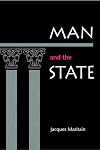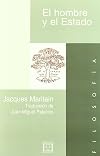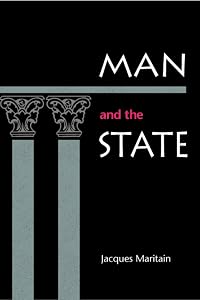
Man and the State
by Jacques Maritain
On This Page
Description
Jacques Maritain's 'El Hombre y el Estado' is a philosophical exploration of political theory, focusing on the relationship between the individual and the state. Originally developed through a series of lectures at the University of Chicago, the book addresses complex concepts such as nationhood, the political body, and state sovereignty. Maritain emphasizes the importance of distinguishing between these entities to cultivate a healthier political philosophy. He delves into the nature of show more human rights, the role of government, and the interplay between religion and politics, aiming to provide a comprehensive understanding of societal structures. The book is intended for scholars, students, and individuals interested in political philosophy and the historical development of political thought. show lessTags
Recommendations


















Member Reviews
Mauritain (1882-1973) is an important lettered French author of books on political science and Thomist theology, and these are lectures he gave in Chicago after WWII. The surprise is the amount of optimism he carries to this subject matter - as he evaluates the State and "authority", and the dangers to justice and public safety. He argues that the State is a tool of the people--vox populi--to secure justice and safety, and is evil when it is adored, because there is a Higher Law derived from reason and nature. The Catholic martyrs defied evil oppressors because of their freedom and spirit, and loygalty to a Higher law. [Ch VI].
The medieval Thomist (1225-1274) approach is freshened. Filled with unsupported historical claims and show more contradiction. For example, he finds the establishment of the American Constitution "peerless" for its significance for political philosophy, but without specification, finds it "repugnant to the idea of making human society stand aloof from God" and religious faith [183-4], although we all know that it does not mention God and forbids the "establishment" of a Church by the State.
Critic of Hobbes, and the Machiavellian "Prince" powers, Although he writes in service to the Church and he literally served as Ambassador of the Vatican (1948-1951), Maritain is of little help to the plutocrats who would use the Government/State as their own device for oppression and monopoly. He is an apologist for democracy and social justice, all the way, every time. show less
The medieval Thomist (1225-1274) approach is freshened. Filled with unsupported historical claims and show more contradiction. For example, he finds the establishment of the American Constitution "peerless" for its significance for political philosophy, but without specification, finds it "repugnant to the idea of making human society stand aloof from God" and religious faith [183-4], although we all know that it does not mention God and forbids the "establishment" of a Church by the State.
Critic of Hobbes, and the Machiavellian "Prince" powers, Although he writes in service to the Church and he literally served as Ambassador of the Vatican (1948-1951), Maritain is of little help to the plutocrats who would use the Government/State as their own device for oppression and monopoly. He is an apologist for democracy and social justice, all the way, every time. show less
Ratings
Members
- Recently Added By
Lists

Filosofía - Clásicos
217 works; 1 member
Author Information

211+ Works 5,281 Members
T. S. Eliot once called Jacques Maritain "the most conspicuous figure and probably the most powerful force in contemporary philosophy." His wife and devoted intellectual companion, Raissa Maritain, was of Jewish descent but joined the Catholic church with him in 1906. Maritain studied under Henri Bergson but was dissatisfied with his teacher's show more philosophy, eventually finding certainty in the system of St. Thomas Aquinas. He lectured widely in Europe and in North and South America, and lived and taught in New York during World War II. Appointed French ambassador to the Vatican in 1945, he resigned in 1948 to teach philosophy at Princeton University, where he remained until his retirement in 1953. He was prominent in the Catholic intellectual resurgence, with a keen perception of modern French literature. Although Maritain regarded metaphysics as central to civilization and metaphysically his position was Thomism, he took full measure of the intellectual currents of his time and articulated a resilient and vital Thomism, applying the principles of scholasticism to contemporary issues. In 1963, Maritain was honored by the French literary world with the national Grand Prize for letters. He learned of the award at his retreat in a small monastery near Toulouse where he had been living in ascetic retirement for some years. In 1967, the publication of "The Peasant of the Garonne" disturbed the French Roman Catholic world. In it, Maritain attacked the "neo-modernism" that he had seen developing in the church in recent decades, especially since the Second Vatican Council. According to Jaroslav Pelikan, writing in the Saturday Review of Literature, "He laments that in avant-garde Roman Catholic theology today he can 'read nothing about the redeeming sacrifice or the merits of the Passion.' In his interpretation, the whole of the Christian tradition has identified redemption with the sacrifice of the cross. But now, all of that is being discarded, along with the idea of hell, the doctrine of creation out of nothing, the infancy narratives of the Gospels, and belief in the immortality of the human soul." Maritain's wife, Raissa, also distinguished herself as a philosophical author and poet. The project of publishing Oeuvres Completes of Jacques and Raissa Maritain has been in progress since 1982, with seven volumes now in print. (Bowker Author Biography) show less
Common Knowledge
Classifications
- Genres
- Politics and Government, Philosophy, Nonfiction, Religion & Spirituality, General Nonfiction
- DDC/MDS
- 320.15 — Society, government, & culture Political science Types of Government The State Nature, entity, concept of the state
- LCC
- JC261 .M32 — Political Science Political theory Political theory. The state. Theories of the state Modern state
- BISAC
Statistics
- Members
- 317
- Popularity
- 99,854
- Reviews
- 1
- Rating
- (4.00)
- Languages
- 7 — Czech, English, French, Italian, Polish, Croatian, Spanish
- Media
- Paper, Ebook
- ISBNs
- 13
- ASINs
- 6