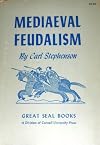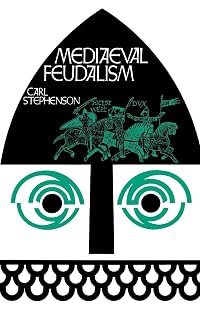
Mediaeval Feudalism
by Carl Stephenson
On This Page
Description
"In the following pages I have tried to explain, as simply and concisely as possible, the historical significance of the feudal system. . . . My purpose has not been to give a comprehensive description of Europe in the feudal age, or even of feudal society. I have taken for granted that the reader will be familiar with the main political events of the Middle ages: the barbarian invasions, the formation of the Carolingian Empire, the establishment of the later monarchies, the Crusades, and show more the like. I have omitted all but cursory mention of the manorial system and the revival of commerce . . . . I have, in other words, restricted the discussion to the few institutions that may be said to have constituted feudalism proper, or to have been peculiarly associated with it."--from the PrefaceThis reprint of the first single-volume work in English (originally published in 1942) to treat the principles of feudalism gives a clear and concise account of the origin, growth, and decay of the feudal system. Special attention is paid to the principles of feudal tenure, chivalry, the military life of the nobility, and the workings of feudal government, as illustrated by actual cases. show lessTags
Recommendations























Member Reviews
Carl Stephenson (1886-1954) was an early to mid-20th century American Medievalist, a student of Charles Homer Haskins (America's "first medievalist"). This little gem was written in 1942 before the more fashionable works on Feudalism by Bloch, Ganshof, Reynolds and Brown. It is a solid and easily digested foundation written in a delightfully simple down to earth style. Even if some of the perspectives have been questioned or expanded by later works, this still provides a necessary and accessible foundation. As the opening paragraph of the 1956 edition says:
[START QUOTE]
SINCE its first printing in 1942 the late Carl Stephenson's 'Mediaeval Feudalism' has enjoyed a distinguished career. Eminent historians of America and Europe have show more reviewed it with high praise in the most respected historical journals. To the college freshman it has been a "vade mecum" in the awesome task of mastering such complicated feudal principles as subinfeudation and liege homage. The omniscient graduate student has at first reading whisked through it with disdain, casting it aside for the imaginative hypotheses of a Marc Bloch or for the impressive tomes of German historians, only to come meekly back to it to obtain his bearings and a sense of proportion. Seasoned scholars and teachers have read the book with discrimination, realizing that behind each page stood years of research and thought devoted to the study of feudalism in mediaeval Europe; they in turn have recommended it to their students.
[END QUOTE]
Another book by Stephenson, 'Medieval History: Europe from the Fourth to the Sixteenth Century', was for decades one of the most widely used textbooks in the field. He is probably best known for 'Borough and Town: A Study of Urban Origins in England' (1933). Stephenson was working in an age rife with prejudiced nationalism among European scholars; as an outsider he helped show the commonality of medieval institutions and move the discussion beyond 19th and early 20th century nationalistic concerns.
From Internet Archive ( http://www.archive.org/details/mediavelfeudalis006821mbp )
Wikipedia article ( http://en.wikipedia.org/wiki/Carl_Stephenson ) show less
[START QUOTE]
SINCE its first printing in 1942 the late Carl Stephenson's 'Mediaeval Feudalism' has enjoyed a distinguished career. Eminent historians of America and Europe have show more reviewed it with high praise in the most respected historical journals. To the college freshman it has been a "vade mecum" in the awesome task of mastering such complicated feudal principles as subinfeudation and liege homage. The omniscient graduate student has at first reading whisked through it with disdain, casting it aside for the imaginative hypotheses of a Marc Bloch or for the impressive tomes of German historians, only to come meekly back to it to obtain his bearings and a sense of proportion. Seasoned scholars and teachers have read the book with discrimination, realizing that behind each page stood years of research and thought devoted to the study of feudalism in mediaeval Europe; they in turn have recommended it to their students.
[END QUOTE]
Another book by Stephenson, 'Medieval History: Europe from the Fourth to the Sixteenth Century', was for decades one of the most widely used textbooks in the field. He is probably best known for 'Borough and Town: A Study of Urban Origins in England' (1933). Stephenson was working in an age rife with prejudiced nationalism among European scholars; as an outsider he helped show the commonality of medieval institutions and move the discussion beyond 19th and early 20th century nationalistic concerns.
From Internet Archive ( http://www.archive.org/details/mediavelfeudalis006821mbp )
Wikipedia article ( http://en.wikipedia.org/wiki/Carl_Stephenson ) show less
Ratings
Members
- Recently Added By
Author Information

6+ Works 460 Members
Common Knowledge
- Original publication date
- 1942
Classifications
Statistics
- Members
- 235
- Popularity
- 138,886
- Reviews
- 1
- Rating
- (3.45)
- Languages
- English
- Media
- Paper, Audiobook
- ISBNs
- 3
- ASINs
- 14