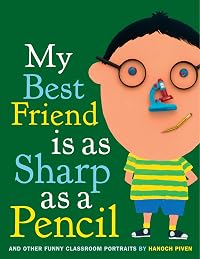
My Best Friend Is As Sharp As a Pencil: And Other Funny Classroom Portraits
by Hanoch Piven
On This Page
Description
When her grandma asks her about school, a girl draws a class portrait, adding details that show what makes each person special.Tags
Recommendations


Member Reviews
Collage: a piece of art made by sticking various different materials such as photographs and pieces of paper or fabric on to a backing.
Piven’s delightful picture book of “funny classroom” portraits is framed as a girl’s attempt to answer her visiting grandmother’s questions in something other than the usual boring way.
Instead of simply telling about her best and second best friends, her teachers, and some other classmates, she uses a variety of similes—some far more effective than others—and found objects (including buttons, crayons, bells, pencils, candies, computer parts, plastic letters, and so on) to create collage portraits of these people.
In my opinion, the best portrait is of the art teacher, whose head, a show more painter’s palette, is quite Picasso-esque. His hair and mouth are created with long colourful crayons, and he wears a little jean vest made of strips of denim. He is one cool dude.
Part of the fun of the book is seeing how Piven uses the objects he introduces as he lists 3 or 4 similes for each character before he goes on to present a portrait on the following page. How will he use the objects he’s shown us? For example, the girl narrator tells us her second best friend in the class is “slower than a snail” (a snail shell is shown), hard as a nut (walnuts are displayed), and green as lettuce leaves.Turn the page and you discover that the friend is class pet Mildred, the turtle. Her collage portrait is surprising: the snail shells are used for eyes, a collection of walnuts make her shell, and the lettuce leaves are used for Mildred’s feet. Other necessary details are drawn in.
I used this book several years back to introduce similes to kids in a language arts class. (As I said, however, many of the similes are rather poor: “happy as a balloon”? “happy as a gummy worm”? Not great models for students.)
In a useful afterword, Piven comments that “making collages with objects helps kids (and grown-ups) realize that they can create art even if they are insecure about their artistic abilities” and that “making pictures out of objects helps to tell stories that might be too long, difficult or boring told in just words.” Clearly, this book is a terrific springboard for doing just that. show less
Piven’s delightful picture book of “funny classroom” portraits is framed as a girl’s attempt to answer her visiting grandmother’s questions in something other than the usual boring way.
Instead of simply telling about her best and second best friends, her teachers, and some other classmates, she uses a variety of similes—some far more effective than others—and found objects (including buttons, crayons, bells, pencils, candies, computer parts, plastic letters, and so on) to create collage portraits of these people.
In my opinion, the best portrait is of the art teacher, whose head, a show more painter’s palette, is quite Picasso-esque. His hair and mouth are created with long colourful crayons, and he wears a little jean vest made of strips of denim. He is one cool dude.
Part of the fun of the book is seeing how Piven uses the objects he introduces as he lists 3 or 4 similes for each character before he goes on to present a portrait on the following page. How will he use the objects he’s shown us? For example, the girl narrator tells us her second best friend in the class is “slower than a snail” (a snail shell is shown), hard as a nut (walnuts are displayed), and green as lettuce leaves.
I used this book several years back to introduce similes to kids in a language arts class. (As I said, however, many of the similes are rather poor: “happy as a balloon”? “happy as a gummy worm”? Not great models for students.)
In a useful afterword, Piven comments that “making collages with objects helps kids (and grown-ups) realize that they can create art even if they are insecure about their artistic abilities” and that “making pictures out of objects helps to tell stories that might be too long, difficult or boring told in just words.” Clearly, this book is a terrific springboard for doing just that. show less
I selected this book under the assumption of it falling into a book about a disability. It is not! However, what I have taken from this book is a new teaching activity. Object Art is the technique of grabbing everyday objects within your environment in order to tell a story and/or create a picture that will help to tell a story.
This technique can be used to differentiate for students. For example, students can use Object Art to help summarize a story, or to introduce themselves to the class and so much more!
I've gained a new activity from this book, that I'm excited to use in my future classroom.
Serendipity!!!!!
This technique can be used to differentiate for students. For example, students can use Object Art to help summarize a story, or to introduce themselves to the class and so much more!
I've gained a new activity from this book, that I'm excited to use in my future classroom.
Serendipity!!!!!
A fun & artistic story about a schoolgirl who decides to animate a day about school to her grandmother. Her classmates characters were artistically described followed by very good illustrations. How would you describe your best friend, your teachers, yourself, how about characters from a book? This is a great introduction into metaphors and thinking outside the box to describe someone.
What is your best friend like? I bet he/she isn’t as sharp as mine. “My Best Friend is as Sharp as a Pencil” hits the spot when talking about school. With the pictures by Rechel, you feel like all of these friends are standing right in front of you waiting to play. If you have an extraordinary imagination or even looking for one, this book will poke your eyes out. Get ready for a read of a lifetime and bring out the creativeness in you.
-Becca Porter
-Becca Porter
I liked this book mostly because of its illustrations. This story featured many cleverly-illustrated and colorful characters that decorated each page. Readers can use this book to help them with their understanding of similes because they are utilized many times throughout the story. I also thought this book would be very helpful for young readers to understand that a simile is used as an exaggeration. The pictures really helped with this concept as well.
In this book a girl is telling her grandma about all her favorite people at school. Her favorite teacher, her best friend, her second best friend, etc. Piven uses similies throughout the book to describe everybody at school.
Although her grandma always asks her questions about school, the main character finds a creative way to answer her grandma's questions. This is a good book for second through fourth graders about finding creative ways to respond to things. I would present this to an English or art class.
Members
- Recently Added By
Lists

Youth: Arts & Crafts
156 works; 1 member
Author Information
10 Works 977 Members
Awards and Honors
Classifications
Statistics
- Members
- 146
- Popularity
- 224,373
- Reviews
- 11
- Rating
- (4.23)
- Languages
- English
- Media
- Paper, Ebook
- ISBNs
- 4
- ASINs
- 2