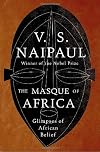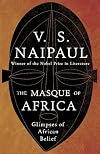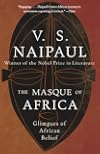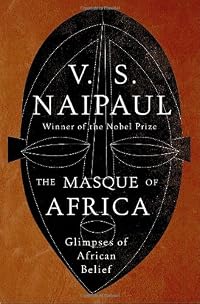
The Masque of Africa: Glimpses of African Belief (Borzoi Books)
by V. S. Naipaul
On This Page
Description
Nobel Prize-winning author Naipaul spirals outward from the central African country of Uganda, to Nigeria, Ghana, the Ivory Coast, Gabon, and concluding in South Africa, to unearth in six chapters a sense of African ancestral belief and practice.Tags
Recommendations







































Member Reviews
More than a travel narrative, Naipaul examines religion and mythology in six African countries and compares present practices with those of his last visit in the sixties, and in the time before colonization. His writing is down-earth with short, sometimes acerbic sentences, that might be considered blunt if they were not tinged with humour or describing risible situations, which happen surprisingly often. But Naipaul has a way with words: even a brief description of a dog in the street conjures up a vivid image of the event. Impressively parsimonious, he negotiates keenly with guides, witch doctors, drivers and so on, often backing out of a trip that he thinks might cost more than he has been quoted. Writers who know Africa have strong show more opinions of this work that has been described as "cliched" and even "toxic". While much of the information is unverified or of mythical origin, it was provided by those who might just be enjoying themselves by recounting an amusing or shocking anecdote. But then, a renowned sceptic himself, Naipaul may have been just along for the yarns too. Recommended for the armchair traveller.
A favourite quotation: "Directly, with no beating about the bush, he {the soothsayer} asked our business. I didn't know what to say. I couldn't say I had come only to have a look." show less
A favourite quotation: "Directly, with no beating about the bush, he {the soothsayer} asked our business. I didn't know what to say. I couldn't say I had come only to have a look." show less
This book, and its reviews on goodreads, taught me a couple of things. Most importantly, I realized how important a book's title can be. I picked this up at the Museum of African Art in D.C., where it was on super-sale. There were a number of fetish objects in the museum, which were much more powerful than most of the modern art around them. The curator's notes suggested that much of this was a response to the slave-trade (especially from Benin), which would have been so catastrophic for the people there. That piqued my interest--in the U.S., you hear a lot about the effect of slavery on slaves (justifiaby), but not much about the effect on the places from which those slaves were, for want of a better word, kidnapped. So I was to learn show more more about traditional African religion. Unfortunately, the books at the Museum's store were all about how great it was/is to be African. They mostly featured very colorful dresses.
So Naipaul was the closest I got to what I was looking for. And here is the importance of titles: this is not a book about African religion. Many reviewers seem almost aggressively angry about that fact, pointing out that Naipaul did no scholarly research, just relates anecdotes, talks about his own feelings etc etc... Well, all that's true. But this book is obviously travel literature. You don't browse J-Stor when you're on holiday.
The second thing I learned follows directly from this: I have no criteria with which to judge travel literature. What am I looking for here? There's little intellectual content, but V.S. does a reasonably good job highlighting the emotional and political importance of traditional religion, as well as how the 'major world religions' get swallowed up by it. The style is readable but hardly admirable. It's repetitious. There's an awful lot in here about how bad Naipaul feels when animals die, but not much about how he feels when people are forced into poverty and suffering. He seems like a bit of a prick, although sometimes conscious of that prickiness.
I learned very little about African religion. But I did learn that I need to read more, better travel literature. My wife recommends Fermor. I'm open to other suggestions. And I also learned that I should read more Naipaul, because if this--a pleasant way to kill an afternoon--is as bad as he gets (which I suspect it might be), the good might be very, very good. show less
So Naipaul was the closest I got to what I was looking for. And here is the importance of titles: this is not a book about African religion. Many reviewers seem almost aggressively angry about that fact, pointing out that Naipaul did no scholarly research, just relates anecdotes, talks about his own feelings etc etc... Well, all that's true. But this book is obviously travel literature. You don't browse J-Stor when you're on holiday.
The second thing I learned follows directly from this: I have no criteria with which to judge travel literature. What am I looking for here? There's little intellectual content, but V.S. does a reasonably good job highlighting the emotional and political importance of traditional religion, as well as how the 'major world religions' get swallowed up by it. The style is readable but hardly admirable. It's repetitious. There's an awful lot in here about how bad Naipaul feels when animals die, but not much about how he feels when people are forced into poverty and suffering. He seems like a bit of a prick, although sometimes conscious of that prickiness.
I learned very little about African religion. But I did learn that I need to read more, better travel literature. My wife recommends Fermor. I'm open to other suggestions. And I also learned that I should read more Naipaul, because if this--a pleasant way to kill an afternoon--is as bad as he gets (which I suspect it might be), the good might be very, very good. show less
Naipaul é escritor trinitario e britânico , de origem indiana. Nesta obra viaja por 6 países africanos, ou melhor mergulha na cultura tradicional, sobretudo a de natureza mágica e religiosa do povo africano. Com início no Uganda, no centro do continente, a viagem de Naipaul passa pelo Ghana, pela Nigéria, Costa do Marfim e acaba onde acaba o continente - na África do Sul. O que gostei neste livro, para além da descrição dos povos e culturas, foi o olhar ao mesmo tempo critico e amoroso com que o autor vê esta cultura através de conversas com pessoas muito diferentes, quer do povo simples das aldeias, passando por feiticeiros, curandeiros, intelectuais e politicos. Uma leitura muito interessante
Even big fans of Naipaul are not going to find much here. Extremely superficial. He'd probably point out that the subtitle is "Glimpses of African Belief." Well, who needs that? Isn't that what newspaper and travel magazines are about? He ostensibly is looking at--no, glimpsing--how traditional religious beliefs still affect current behavior and beliefs. But he doesn't even scratch the surface of what those traditional beliefs are!
Of course, with 100-whatever tribes in Nigeria alone, even looking at a single country would have been a challenge but he goes to half a dozen. Briefly in the 1960s, Naipaul was attached to a university in Uganda, where Paul Theroux met him. I expected him to dive into what he knew about Ugandan religious show more beliefs then and now but nope. I think South Africa might be the most embarrassing entry. He actually visits Winnie Mandela without mentioning her numerous crimes or why Nelson M "lives apart." In fact, they separated 20 years ago and he remarried a few years later. Is it possible that he doesn't know about her convictions re theft and corruption, ordering the torture and murder of a young boy, endorsing necklacing?
As was also true when Naipaul's first wife accompanied him, you'd never guess from this book when the 2nd wife was present. Turns out she was with him on the visit to Winnie and wrote an article that whipped up anti-Winnie sentiment in South Africa.
Well, the gist of that article doesn't seem much different from what Naipaul recounts here: http://www.standard.co.uk/news/how-nelson-mandela-betrayed-us-says-exwife-winnie... (Warning: Egad, Nadira Naipaul is a horrible writer. First two graphs begin with "My husband") . So, from this article I see now that they surely were aware of the torture murder charges, necklacing, etc. but the part, in the middle, that set off the fury is in VS's account: Nelson M was too easy on de Klerk, Mandela let us down, whites still run everything. She seems to have a bigger ego than Naipaul, considering their circumstances. Was her role that big in the ANC? Maybe Naipaul toned down his account because of the reaction to this story?
Anyhoo, getting back to the book at hand ...You expect more from a writer of his pedigree, especially one with not superficial Indian roots. I understand the criticisms Indians have of Naipaul's attempts at political analysis and I'm sure he isn't a very pleasant person to deal with (see Paul Theroux's memoir). An egomaniac; fastidious about food, comforts and noise (so why not stay home?).
All the more surprising then but ... When he's in the mood to exercise it, his strength is a combination of observation and empathy.
It's most evident in his 3rd and most personal India book. He will be in the home of a humble person, he will notice the care taken to make the place prettier and cleaner. The same with attire and grooming. He can sense what a struggle it was for a person from the bush or the pavement to draw themselves up to become a govt leader or an overseas student or a business owner. There are some glimpses of that here but they're
few and far between.
I guess it's oft been mentioned that Naipaul craved too much the approval of the colonial masters. Amitav Ghosh or Rushdie or Adichie he is not. But two of his very earliest nonfiction books about the West Indies, The Loss of El Dorado and the Middle Passage, have stuck with me for many years because of how he conveyed the terrible weight and humiliation of colonization and slavery. In The Middle Passage he hopped around five states that were on the verge of independence or had just achieved it. He could also sense the rising Marxist movements. The Masque of Africa seems so very distant from those books. That hit me hard when a man he's interviewing asks Naipaul where he's from. Somewhat to my surprise, Naipaul says "Trinidad." The man doesn't understand, then kind of gets it: "Jamaica, Slavery. Ha England ever apologized for that?" (I have wondered as well. And how are reparations proceeding?) Naipaul says something like, "It was a long time ago and many nations were involved." But England was the main trafficker, buying and delivering even for the Spanish; they're the ones that accumulated the most wealth out of so much suffering. It would be pretty easy to identify the large number of upper-class families today whose fortunes were built on slave-trading. Once upon a time, Naipaul knew that in his bones.
Do any other readers have thoughts about the recurrence of cats (usually kittens, I guess) in this books? show less
Of course, with 100-whatever tribes in Nigeria alone, even looking at a single country would have been a challenge but he goes to half a dozen. Briefly in the 1960s, Naipaul was attached to a university in Uganda, where Paul Theroux met him. I expected him to dive into what he knew about Ugandan religious show more beliefs then and now but nope. I think South Africa might be the most embarrassing entry. He actually visits Winnie Mandela without mentioning her numerous crimes or why Nelson M "lives apart." In fact, they separated 20 years ago and he remarried a few years later. Is it possible that he doesn't know about her convictions re theft and corruption, ordering the torture and murder of a young boy, endorsing necklacing?
As was also true when Naipaul's first wife accompanied him, you'd never guess from this book when the 2nd wife was present. Turns out she was with him on the visit to Winnie and wrote an article that whipped up anti-Winnie sentiment in South Africa.
Well, the gist of that article doesn't seem much different from what Naipaul recounts here: http://www.standard.co.uk/news/how-nelson-mandela-betrayed-us-says-exwife-winnie... (Warning: Egad, Nadira Naipaul is a horrible writer. First two graphs begin with "My husband") . So, from this article I see now that they surely were aware of the torture murder charges, necklacing, etc. but the part, in the middle, that set off the fury is in VS's account: Nelson M was too easy on de Klerk, Mandela let us down, whites still run everything. She seems to have a bigger ego than Naipaul, considering their circumstances. Was her role that big in the ANC? Maybe Naipaul toned down his account because of the reaction to this story?
Anyhoo, getting back to the book at hand ...You expect more from a writer of his pedigree, especially one with not superficial Indian roots. I understand the criticisms Indians have of Naipaul's attempts at political analysis and I'm sure he isn't a very pleasant person to deal with (see Paul Theroux's memoir). An egomaniac; fastidious about food, comforts and noise (so why not stay home?).
All the more surprising then but ... When he's in the mood to exercise it, his strength is a combination of observation and empathy.
It's most evident in his 3rd and most personal India book. He will be in the home of a humble person, he will notice the care taken to make the place prettier and cleaner. The same with attire and grooming. He can sense what a struggle it was for a person from the bush or the pavement to draw themselves up to become a govt leader or an overseas student or a business owner. There are some glimpses of that here but they're
few and far between.
I guess it's oft been mentioned that Naipaul craved too much the approval of the colonial masters. Amitav Ghosh or Rushdie or Adichie he is not. But two of his very earliest nonfiction books about the West Indies, The Loss of El Dorado and the Middle Passage, have stuck with me for many years because of how he conveyed the terrible weight and humiliation of colonization and slavery. In The Middle Passage he hopped around five states that were on the verge of independence or had just achieved it. He could also sense the rising Marxist movements. The Masque of Africa seems so very distant from those books. That hit me hard when a man he's interviewing asks Naipaul where he's from. Somewhat to my surprise, Naipaul says "Trinidad." The man doesn't understand, then kind of gets it: "Jamaica, Slavery. Ha England ever apologized for that?" (I have wondered as well. And how are reparations proceeding?) Naipaul says something like, "It was a long time ago and many nations were involved." But England was the main trafficker, buying and delivering even for the Spanish; they're the ones that accumulated the most wealth out of so much suffering. It would be pretty easy to identify the large number of upper-class families today whose fortunes were built on slave-trading. Once upon a time, Naipaul knew that in his bones.
Do any other readers have thoughts about the recurrence of cats (usually kittens, I guess) in this books? show less
Naipaul's latest tome which is chiefly about traditional beliefs and practices in some of the African countries like Uganda, Nigeria, Ghana, Gabon and South Africa. He has stayed true to his rather acerbic style and wit. Colonialism and it's remnants of civil life have done little to alleviate the lot of the average African. Their legacies have been rapidly taken over by the tropical jungle and the people have fallen back on their traditional ways of Shamanic beliefs, witchcraft, polygamy, internecine tribal warfare and the ill effects of modern global trade like rampant logging and poaching. All together a very grim and unredeemable scenario.
With regard to non-fictional writing about religion, V. S. Naipaul is mostly known for his two travelogues exploring an mapping the practice of Islam in two books, viz. Among the Believers: An Islamic Journey, published in 1981, followed by Beyond Belief: Islamic Excursions among the Converted Peoples, which appeared in 1994. In both books Naipaul describes Arab countries and other asian countries where Islam was an adopted religion, following conversion, which are the main focus of Naipaul's interest. Both books have been criticised for being superficial and erronous.
In 2010, V. S. Naipaul published The masque of Africa. Glimpses of African belief. The book consists of six extended pieces of writing about his experience in different show more African countries. Whereas the two books about Islam were focused on converted people who professed to the religion of the Islam, and those books were the result of respectively five and six months of travel, The masque of Africa. Glimpses of African belief is a much more eclectic book, consisting of travels undertaken at various, unrelated moments in time, and with a quite different unrelated purpose. It is therefore surprising that the first and longest piece takes the reader back to 1966 when Naipaul when Naipaul spent "eight to nine months" in East Africa, of which six weeks were spent in Kenya, a month in Tanzania, and the remaining half year in Uganda. "Forty-two years after that first visit I went back to Uganda (...) hoping to get started there on this book about the nature of African belief, and I thought it would be better to ease myself into my subject in a country I knew or half knew. But I found the place eluding me." (p. 1)
V. S. Naipaul does not make clear which place eluded him, Uganda he half knew, or the African continent as a whole. The introductory passage also shows the author's half-hearted interest in his subject, or possibly no interest in it at all. Perhaps The masque of Africa. Glimpses of African belief is just a suggestion of the publisher, an attempt to cash in on Naipaul's fame as a Nobel Prize winning author with a reputation for writing non-fictional travelogue about religion.
The first, long essay (80 pages) informs the reader much about Naipaul's stay in Uganda in 1966, but provides only the merest suggestion of religious practice.
Nations on the African continent, whether their current boundaries are temporary or permanent, have existed for hundreds of years, and some countries have an abundantly rich cultural variety, for which Naipaul does not seem prepared. Thus, his journey takes him through Ghana and Nigeria, the Ivory Coast and Gabon, and South Africa, making some general observations about religion, besides many touristic travellers' views.
The second essay is called Sacred places. After an introduction to the history of Nigeria, Naipaul is introduced to his guide who supposedly knows about Yoruba culture, and leads Naipaul to meet an Oba in the Yoruba homeland. However, Naipaul's subsequent description about Mumbo Jumbo is more likely taken from the author's reading of Mungo Park's travel journals Travels in the Interior of Africa (1795), to which he already made reference in the introductory section of the essay (but does not refer to here). Naipaul does not learn anything knew about Yoruba religion from his informers. The next section of "Sacred places" deals with a ling biographical descriptions of another informer, who takes Naipaul to see a soothsayer. Further sections return to Yoruba religion and Islam in Nigeria. Only a few fleeting remarks are made about the "orthodox Christian Cherubim and Seraphim Church Movement," but Naipaul does not write anything about Christianity in Nigeria.
"Men Possessed" described the Ashanti religion of Ghana, with a visit to another soothsayer. Naipaul tells us that both the soothsayer of the Yoruba religion in Nigeria and the one here in Ghana required a bottle of liquor as a tribute, before their session. In between some references to Moslem and Christian religions, which Naipaul does not pursue, he is taken to see the high priest of the Gaa cult in Ghana. The following description is a mockery of Naipaul's professed cultural sensitivity. The high priest is not there but sends them a message on his mobile phone. They are received by a dignified old chief, dressed in a purple silk gown, wearing silver bangles and golden earrings, and tattoos or markings on his skin. "He could certainly have been expecting some schnapps, and perhaps a gift of money." Everyone ends up being irritated: Naipaul because "in my dealings with magicians, I had understood that beyond a certain stage there was no place for simple inquirers", and the old chief "who might have been misled about the visitor, (...) involved him in this waste of time, without even the likelihood of a bottle of schnapps at the end. (p. 185). The repeated references to bottles of liquor rather jeopardize Naipaul's sincerity in these transactions.
References on page 185, suggest that Naipaul's visit to Ivory Coast in the following chapter, "The Forest King" were actually made twenty years earlier, or, as with the visit to Uganda, a visit long ago, followed by a renewed visit for the purpose of writing this book. With just 18 pages, this essay is oddly short.
"The Children of the Old Forest" describes the religion of the pygmies (consistently misspelled "pigmies" by Naipaul) in Gabon. Here, Naipaul has several informers and guides who lead him to meet the rather primitive tribes in the forests. The last essay, "Private Monuments, Private Wastelands" presents a very general introduction to South Africa, including a description of the religious beliefs of a Zulu traditionalist.
The masque of Africa. Glimpses of African belief is presented as a travelogue focusing on religious belief in Africa. While the book does introduce some aspects of religion, choice and focus are superficial, and of no particular interest but to the most general reader. A topic which should be introduced by an experienced anthropologist, is trampled by a rather vulgar tourist, whose memories of 20 - 40+ years past, travels and observations made with a completely different interest, now inform a very superficial travelogue through Africa.
In most cases in is quite easy to evaluate a book with a number of stars, and in some cases it is more complicated. My expectations about the book were not met, but in spite of that, [The masque of Africa. Glimpses of African belief] is still a very readable book.
[The masque of Africa. Glimpses of African belief] is published without an introduction, so [[Naipaul]]'s intentions with the book are not made explicit. The author is not an anthropologist, and therefore, the book should perhaps simply be appreciated for what it offers: Glimpses of African belief. Lacking an introduction, the reader should perhaps be guided by the blurb text which introduces the intention as follows: "Focusing upon the theme of belief - though sometimes the political or economical realities are so overwhelming that they have to be taken into account - Naipaul examines the fragile but enduring quality of the old world of magic." That is more or less exactly what the book does. The title itself: "The masque of Africa." shows that much remains hidden.
Averaging 70 pages, the five long plus one short essays are all very well-written. While the descriptions of each religion is but scanty, the total picture of each African country is fairly comprehensive. This is a major plus point, since generally, so little is written and known about African countries in the first place.
There is section for acknowledgements, and on the last page is written: March 2008 - September 2009, which means the essays were especially written for the publication of this book. While some older memories may have gone into the book, the essays were written for this occasion, and not scrambled, as so often happens in other publications, where old essays are brought together to describe a new story.
Therefore, I would still recommend [The masque of Africa. Glimpses of African belief] as an introduction to these African countries and some of the traditional beliefs held by their people, awarding the book four stars. show less
In 2010, V. S. Naipaul published The masque of Africa. Glimpses of African belief. The book consists of six extended pieces of writing about his experience in different show more African countries. Whereas the two books about Islam were focused on converted people who professed to the religion of the Islam, and those books were the result of respectively five and six months of travel, The masque of Africa. Glimpses of African belief is a much more eclectic book, consisting of travels undertaken at various, unrelated moments in time, and with a quite different unrelated purpose. It is therefore surprising that the first and longest piece takes the reader back to 1966 when Naipaul when Naipaul spent "eight to nine months" in East Africa, of which six weeks were spent in Kenya, a month in Tanzania, and the remaining half year in Uganda. "Forty-two years after that first visit I went back to Uganda (...) hoping to get started there on this book about the nature of African belief, and I thought it would be better to ease myself into my subject in a country I knew or half knew. But I found the place eluding me." (p. 1)
V. S. Naipaul does not make clear which place eluded him, Uganda he half knew, or the African continent as a whole. The introductory passage also shows the author's half-hearted interest in his subject, or possibly no interest in it at all. Perhaps The masque of Africa. Glimpses of African belief is just a suggestion of the publisher, an attempt to cash in on Naipaul's fame as a Nobel Prize winning author with a reputation for writing non-fictional travelogue about religion.
The first, long essay (80 pages) informs the reader much about Naipaul's stay in Uganda in 1966, but provides only the merest suggestion of religious practice.
Nations on the African continent, whether their current boundaries are temporary or permanent, have existed for hundreds of years, and some countries have an abundantly rich cultural variety, for which Naipaul does not seem prepared. Thus, his journey takes him through Ghana and Nigeria, the Ivory Coast and Gabon, and South Africa, making some general observations about religion, besides many touristic travellers' views.
The second essay is called Sacred places. After an introduction to the history of Nigeria, Naipaul is introduced to his guide who supposedly knows about Yoruba culture, and leads Naipaul to meet an Oba in the Yoruba homeland. However, Naipaul's subsequent description about Mumbo Jumbo is more likely taken from the author's reading of Mungo Park's travel journals Travels in the Interior of Africa (1795), to which he already made reference in the introductory section of the essay (but does not refer to here). Naipaul does not learn anything knew about Yoruba religion from his informers. The next section of "Sacred places" deals with a ling biographical descriptions of another informer, who takes Naipaul to see a soothsayer. Further sections return to Yoruba religion and Islam in Nigeria. Only a few fleeting remarks are made about the "orthodox Christian Cherubim and Seraphim Church Movement," but Naipaul does not write anything about Christianity in Nigeria.
"Men Possessed" described the Ashanti religion of Ghana, with a visit to another soothsayer. Naipaul tells us that both the soothsayer of the Yoruba religion in Nigeria and the one here in Ghana required a bottle of liquor as a tribute, before their session. In between some references to Moslem and Christian religions, which Naipaul does not pursue, he is taken to see the high priest of the Gaa cult in Ghana. The following description is a mockery of Naipaul's professed cultural sensitivity. The high priest is not there but sends them a message on his mobile phone. They are received by a dignified old chief, dressed in a purple silk gown, wearing silver bangles and golden earrings, and tattoos or markings on his skin. "He could certainly have been expecting some schnapps, and perhaps a gift of money." Everyone ends up being irritated: Naipaul because "in my dealings with magicians, I had understood that beyond a certain stage there was no place for simple inquirers", and the old chief "who might have been misled about the visitor, (...) involved him in this waste of time, without even the likelihood of a bottle of schnapps at the end. (p. 185). The repeated references to bottles of liquor rather jeopardize Naipaul's sincerity in these transactions.
References on page 185, suggest that Naipaul's visit to Ivory Coast in the following chapter, "The Forest King" were actually made twenty years earlier, or, as with the visit to Uganda, a visit long ago, followed by a renewed visit for the purpose of writing this book. With just 18 pages, this essay is oddly short.
"The Children of the Old Forest" describes the religion of the pygmies (consistently misspelled "pigmies" by Naipaul) in Gabon. Here, Naipaul has several informers and guides who lead him to meet the rather primitive tribes in the forests. The last essay, "Private Monuments, Private Wastelands" presents a very general introduction to South Africa, including a description of the religious beliefs of a Zulu traditionalist.
The masque of Africa. Glimpses of African belief is presented as a travelogue focusing on religious belief in Africa. While the book does introduce some aspects of religion, choice and focus are superficial, and of no particular interest but to the most general reader. A topic which should be introduced by an experienced anthropologist, is trampled by a rather vulgar tourist, whose memories of 20 - 40+ years past, travels and observations made with a completely different interest, now inform a very superficial travelogue through Africa.
In most cases in is quite easy to evaluate a book with a number of stars, and in some cases it is more complicated. My expectations about the book were not met, but in spite of that, [The masque of Africa. Glimpses of African belief] is still a very readable book.
[The masque of Africa. Glimpses of African belief] is published without an introduction, so [[Naipaul]]'s intentions with the book are not made explicit. The author is not an anthropologist, and therefore, the book should perhaps simply be appreciated for what it offers: Glimpses of African belief. Lacking an introduction, the reader should perhaps be guided by the blurb text which introduces the intention as follows: "Focusing upon the theme of belief - though sometimes the political or economical realities are so overwhelming that they have to be taken into account - Naipaul examines the fragile but enduring quality of the old world of magic." That is more or less exactly what the book does. The title itself: "The masque of Africa." shows that much remains hidden.
Averaging 70 pages, the five long plus one short essays are all very well-written. While the descriptions of each religion is but scanty, the total picture of each African country is fairly comprehensive. This is a major plus point, since generally, so little is written and known about African countries in the first place.
There is section for acknowledgements, and on the last page is written: March 2008 - September 2009, which means the essays were especially written for the publication of this book. While some older memories may have gone into the book, the essays were written for this occasion, and not scrambled, as so often happens in other publications, where old essays are brought together to describe a new story.
Therefore, I would still recommend [The masque of Africa. Glimpses of African belief] as an introduction to these African countries and some of the traditional beliefs held by their people, awarding the book four stars. show less
Naipaul's latest tome which is chiefly about traditional beliefs and practices in some of the African countries like Uganda, Nigeria, Ghana, Gabon and South Africa. He has stayed true to his rather acerbic style and wit. Colonialism and it's remnants of civil life have done little to alleviate the lot of the average African. Their legacies have been rapidly taken over by the tropical jungle and the people have fallen back on their traditional ways of Shamanic beliefs, witchcraft, polygamy, internecine tribal warfare and the ill effects of modern global trade like rampant logging and poaching. All together a very grim and unredeemable scenario.
Members
- Recently Added By
Author Information

97+ Works 25,732 Members
Vidiadhar Surajprasad Naipaul was born of Indian ancestry in Chaguanas, Trinidad on August 17, 1932. He was educated at University College, Oxford and lived in Great Britain since 1950. From 1954 to 1956, he edited a radio program on literature for the British Broadcasting Corporation's Caribbean Service. His first novel, The Mystic Masseur, was show more published in 1957. His other novels included A House for Mr. Biswas, A Bend in the River, Guerrillas, and Half a Life. In a Free State won the Booker Prize in 1971. He started writing nonfiction in the 1960s. His first nonfiction book, The Middle Passage, was published in 1962. His other nonfiction works included An Area of Darkness, Among the Believers, Beyond Belief, and A Turn in the South. He was knighted in 1990 and received the Nobel Prize in Literature in 2001. He died on August 11, 2018 at the age of 85. (Bowker Author Biography) show less
Awards and Honors
Common Knowledge
- Important places*
- Uganda
*Some information comes from Common Knowledge in other languages. Click "Edit" for more information.
Classifications
- Genres
- Nonfiction, Travel, Religion & Spirituality
- DDC/MDS
- 200.96 — Religion The Bible & Christianity Religion History, geographic treatment, biography Africa
- LCC
- BL2400 .N34 — Philosophy, Psychology and Religion Religions. Mythology. Rationalism Religions. Mythology. Rationalism History and principles of religions African
- BISAC
Statistics
- Members
- 345
- Popularity
- 91,256
- Reviews
- 9
- Rating
- (3.67)
- Languages
- 6 — Chinese, Dutch, English, Italian, Portuguese, Spanish
- Media
- Paper, Ebook
- ISBNs
- 19
- ASINs
- 5