Perspective Made Easy
by Ernest R. Norling
On This Page
Description
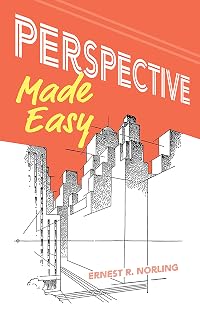
Perspective is easy; yet, surprisingly few artists know the simple rules that make it so. Now they can remedy that situation with this step-by-step book, the first devoted entirely to clarifying the laws of perspective. Using over 250 simple line drawings, the author leads the reader through every important concept. 256 illustrations.Tags
Recommendations




Member Reviews
Don't get me wrong, this is an excellent book, but, even forewarned, I found it brought on slight culture shock. I was surprised to find it had been published as late as 1939; from the artwork I had guessed somewhat earlier. However, there are examples on almost every page in clean, deceptively simple, pen and ink; 256 in 203 pages, I'm told, so there's plenty to look at. I found myself thinking 'but that's simple. I could do that', regularly.
I can't say how long the site will be available, but a quick internet search lead me to a couple of examples of pages here: http://www.fulltable.com/vts/p/psp/en/p.htm
Ernest Norling teaches basic perspective by explaining eye-lines and then saying 'draw a brick'. A brick allows illustration of show more vanishing points, especially if you have one handy, as will anybody saving for a house the old fashioned way.
Drawing stacked bricks leads to buildings in perspective. Buildings need streets and populating the streets leads us to wheeled vehicles, the oval as a circle seen in perspective and how to integrate the oval into an outline of a brick and thus give wheelbases, barrels, bridge arches, plinths, towers, bottles or anything else possibly cylindrical into a perspective drawing. There are three methods of oval construction given, by the way, which, with a little effort, give results as good as an oval created in a graphics package, printed to scale and then traced. The difference is, of course, you need to make the effort, but I've found that lugging a computer and printer with me just for oval creation is far more effort than learning a manual technique or two.
Then there are all the useful little tricks for the fiddly work of perspective. Shadows and how they fall when cast by the sun or by a lamp (there's a difference, believe me); how to space fence posts, windows or other repetitive patterns - say a chess board or the spokes of an umbrella - accurately and easily; how to deal with reflections; how to size people within a perspective scene.
There are also brief sections on vertical perspective, perspectives from the top and bottom of hills and an introduction to mechanical perspective. The latter is covered in about the same detail as most books on drawing seem to give to perspective, by the way: enough to get you by but leaving so much more to be discovered.
Perspective Made Easy has become my bible on the subject; I admit that it is dated, but the techniques are eternal and Ernest Norling teaches them clearly and and shows them to be easy.
My only real annoyances with the book are that this edition (I can't speak for the rest) is paperback and springs shut in a moment - I'd love to see it spiral bound or with a spine that allows it to lie open while you are trying things out and referring back - and that the 'now you try it' sections at the end of the chapters are titled 'problems'. And that's not a problem at all; it's just my perspective. show less
I can't say how long the site will be available, but a quick internet search lead me to a couple of examples of pages here: http://www.fulltable.com/vts/p/psp/en/p.htm
Ernest Norling teaches basic perspective by explaining eye-lines and then saying 'draw a brick'. A brick allows illustration of show more vanishing points, especially if you have one handy, as will anybody saving for a house the old fashioned way.
Drawing stacked bricks leads to buildings in perspective. Buildings need streets and populating the streets leads us to wheeled vehicles, the oval as a circle seen in perspective and how to integrate the oval into an outline of a brick and thus give wheelbases, barrels, bridge arches, plinths, towers, bottles or anything else possibly cylindrical into a perspective drawing. There are three methods of oval construction given, by the way, which, with a little effort, give results as good as an oval created in a graphics package, printed to scale and then traced. The difference is, of course, you need to make the effort, but I've found that lugging a computer and printer with me just for oval creation is far more effort than learning a manual technique or two.
Then there are all the useful little tricks for the fiddly work of perspective. Shadows and how they fall when cast by the sun or by a lamp (there's a difference, believe me); how to space fence posts, windows or other repetitive patterns - say a chess board or the spokes of an umbrella - accurately and easily; how to deal with reflections; how to size people within a perspective scene.
There are also brief sections on vertical perspective, perspectives from the top and bottom of hills and an introduction to mechanical perspective. The latter is covered in about the same detail as most books on drawing seem to give to perspective, by the way: enough to get you by but leaving so much more to be discovered.
Perspective Made Easy has become my bible on the subject; I admit that it is dated, but the techniques are eternal and Ernest Norling teaches them clearly and and shows them to be easy.
My only real annoyances with the book are that this edition (I can't speak for the rest) is paperback and springs shut in a moment - I'd love to see it spiral bound or with a spine that allows it to lie open while you are trying things out and referring back - and that the 'now you try it' sections at the end of the chapters are titled 'problems'. And that's not a problem at all; it's just my perspective. show less
Great book for beginner who want to try study perspective.
Ratings
Members
- Recently Added By
Lists

Wishlist
5 works; 1 member
Author Information
10+ Works 634 Members
Series
Belongs to Publisher Series
Common Knowledge
- Canonical title
- Perspective Made Easy
- Original publication date
- 1939
Classifications
Statistics
- Members
- 448
- Popularity
- 68,234
- Reviews
- 2
- Rating
- (4.03)
- Languages
- English
- Media
- Paper, Audiobook, Ebook
- ISBNs
- 13
- UPCs
- 1
- ASINs
- 8