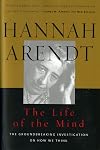
The Life of the Mind: One-Volume Edition
by Hannah Arendt 
The Life of the Mind (Collections and Selections — omnibus 1-2), Gifford Lectures (1972-1974)
On This Page
Description
The author's final work, presented in a one-volume edition, is a rich, challenging analysis of man's mental activity, considered in terms of thinking, willing, and judging. Edited by Mary McCarthy; Indices.Tags
Recommendations


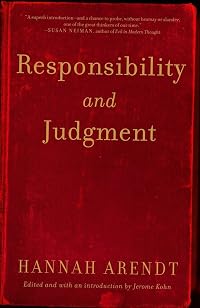


















Member Reviews
Hannah Arendt asks whether the banality of evil might not be an absence of thought. She goes on to explore the thinking process, as well as truth and meaning, will and judgment, and sense and consensus.
The Life of the Mind, Hannah Arendt's voyage into the realm of invisible mental activities, was originally conceived of in two volumes, the first on Thinking and the second on Willing and Judging. Arendt, however, died before completing (or even formally starting) Judging.
Thinking covers ground that will likely be familiar to readers of Arendt's Between Past and Future and Responsibility and Judgment (particularly her essay "Some Questions of Moral Philosophy"). Where Arendt breaks new ground is by reapproaching the realm of metaphysics, not so much to rescue it from its somewhat dubious status but to integrate it more solidly within the framework of philosophy. To this end, Arendt suggests that metaphysics is not outdated but often show more times "implausible." A new approach to metaphysics and its reintegration into philosophy requires that philosophers ask new, plausible questions. With this goal in mind, Arendt is able to quiet concerns about the two-world theory (a fallacy anyway, she argues) and offers a compelling argument on the primacy of appearances (which turns out to be not as positivist as you might think). From this unlikely point Arendt is able to bring us back to the world of invisibles and ask such questions as what makes us think and where we are when we do it. Arendt accomplishes this through some of her familiar mainstays--etymological studies of the words we use to talk about thinking and our Greek and Roman philosophical inheritances on the subject. Of course, numerous references to Kant abound (the structure of The Life of the Mind was intended to mirror Kant's Critiques), and a thoughtful evaluation of Arendt's "thinker par excellence," Socrates, surfaces again in this work.
The second part of this work, Willing, provides a comprehensive philosophical history on the subject, stretching from Epictectus through Nietzsche and Heidegger. With so much history, what is missing from this volume is Arendt's sparkling originality of thought, present throughout every page of works like The Origins of Totalitarianism. The work feels comprehensive (mainly because it can be rather exhausting at times) but not necessarily as original as one might expect from Arendt.
Also of note is Mary McCarthy's Postface to this work, which provides a fascinating glimmer of light onto Arendt's remarkably private character. show less
Thinking covers ground that will likely be familiar to readers of Arendt's Between Past and Future and Responsibility and Judgment (particularly her essay "Some Questions of Moral Philosophy"). Where Arendt breaks new ground is by reapproaching the realm of metaphysics, not so much to rescue it from its somewhat dubious status but to integrate it more solidly within the framework of philosophy. To this end, Arendt suggests that metaphysics is not outdated but often show more times "implausible." A new approach to metaphysics and its reintegration into philosophy requires that philosophers ask new, plausible questions. With this goal in mind, Arendt is able to quiet concerns about the two-world theory (a fallacy anyway, she argues) and offers a compelling argument on the primacy of appearances (which turns out to be not as positivist as you might think). From this unlikely point Arendt is able to bring us back to the world of invisibles and ask such questions as what makes us think and where we are when we do it. Arendt accomplishes this through some of her familiar mainstays--etymological studies of the words we use to talk about thinking and our Greek and Roman philosophical inheritances on the subject. Of course, numerous references to Kant abound (the structure of The Life of the Mind was intended to mirror Kant's Critiques), and a thoughtful evaluation of Arendt's "thinker par excellence," Socrates, surfaces again in this work.
The second part of this work, Willing, provides a comprehensive philosophical history on the subject, stretching from Epictectus through Nietzsche and Heidegger. With so much history, what is missing from this volume is Arendt's sparkling originality of thought, present throughout every page of works like The Origins of Totalitarianism. The work feels comprehensive (mainly because it can be rather exhausting at times) but not necessarily as original as one might expect from Arendt.
Also of note is Mary McCarthy's Postface to this work, which provides a fascinating glimmer of light onto Arendt's remarkably private character. show less
Hannah Arendt was a genius, an unbelievably brilliant thinker, philosopher, social historian and writer. As with all of her books I have read (3 prior) I learned a lot and was stunned by the vastness & depth of her mind. I could not understand all of this, but it nevertheless expanded me.
The Life of the Mind (Combined 2 Volumes in 1) by Hannah Arendt (1981)
--Part 2, On Willing, about history of notion of free will from Stoics, through St. Augustine, etc.
Purtroppo incompiuta, quest'opera tenta l'impresa di farsi sistematica e riprende la tripartizione kantiana con un linguaggio volutamente semplice. Anziché Ragion pura, pratica e Giudizio qui abbiamo Pensare, Volere e Giudicare. E Kant, insieme a Duns Scoto, è uno dei riferimenti continui. Ovviamente senza la terza parte possiamo solo immaginare il punto di arrivo. Ne sono una traccia tutti gli scritti politici di Hanna Arendt e la sua interpretazone di Agostino, che è centrale e di cui si sente la presenza sottile anche in questo testo. A lui è dedicato un capitolo fondamentale della seconda parte, dove in forma meno accademica e più matura tornano tutti i temi della sua tesi di Laurea sull'Amore in Sant'Agostino.
Azzardo questa show more sintesi: il perdono per il passato e la promessa per il futuro, come uniche condizioni per aprire al senso il Presente.
N.b. Una nota dolente è l'assenza di apparati critici. Manca un indice dei nomi, e una bibliografia dei testi citati. Le note soltanto operano dei rimandi puntuali, anche interni. show less
Azzardo questa show more sintesi: il perdono per il passato e la promessa per il futuro, come uniche condizioni per aprire al senso il Presente.
N.b. Una nota dolente è l'assenza di apparati critici. Manca un indice dei nomi, e una bibliografia dei testi citati. Le note soltanto operano dei rimandi puntuali, anche interni. show less
Jan 16, 2025Italian
De drie delen van het hoofdwerk van Hannah Arendt nu eindelijk in één boek.
‘Niet de mens, maar mensen bewonen deze planeet. Pluraliteit is de wet van de aarde.’
'Het leven van de geest' is het laatste hoofdwerk van Hannah Arendt. In dit boek ontvouwt ze haar ideeën over de mogelijkheden van de menselijke geest. Ze onderscheidt drie capaciteiten die iedereen bezit: denken, willen en oordelen. Tot haar dood bleef ze aan dit opus werken. Van het laatste deel, dat onvoltooid is gebleven, is hier het concept opgenomen. Dit is internationaal gezien de eerste editie die al het materiaal in één band samenbrengt.
'Het leven van de geest verdient een plaats in de galerij van de allergrootste filosofische werken. Een meesterwerk.'- De show more Volkskrant (vijf sterren) show less
‘Niet de mens, maar mensen bewonen deze planeet. Pluraliteit is de wet van de aarde.’
'Het leven van de geest' is het laatste hoofdwerk van Hannah Arendt. In dit boek ontvouwt ze haar ideeën over de mogelijkheden van de menselijke geest. Ze onderscheidt drie capaciteiten die iedereen bezit: denken, willen en oordelen. Tot haar dood bleef ze aan dit opus werken. Van het laatste deel, dat onvoltooid is gebleven, is hier het concept opgenomen. Dit is internationaal gezien de eerste editie die al het materiaal in één band samenbrengt.
'Het leven van de geest verdient een plaats in de galerij van de allergrootste filosofische werken. Een meesterwerk.'- De show more Volkskrant (vijf sterren) show less
Jan 28, 2022Dutch
Members
- Recently Added By
Published Reviews
ThingScore 75
added by mkjones
Lists

In Our Time books
4,934 works; 2 members
Author Information

263+ Works 26,397 Members
Born in Hanover, Germany, Hannah Arendt received her doctorate from Heidelberg University in 1928. A victim of naziism, she fled Germany in 1933 for France, where she helped with the resettlement of Jewish children in Palestine. In 1941, she emigrated to the United States. Ten years later she became an American citizen. Arendt held numerous show more positions in her new country---research director of the Conference on Jewish Relations, chief editor of Schocken Books, and executive director of Jewish Cultural Reconstruction in New York City. A visiting professor at several universities, including the University of California, Columbia, and the University of Chicago, and university professor on the graduate faculty of the New School for Social Research, in 1959 she became the first woman appointed to a full professorship at Princeton. She also won a number of grants and fellowships. In 1967 she received the Sigmund Freud Prize of the German Akademie fur Sprache und Dichtung for her fine scholarly writing. Arendt was well equipped to write her superb The Origins of Totalitarianism (1951) which David Riesman called "an achievement in historiography." In his view, "such an experience in understanding our times as this book provides is itself a social force not to be underestimated." Arendt's study of Adolf Eichmann at his trial---Eichmann in Jerusalem (1963)---part of which appeared originally in The New Yorker, was a painfully searching investigation into what made the Nazi persecutor tick. In it, she states that the trial of this Nazi illustrates the "banality of evil." In 1968, she published Men in Dark Times, which includes essays on Hermann Broch, Walter Benjamin, and Bertolt Brecht (see Vol. 2), as well as an interesting characterization of Pope John XXIII. (Bowker Author Biography) show less
Hannah Arendt has a Legacy Library. Legacy libraries are the personal libraries of famous readers, entered by LibraryThing members from the Legacy Libraries group.
All Editions
Some Editions
Series

The Life of the Mind
1 works (Collections and Selections — omnibus 1-2)

Gifford Lectures
184 works (1972-1974)
Belongs to Publisher Series
Work Relationships
Common Knowledge
- Canonical title
- The Life of the Mind: One-Volume Edition
- Original title
- The Life of the Mind
- Alternate titles
- The Life of the Mind: The Groundbreaking Investigation on How We Think
- Original publication date
- 1978
- Epigraph
- Numquam se plus agere quam nihil com ageret, numquam minus solum esse quam cum solus esset. Cato
Everyone one of us is like a man who sees things in a dream and thinks that he knows them perfectly and then wakes up to find that he knows nothing. Plato - First words
- The world man are born into contains many things, natural and artificial, living and dead, transient and sempiternal, all of which have in common that they appear and hence are meant to be seen, heard, touched, tasted, and sm... (show all)elled, to be perceived by sentient creatures endowed with the appropriate sense organs.
- Blurbers
- Kateb, George; Bernstein, Richard J.; Altman, James M.
- Original language
- English
Classifications
Statistics
- Members
- 898
- Popularity
- 30,103
- Reviews
- 8
- Rating
- (4.21)
- Languages
- 10 — Danish, Dutch, English, French, German, Italian, Polish, Portuguese, Romanian, Spanish
- Media
- Paper, Audiobook, Ebook
- ISBNs
- 30
- ASINs
- 12