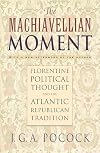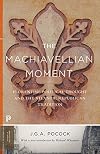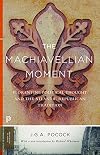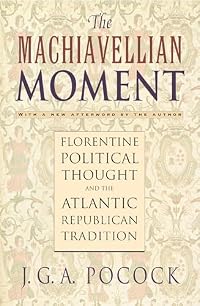
The Machiavellian Moment: Florentine Political Thought and the Atlantic Republican Tradition
by John Greville Agard Pocock, Eloy García (Introduction), Joaquín Gomes Canotilho (Preface), Marta Vázquez-Pimentel (Translator)
There is 1 current discussion about this work.
On This Page
Description
Originally published in 1975, The Machiavellian Moment remains a landmark of historical and political thought. Celebrated historian J.G.A. Pocock looks at the consequences for modern historical and social consciousness arising from the ideal of the classical republic revived by Machiavelli and other thinkers of Renaissance Italy. Pocock shows that Machiavelli's prime emphasis was on the moment in which the republic confronts the problem of its own instability in time, which Pocock calls the show more "Machiavellian moment."After examining this problem in the works of Machiavelli, Guicciardini, and Giannotti, Pocock turns to the revival of republican ideology in Puritan England and in Revolutionary and Federalist America. He argues that the American Revolution can be considered the last great act of civic humanism of the Renaissance and he relates the origins of modern historicism to the clash between civic, Christian, and commercial values in eighteenth-century thought.This Princeton Classics edition of The Machiavellian Moment features a new introduction by Richard Whatmore. show lessTags
Recommendations






Member Reviews
This is easily one of ten most influential books in my life. The author traces the origins and development of 16th-century Italian political thought and its transmission to a very different political culture in 17th-century England, painting a very thorough picture of how different thinkers wrestled with their own and each others' frameworks for understanding, interpreting, and discussing the political worlds they inhabited. The book is very tough going - Pocock's style is not the easiest to read - but if you get through it, it will dramatically alter and expand your understanding of political thinking.
Ratings
Members
- Recently Added By
Lists

Books Read in 2022
5,164 works; 113 members

Bibliography of How the Old World Ended by Jonathan Scott
308 works; 1 member
Talk Discussions
Current Discussions
Not finishing “The Machiavellian Moment” by J.G.A. Pocock in Reformation Era: History and Literature (April 25)
Author Information

28+ Works 1,071 Members
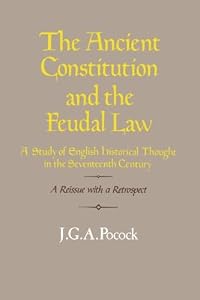
Professor John Pocock, Honorary Fellow of St John's Cambridge, is the Harry C. Black Emeritus Professor of History at the Johns Hopkins University. His many seminal works on intellectual history include The Ancient Constitution and the Feudal Law (1957, second edition 1987), Politics, Language and Time (1971), The Machiavellian Moment (1975), show more Virtue, Commerce and History (1985), Barbarism and Religion (1999) and The Discovery of Islands (2005). He has edited The Political Works of James Harrington (1977) and Burke's Reflections on the Revolution in France (1987), as well as the collaborative study The Varieties of British Political Thought (1995). Professor Pocock is a Corresponding Fellow of the British Academy and of the Royal Historical Society, and a member of both the American Academy of Arts and Sciences and the American Philosophical Society. show less
Awards and Honors
Awards
Common Knowledge
- Canonical title
- The Machiavellian Moment: Florentine Political Thought and the Atlantic Republican Tradition
- Original title
- The Machiavellian moment
- Original publication date
- 1975
- People/Characters
- Niccolò Machiavelli
- Important places
- Florence, Tuscany, Italy; Italy; Tuscany, Italy
- First words
- A sustained intention throughout this book will be that of depicting early modern republican theory in the context of an emerging historicism, the product of ideas and conceptual vocabularies which were available to medieval ... (show all)and Renaissance minds—such as C. S. Lewis called "Old Western"—for the purpose of dealing with particular and contingent events and with time as the dimension of contingent happenings.
- Last words
- (Click to show. Warning: May contain spoilers.)There is a freedom to decline moral absolutes; even those of the polis and history, even that of freedom when proposed as an absolute.
Classifications
- Genres
- Nonfiction, History, Philosophy, Politics and Government, General Nonfiction
- DDC/MDS
- 320.1092 — Society, Government, and Culture Political science Types of Government The State Biography And History Biography
- LCC
- JC143 .M4 .P6 — Political Science Political theory Political theory. The state. Theories of the state Modern state
- BISAC
Statistics
- Members
- 333
- Popularity
- 94,947
- Reviews
- 1
- Rating
- (4.09)
- Languages
- English, Spanish
- Media
- Paper, Ebook
- ISBNs
- 10
- ASINs
- 3