
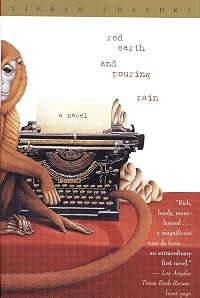
Red Earth and Pouring Rain
by Vikram Chandra
On This Page
Description
A tale of 19th-century India: of Sanjay, a poet, and Sikander, a warrior; of great wars and love affairs and a city gone mad with poetry. Woven into this tapestry of stories is a second, modern narrative - the adventures of a young Indian criss-crossing America in a car with his friends.Tags
Recommendations







Member Recommendations
Member Reviews
How do you bring the worldview of a hundred and fifty years ago into the grammar of a people caught in the cusp of modernity, and tell it through an adopted language? You make a monkey tell the story of a man, himself.
A monkey is shot by an irritated teenager back home in Delhi for a vacation from college in the US. The gods begin a tussle for the monkey's soul, and a wager is made: the monkey will live as long as he can tell a story. A typewriter is produced, and the neighbourhood assembles to hear the monkey recall his past life as a scholar-warrior-poet during and after the Great Mutiny of 1857. What follows is much more than a history lesson...
Red Earth and Pouring Rain is not a book with a point or purpose, or at least the kind of show more point and purpose you might expect from a book about stories and storytellers (the closest parallel I can think of is Umberto Eco's "Baudolino") - or maybe it is a book about life and all of its points and purposes. The canvas is vast, and takes time to paint, and Vikram Chandra does so with skill and fluidity - the words are English, but the language itself is utterly Indian. Westerners who think the English language and literary style still belong to the West will find this book hard to understand.
This is not a book about the English occupation of India, nor is it a fantasy about wilful gods. It is not a book for the impatient: stories take to womb within stories, and the utterly impossible mingles comfortably with the utterly mundane. It is not a book for the cultural voyeur, either - you will get no great insight into Indian "culture" by wading through this epic - the 'exotic' in this book is exotic for modern Indians as well.
What it is, however, is a story of a people divided between the eternal and the now, and their struggle to come to grips with themselves (reformists and optimists, take note). It is a story of rebirths and becomings, of contradictions and impossibilities, and unbearable cruelty and love. Behold, and be enchanted. Above all, surrender. show less
A monkey is shot by an irritated teenager back home in Delhi for a vacation from college in the US. The gods begin a tussle for the monkey's soul, and a wager is made: the monkey will live as long as he can tell a story. A typewriter is produced, and the neighbourhood assembles to hear the monkey recall his past life as a scholar-warrior-poet during and after the Great Mutiny of 1857. What follows is much more than a history lesson...
Red Earth and Pouring Rain is not a book with a point or purpose, or at least the kind of show more point and purpose you might expect from a book about stories and storytellers (the closest parallel I can think of is Umberto Eco's "Baudolino") - or maybe it is a book about life and all of its points and purposes. The canvas is vast, and takes time to paint, and Vikram Chandra does so with skill and fluidity - the words are English, but the language itself is utterly Indian. Westerners who think the English language and literary style still belong to the West will find this book hard to understand.
This is not a book about the English occupation of India, nor is it a fantasy about wilful gods. It is not a book for the impatient: stories take to womb within stories, and the utterly impossible mingles comfortably with the utterly mundane. It is not a book for the cultural voyeur, either - you will get no great insight into Indian "culture" by wading through this epic - the 'exotic' in this book is exotic for modern Indians as well.
What it is, however, is a story of a people divided between the eternal and the now, and their struggle to come to grips with themselves (reformists and optimists, take note). It is a story of rebirths and becomings, of contradictions and impossibilities, and unbearable cruelty and love. Behold, and be enchanted. Above all, surrender. show less
I really enjoyed this novel. Abhay has recently returned to India from college in America and irritated by the thieving antics of a monkey injures it. His parents bring the monkey into the house and discover that it remembers its previous incarnation as a man. As the monkey tells its story of early colonialism in India we also hear some incidents from Abhay's time in America.
This is a multi-layered story that works very well, in my opinion. The history section is the longest and most interesting for me. I loved taking my time with this book, as the stories intertwine and build it becomes a wonderful picture of India and its inhabitants in the past and how the effects of that history are still felt today. I must admit that some of show more Abhay's story shocked me slightly - not the kind of thing I would talk about in front of my parents (if I had ever done such things!). Fortunately these sections are brief and work to show that some of the old colonial attitudes are still extant. Overall a very good read. show less
This is a multi-layered story that works very well, in my opinion. The history section is the longest and most interesting for me. I loved taking my time with this book, as the stories intertwine and build it becomes a wonderful picture of India and its inhabitants in the past and how the effects of that history are still felt today. I must admit that some of show more Abhay's story shocked me slightly - not the kind of thing I would talk about in front of my parents (if I had ever done such things!). Fortunately these sections are brief and work to show that some of the old colonial attitudes are still extant. Overall a very good read. show less
This novel flip flops between early 19th century India, and 1990s India and California/Texas. It is about coming home and what is home, family and what is family, and identity. The cover is not lying, there is a typing monkey.
Many of Chandra's early 19th century characters were real people. I am not well-versed in Indian history (especially Indian military history), so I spent a fair amount of time reading about James Sikander Skinner, George Thomas (Jaharai Jung), Begum Sumroo, and more on Wikipedia. I looked up foods and places and wars. I am sure that someone with good knowledge of Indian history and culture would get a lot more out of this book than I did.
But I did enjoy this. Stories within stories, characters across time, gods, show more cricket in Houston, college in LA, driving long distances, characters in the 19th century and the 20th century wondering who they are and where they belong. show less
Many of Chandra's early 19th century characters were real people. I am not well-versed in Indian history (especially Indian military history), so I spent a fair amount of time reading about James Sikander Skinner, George Thomas (Jaharai Jung), Begum Sumroo, and more on Wikipedia. I looked up foods and places and wars. I am sure that someone with good knowledge of Indian history and culture would get a lot more out of this book than I did.
But I did enjoy this. Stories within stories, characters across time, gods, show more cricket in Houston, college in LA, driving long distances, characters in the 19th century and the 20th century wondering who they are and where they belong. show less
Abhay comes home to India after studying in America, and he shoots a monkey that's been bothering the family for years. Wounded, they take the monkey in and nurse it, hopefully back to health. The monkey starts having flashbacks and realizes that it's a reincarnation of his former human self. the God of Death, Yama appears to the monkey, aka Sanjay in his former life, and wants to take him but Hanuman, the God of monkeys appears when he's appealed to by Sanjay. They strike a bargain and if Sanjay can keep an audience enthralled with stories for 2 hours a day, he will be allowed to live, perhaps in another life form, but at least out of the final clutches of Yama.
Abhay and his family, including a precocious little girl, named Saira, are show more captivated by this monkey who can't speak (and we learn later why not) but who can type. Saira manages to gather up an audience of school children the next day when the story-telling sessions begin and what occurs next is a little like an Indian version of 1001 Arabian Nights.
We are treated to the unfolding drama and saga of Sanjay's life, from the time before his mystical conception to his current condition. The stories are interspersed of course with breaks in time because there's only so much a monkey can type, and also the stories were supposed to only last for 2 hour sessions at a time. The stories include that of his equally mystically conceived brothers, Chotta and the famous warrior Sikander, and their journey from reckless boyhood, through harsh family trials, accidents, quests and wars between the Indians and their English masters.
The stories are so well told that we are immersed in each moment, and forget that it's being told by a typing monkey.
During the intervals between the passages of time in the stories, we are brought back to the present, and find that the elephant God, Ganesh, has joined the other 2 celestial beings, and there is light banter amongst them all.
The only odd notes in this book was that the author felt the need to have Abhay contribute some of his own stories, of a portion of his life in America to the mix, ostensibly because Sanjay's monkey paws were cramping from prolonged typing. I thought his trite stories of college partying, some drug use, and road trips rather jarring to the overall lyrical tone of the book. Thankfully, there weren't too many of Abhay's stories to be too distracting.
It is truly Sanjay's stories of his epic life journey that make this book a compelling read. show less
Abhay and his family, including a precocious little girl, named Saira, are show more captivated by this monkey who can't speak (and we learn later why not) but who can type. Saira manages to gather up an audience of school children the next day when the story-telling sessions begin and what occurs next is a little like an Indian version of 1001 Arabian Nights.
We are treated to the unfolding drama and saga of Sanjay's life, from the time before his mystical conception to his current condition. The stories are interspersed of course with breaks in time because there's only so much a monkey can type, and also the stories were supposed to only last for 2 hour sessions at a time. The stories include that of his equally mystically conceived brothers, Chotta and the famous warrior Sikander, and their journey from reckless boyhood, through harsh family trials, accidents, quests and wars between the Indians and their English masters.
The stories are so well told that we are immersed in each moment, and forget that it's being told by a typing monkey.
During the intervals between the passages of time in the stories, we are brought back to the present, and find that the elephant God, Ganesh, has joined the other 2 celestial beings, and there is light banter amongst them all.
The only odd notes in this book was that the author felt the need to have Abhay contribute some of his own stories, of a portion of his life in America to the mix, ostensibly because Sanjay's monkey paws were cramping from prolonged typing. I thought his trite stories of college partying, some drug use, and road trips rather jarring to the overall lyrical tone of the book. Thankfully, there weren't too many of Abhay's stories to be too distracting.
It is truly Sanjay's stories of his epic life journey that make this book a compelling read. show less
Fascinating! And dense with characters and events. I found it a bit hard to follow -- so many characters, some mythical, and the writing is rich with detail of all kinds. It's a story of stories, narrated mostly by a god-like monkey who used to be human. I'd like to read it again sometime, as I was less confused after reading half the book and I'd get more out of it the second time. This author has boundless imagination! I couldn't tell how much was historical, if any. It's a complex book and richly so, as I said. There are many long, run-on sentences, so the reader must pay close attention. There is much to admire in the book and writing. There are several comical scenes of the monkeys running off with clothing from the clothesline on show more the roof, and more. Most of the stories interlock, revealing a saga of the life of the monkey as a human and other key people and their adventures, trials, lives and loves, and foes. I'd recommend the book for more sophisticated readers and perhaps for those living in India or who have lived there or visited at length. Though I have heard of the Gods in the book, I know nothing about them. show less
One story just flows into another in a rather dizzy way, but it's fun and filled with variety. A monkey narrator on a typewriter, an Indian attending college in America -- a wonderful contrast. Grandly epic and wonderously mythical, but lacks the full characterizations of his later novel _Sacred Games_.
I read this book whilst travelling through Indonesia ten or so years back. It is one of my all time favourite books. Amazing story narrated by a monkey to hindu gods spanning India and america.
Members
- Recently Added By
Lists

All Things India
95 works; 21 members

Dishonourable Mentions of 2013
189 works; 62 members

Myth (Reuse and Retelling)
188 works; 24 members

Speculative Fiction from around the World
610 works; 17 members
Author Information

12+ Works 4,056 Members
Author Vikram Chandra was born in New Delhi, India in 1961. He attended college in the United States receiving a BA in English with a concentration in creative writing from Pomona College and attended the film school at Columbia University before dropping out to work on his first novel. His first novel, Red Earth and Pouring Rain, was inspired by show more an autobiography of a nineteenth century soldier named Colonel James "Sikander" Skinner. It won the Commonwealth Writers Prize for Best First Book and the David Higham Prize for Fiction. His next novel, Love and Longing in Bombay, won the Commonwealth Writers Prize for Best Book (Eurasia region) and was short-listed for the Guardian Fiction Prize. In 2000, he and Suketu Mehta co-wrote the Bollywood movie Mission Kashmir. He teaches creative writing at the University of California and currently divides his time between Berkeley, California and Mumbai. (Bowker Author Biography) show less
Awards and Honors
Awards
Series
Belongs to Publisher Series
Common Knowledge
- Canonical title
- Red Earth and Pouring Rain
- Original publication date
- 1995
- Important places
- India
- Dedication
- For my father and mother, Navin and Kamna
Classifications
Statistics
- Members
- 1,037
- Popularity
- 24,869
- Reviews
- 13
- Rating
- (3.90)
- Languages
- 7 — Danish, Dutch, English, German, Italian, Norwegian (Bokmål), Spanish
- Media
- Paper, Ebook
- ISBNs
- 26
- ASINs
- 9