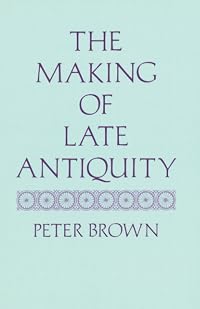
The Making of Late Antiquity
by Peter Brown
On This Page
Description
Peter Brown presents a masterly history of Roman society in the second, third, and fourth centuries. Brown interprets the changes in social patterns and religious thought, breaking away from conventional modern images of the period.Tags
Recommendations
















Member Reviews
Peter Brown had an essay recently in the NYRB, and I'd had a conversation not long before that on neoplatonism, so I picked up this book. It is a set of lectures that extend the argument in his book The World of Late Antiquity (1971) that Gibbon had it wrong, and that the period in which paganism subsided and Christianity took power was not one of decline but of striving transition. In particular, it was a transition from communities in which competition was kept in tense check by various moral and social pressures, to a society in which there were almost no limits to power-seeking. The book also offers an interesting interpretation of daemons, of mystics both pagan and Christian, and other fine points often seeming to be directed at show more specific scholars, most of which are over the head of a non-specialist.
Perhaps I find Brown's arguments easy to accept because they fit in the same world as Braudel and later on, Foucault; that is to say, more on the anthropology side of history than the classics side. One can't help wondering, however, whether Brown is convincing because his view echos contemporary concerns. Gibbon, writing in the mid-18th century, had his reasons for poking a pin in the balloon of Christian orthodoxy, and for envisioning a civilization that has irrevocably declined since its golden youth. Perhaps Brown too had reasons, already in the 1970s and certainly in this new century, to see unbridled ambition as the engine of change. show less
Perhaps I find Brown's arguments easy to accept because they fit in the same world as Braudel and later on, Foucault; that is to say, more on the anthropology side of history than the classics side. One can't help wondering, however, whether Brown is convincing because his view echos contemporary concerns. Gibbon, writing in the mid-18th century, had his reasons for poking a pin in the balloon of Christian orthodoxy, and for envisioning a civilization that has irrevocably declined since its golden youth. Perhaps Brown too had reasons, already in the 1970s and certainly in this new century, to see unbridled ambition as the engine of change. show less
Seminal.
Ratings
Members
- Recently Added By
Lists

Books in the Bibliography of The History of Hell by Alice K. Turner
155 works; 1 member
Author Information

33+ Works 8,837 Members
Series
Belongs to Publisher Series
Carl Newell Jackson Lectures (1976 Lecture)
Common Knowledge
- Canonical title
- The Making of Late Antiquity
- Original title
- The Making of Late Antiquity
- Disambiguation notice
- Originaltitel: The making of late antiquity by Peter Robert Lamont Brown
Classifications
- Genres
- Nonfiction, History, Religion & Spirituality, General Nonfiction
- DDC/MDS
- 937.06 — History & geography History of ancient world (to ca. 499) Italian Peninsula to 476 and adjacent territories to 476 Empire 31 B.C.-476 A.D.
- LCC
- DG312 .B76 — History of Europe, Asia, Africa and Oceania City History of Italy Ancient Italy. Rome to 476 History By period Empire, 27 B.C. - 476 A.D. 284-476. Decline and fall
- BISAC
Statistics
- Members
- 284
- Popularity
- 113,510
- Reviews
- 2
- Rating
- (3.78)
- Languages
- English, French, German, Italian
- Media
- Paper
- ISBNs
- 7
- ASINs
- 2