On This Page
Description
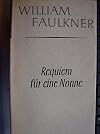
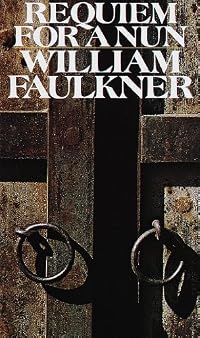
This sequel to Faulkner's most sensational novel, 'Sanctuary', was written twenty years later but takes up the story of Temple Drake eight years after the events related in 'Sanctuary'. Temple is now married to Gowan Stevens. The book begins when the death sentence is pronounced on the nurse Nancy for the murder of Temple and Gowan's child. In an attempt to save her, Temple goes to see the judge to confess her own guilt. Told partly in prose, partly in play form, 'Requiem For A Nun' is a show more haunting exploration of the impact of the past on the present. show lessTags
Recommendations









































Member Reviews
Faulkner obviously could not leave Temple Drake as we last saw her in Sanctuary. There was more to her story and it must have haunted him, as it haunted me, for he returned to her twenty years later to put her soul under a microscope.
I, unlike so many, do not view Temple as an evil person. I view her as a damaged soul, someone who has been so marred by life that she can no longer function. She fails to understand, even herself, what makes her unable to feel emotion as others do, and she carries the blame within her for her obvious shortcomings. She is trapped forever in the moment of her life in which she gets into a car with a drunkard and leaves her life and self behind. Married to Gowan, she can never hope to escape that moment...for show more even his mere presence is a constant reminder.
To read this without first reading Sanctuary would certainly lessen the impact of the story, and in truth, I do not think you could sufficiently understand Temple without the background story that unfolds in Sanctuary. Faulkner is such a remarkable writer and his works are so layered, that I think I will still be thinking about these characters and dissecting them for some time.
The format used here is quite unique. There is a play, sandwiched within three sections of historical exposition of Jackson and Yoknapatawpha County. The history is riveting and it is unbelievable how much information and emotion Faulkner is able to convey in a these rather short sections.
I pondered the title. Faulkner does nothing haphazardly, so I’m absolutely sure there is some deep meaning to this choice. A requiem is a mass for the dead soul--and that is easy enough to equate to Temple. Her soul is undoubtedly dead. But, why a nun? Is she cloistered by her past, living apart from society, from secular life? She has no spiritual attachment to save her, nothing to worship that I can see. If anyone else has an idea about the title, I would love to hear your thoughts. show less
I, unlike so many, do not view Temple as an evil person. I view her as a damaged soul, someone who has been so marred by life that she can no longer function. She fails to understand, even herself, what makes her unable to feel emotion as others do, and she carries the blame within her for her obvious shortcomings. She is trapped forever in the moment of her life in which she gets into a car with a drunkard and leaves her life and self behind. Married to Gowan, she can never hope to escape that moment...for show more even his mere presence is a constant reminder.
To read this without first reading Sanctuary would certainly lessen the impact of the story, and in truth, I do not think you could sufficiently understand Temple without the background story that unfolds in Sanctuary. Faulkner is such a remarkable writer and his works are so layered, that I think I will still be thinking about these characters and dissecting them for some time.
The format used here is quite unique. There is a play, sandwiched within three sections of historical exposition of Jackson and Yoknapatawpha County. The history is riveting and it is unbelievable how much information and emotion Faulkner is able to convey in a these rather short sections.
I pondered the title. Faulkner does nothing haphazardly, so I’m absolutely sure there is some deep meaning to this choice. A requiem is a mass for the dead soul--and that is easy enough to equate to Temple. Her soul is undoubtedly dead. But, why a nun? Is she cloistered by her past, living apart from society, from secular life? She has no spiritual attachment to save her, nothing to worship that I can see. If anyone else has an idea about the title, I would love to hear your thoughts. show less
Now this was strange: part novel and part play and part who knows what. Faulkner's always trying to push the envelope here. It follows Temple Drake after her appearance in Sanctuary, but it's not as exciting of a read. There are better Faulkner books out there.
530. Requiem for a Nun by William Faulkner (read 18 Jan 1958) I did no post-reading note but was suitably impressed by this book
Ratings
Members
- Recently Added By
Lists

20th Century Literature
1,161 works; 54 members

1950s
340 works; 22 members

the law is an ass
20 works; 5 members
National Book Award Finalists - Fiction
377 works; 12 members
Author Information

460+ Works 98,983 Members
Born in an old Mississippi family, William Faulkner made his home in Oxford, seat of the University of Mississippi. After the fifth grade he went to school only off and on-lived, read, and wrote much as he pleased. In 1918, refusing to enlist with the "Yankees," he joined the Canadian Air Force, and was transferred to the British Royal Air Force. show more After the war he studied a little at the University, did house painting, worked as a night superintendent at a power plant, went to New Orleans and became a friend of Sherwood Anderson, then to Europe and back home to Oxford. By this time he had written two novels. The Sound and the Fury followed in 1929. Financial success came with Sanctuary in 1931, which he assisted in filming. Faulkner 's novels are intense in their character portrayals of disintegrating Southern aristocrats, poor whites, and African Americans. A complex stream-of-consciousness rhetoric often involves Faulkner in lengthy sentences of anguished power. Most of his tales are set in the mythical Yoknapatawpha County, Mississippi, and are characterized by the use of many recurring characters from families of different social levels spanning more than a century. His best subjects are the old, dying South and the newer materialistic South. As I Lay Dying (1930), is a grotesquely tragicomic story about a family of poor southern whites. With Absalom, Absalom! (1936); the difficult parts of his famous short novel "The Bear" (published in Go Down, Moses, 1942); and the allegorical A Fable (1954), a non-Yoknapatawpha novel set in France during World War I; Faulkner returned to an innovative and difficult style that most readers have trouble with. Yet, interspersed among such works are collections of easily read stories originally published in popular magazines. There seems to be a growing sentiment among critics that the Snopes trilogy-The Hamlet (1940), The Town (1957), and The Mansion (1959)-for the most part an example of Faulkner's "moderate" style, could well be among his most important works. Faulkner was awarded the 1949 Nobel Prize for literature "for his powerful and artistically independent contribution to the new American novel," but it would appear now that he also deserved to win that honor for his contribution to world literature. When reporting his death, the Boston Globe quoted Faulkner's having once told an interviewer: "Since man is mortal, the only immortality for him is to leave something behind him that is immortal since it will always move. That is the artist's way of scribbling "Kilroy was here" on the wall of the final and irrevocable oblivion through which he must some day pass." In addition to the Nobel Prize, Faulkner received the Howells Medal of the American Academy of Arts and Letters in 1950, and in 1951 he was given the National Book Award for his Collected Stories Collected Stories. For his novel A Fable he received the National Book Award for the second time, as well as the Pulitzer Prize in 1955. The Reivers (1962) was awarded the Pulitzer Prize in 1963. In 1957 and 1958, he was the University of Virginia's first writer-in-residence, and in January 1959 he accepted an appointment as consultant on contemporary literature to the Alderman Library of that university. Although Faulkner was not without honors in his lifetime and has received world recognition since then, it is surprising to learn that, when Malcolm Cowley edited The Portable Faulkner in 1946, he found that almost all of Faulkner's books were out of print. By arranging selections from the works to form a continuous chronicle, Cowley deserves much of the credit for making readers aware of the way in which Faulkner was creating a fictive world on a scale grander than that of any novelist since Balzac. William Faulkner died in Oxford, Mississippi, in 1962. (Bowker Author Biography) show less
Awards and Honors
Awards
Distinctions
Series

Belongs to Publisher Series
Work Relationships
Is contained in
Has the adaptation
Has as a study
Has as a concordance
Common Knowledge
- Original title
- Requiem for a Nun
- Original publication date
- 1951
- Important places
- Yoknapatawpha County, Mississippi, USA
- Quotations
- “The past is never dead. It’s not even past.”
- Original language
- English
Classifications
Statistics
- Members
- 730
- Popularity
- 38,563
- Reviews
- 3
- Rating
- (3.47)
- Languages
- 10 — Catalan, English, French, German, Italian, Polish, Portuguese, Romanian, Spanish, Swedish
- Media
- Paper, Ebook
- ISBNs
- 26
- ASINs
- 30