Blue Chameleon
by Emily Gravett 
On This Page
Description
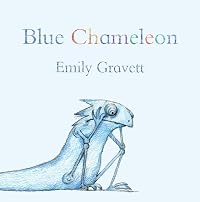
The chameleon is feeling blue because he's lonely, so he goes and visits a yellow banana, pink cockatoo, swirly snail, brown boot, and so on. Each time, not only does he change his color to match the object or animal, but he also contorts himself into a shape that matches them.Tags
Recommendations








Member Recommendations
Member Reviews
Summary
Blue Chameleon by Emily Gravett presents a lonely chameleon that is searching for a companion. At first, the chameleon uses its color-changing abilities to mimic the creatures and items that it is seeking friendship with. When it meets a banana, it turns yellow and curved. When it meets a snail, it turns swirly, like the snails shell. When it meets a striped sock, it turns “stripy.” However, after being unsuccessful, the chameleon learns in order to truly be happy and find a real friend, it must be itself.
Critique
Gravett creates this story by using minimal text (There are usually just two words per page layout.) and pencil-type, colored illustrations. Most of the phrases are separated by having the adjective on the left with show more the noun on the right. This separation of grammar lends itself well to helping younger students with processing language structure and word types.
Besides the words, including speech bubbles, the chameleon and the object of its attention are the only things present. Gravett's use of minimal background, along with the large, handlettered Bembo text, emphasizes the similarities between the chameleon and each object. At one point, the chameleon merges with the blank page, disappearing in the whiteness. Gravett uses the similarities and contrasts of color and pattern to emphasize the theme of the book: being true to oneself.
Recommendation
Gravett's book is great for young readers. The vibrant, yet simplistic, sketches along with the minimal text with consistent phrase structure would be a great book for teaching emergent readers the adjective-noun connection. The message of “being true to oneself” is also articulated well through both the illustrations and text and is a lesson well worth learning. show less
Blue Chameleon by Emily Gravett presents a lonely chameleon that is searching for a companion. At first, the chameleon uses its color-changing abilities to mimic the creatures and items that it is seeking friendship with. When it meets a banana, it turns yellow and curved. When it meets a snail, it turns swirly, like the snails shell. When it meets a striped sock, it turns “stripy.” However, after being unsuccessful, the chameleon learns in order to truly be happy and find a real friend, it must be itself.
Critique
Gravett creates this story by using minimal text (There are usually just two words per page layout.) and pencil-type, colored illustrations. Most of the phrases are separated by having the adjective on the left with show more the noun on the right. This separation of grammar lends itself well to helping younger students with processing language structure and word types.
Besides the words, including speech bubbles, the chameleon and the object of its attention are the only things present. Gravett's use of minimal background, along with the large, handlettered Bembo text, emphasizes the similarities between the chameleon and each object. At one point, the chameleon merges with the blank page, disappearing in the whiteness. Gravett uses the similarities and contrasts of color and pattern to emphasize the theme of the book: being true to oneself.
Recommendation
Gravett's book is great for young readers. The vibrant, yet simplistic, sketches along with the minimal text with consistent phrase structure would be a great book for teaching emergent readers the adjective-noun connection. The message of “being true to oneself” is also articulated well through both the illustrations and text and is a lesson well worth learning. show less
I loved this book! Blue chameleon is feeling lonely, so as he meets other animals (and, entertainingly, things) he greets them by imitating their colors and shapes, until, just as he's given up, he meets a new friend.
This is a very simple, non-cluttered book. Each page has only a couple of words (most of which are in chameleon's word balloons), and the pictures are against a pure white background. That background really lets Gravett's art pop. And her illustrations are gorgeous! The colors are rich, and the drawings very expressive, which makes it a great storytime book. But what I loved best is that the art is drawn, and Gravett included those throwaway lines - the ones she decided not to use and that others would normally erase, and show more those inclusions really make the book for me. I guess I appreciate seeing the 'building blocks' of a drawing... Plus, there's a really great page in which chameleon really blends in!
Highly recommended! show less
This is a very simple, non-cluttered book. Each page has only a couple of words (most of which are in chameleon's word balloons), and the pictures are against a pure white background. That background really lets Gravett's art pop. And her illustrations are gorgeous! The colors are rich, and the drawings very expressive, which makes it a great storytime book. But what I loved best is that the art is drawn, and Gravett included those throwaway lines - the ones she decided not to use and that others would normally erase, and show more those inclusions really make the book for me. I guess I appreciate seeing the 'building blocks' of a drawing... Plus, there's a really great page in which chameleon really blends in!
Highly recommended! show less
Oh! Much more light and simple than I expected, based on the other Gravett titles that have impressed me. There's, what, about 20 total words in this book that uses 'colors' to teach about friendship.... But I feel I ought to mention that it's pretty easy to read a negative subtext into the story. A reader could get the message that it's ridiculous to make friends with others, that clans should cohere, and that everyone else is 'other.' Why the heck can't a chameleon and a grasshopper be friends? Why can't a Jew and an Arab be friends? I do like the body language of the sad chameleon, though, as he tries to be empathetic and akin to the grasshopper, and the cockatoo, etc.
This delightful, clever concept book focuses on colors and patterns, while also telling the story of a lonely chameleon, looking for someone to play with. The chameleon starts out feeling "blue" because he's lonely. Then he turns yellow when he sees and attempts to befriend a banana. He becomes pink like a cockatoo, swirly like a snail and spotty like a ball. But only when he finds another multi-colored chameleon at the end of the book, does his loneliness come to an end.
Grades PS-1
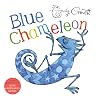
Why is the chameleon blue? Kids will enjoy predicting what the story is about from the expressive chameleon on the cover. With only two words per each double-page spread-- yellow banana... pink cockatoo... spotty ball-- Gravett clearly portrays the chameleon's desire for a friend and the lengths to which he will go to fit in. As he gets more and more discouraged, he goes to gray on a rock, and then blends in to white on the page. Children will have to look closely to see the little hand reaching over on the white page with a tentative "Hello?" and will love the happily ever after exuberant ending.
Why is the chameleon blue? Kids will enjoy predicting what the story is about from the expressive chameleon on the cover. With only two words per each double-page spread-- yellow banana... pink cockatoo... spotty ball-- Gravett clearly portrays the chameleon's desire for a friend and the lengths to which he will go to fit in. As he gets more and more discouraged, he goes to gray on a rock, and then blends in to white on the page. Children will have to look closely to see the little hand reaching over on the white page with a tentative "Hello?" and will love the happily ever after exuberant ending.
A lonely chameleon attempts to connect with other objects and animals by making himself look like them and talk like them. The narration is minimal (two words on each page, plus dialogue bubbles from the characters), but the colored pencil drawings are bright and animated.
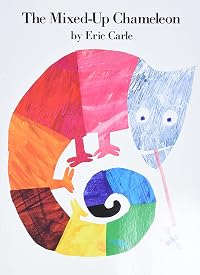
All the charm of Orange Pear Apple Bear, but with more of a story: chameleon tries to blend in to match others (a banana, a snail, a sock, a grasshopper), but finally finds another brightly multicolored chameleon. Reminiscent of Eric Carle's The Mixed-Up Chameleon.
Members
- Recently Added By
Lists

Written and Illustrated By
805 works; 1 member
Author Information

34+ Works 7,017 Members
Emily Gravett is a LibraryThing Author, an author who lists their personal library on LibraryThing.
Awards and Honors
Awards
Notable Lists
Classifications
Statistics
- Members
- 352
- Popularity
- 89,688
- Reviews
- 34
- Rating
- (3.88)
- Languages
- 6 — Arabic, Chinese, English, French, Galician, Spanish
- Media
- Paper, Ebook
- ISBNs
- 16
- ASINs
- 3