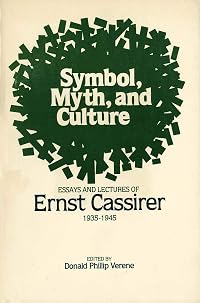
Symbol, Myth, and Culture: Essays and Lectures of Ernst Cassirer, 1935-1945
by Ernst Cassirer
37 Members (4.50)
On This Page
Description
The papers in this volume of Ernst Cassirer's unpublished works give insight into the major issues that engaged Cassirer's interest between 1935 and 1945. The book begins with his inaugural address at the University of Göteborg, Sweden, in the first years of his exile from Hitler's Germany, and ends with a talk to the Columbia Philosophy Club. The note that introduces this piece was written on the day of his death. In his long and productive career, Ernst Cassirer always tried to show more integrate his works of original philosophy and studies in intellectual history into a general understanding of the nature of myth, culture, and symbol. These essays show that his interest persisted to the end. His piece on Judaism and political myths is perhaps the most dramatic in this collection, as it blends philosophical coolness with his deeply felt outrage at fascism. Best known in this country for The Myth of the State, The Philosophy of Symbolic Forms, and An Essay on Man, Ernst Cassirer has been read and studied by generations of students. In this book they will find illuminations, in a more informal voice, of the major themes in Cassirer's work. New readers will be introduced to the great issues that occupied the interest of one of the twentieth century's most widely read philosophers. "A genuine contribution to the history of modern philosophy - and of special value to the informed general reader, since it includes a number of valid attempts by Cassirer to translate his radical, sometimes difficult, concepts of culture into non-technical terms." -- The Booklist show lessTags
Recommendations






































Member Reviews
Members
- Recently Added By
Author Information

171+ Works 5,268 Members
Ernst Cassirer, a German neo-Kantian philosopher, taught at several European universities before moving to the United States and teaching at Yale (1941-1944) and Columbia universities. A prolific historian of philosophy, Cassirer was influenced by Immanuel Kant and Georg Hegel but originated his own distinctive doctrine. The centerpiece of show more Cassirer's thought is his theory of symbolic forms. He construed representation, the ground of symbolic form, to be essentially symbolic, fusing perceptual materials with conceptual meanings. The human species, he taught, is essentially a symbolizing animal. He maintained that symbolic forms are manifest in different modes-languages, myth, art, science, and religion. Cassirer utilized his theory of symbolic forms in the elaboration of a flexible philosophy of culture. (Bowker Author Biography) show less
Classifications
Statistics
- Members
- 37
- Popularity
- 766,235
- Rating
- (4.50)
- Languages
- English
- Media
- Paper
- ISBNs
- 3