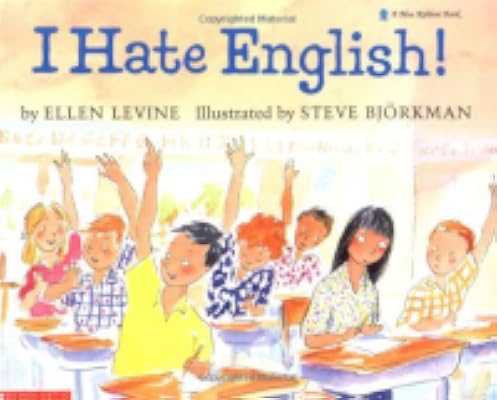
I Hate English! (A Blue Ribbon Book)
by Ellen Levine
On This Page
Description
When her family moves to New York from Hong Kong, Mei Mei finds it difficult to adjust to school and learn the alien sounds of English.Tags
Recommendations








Member Reviews
I Hate English! is a book about a Chinese girl whose family has come to live in America. She is sent to an American school to learn, but she does not understand English. She goes to a program after school to help her learn the English language but she refuses to learn. She still writes in Chinese because she thinks that the writing is so much prettier than writing in English. She finally has a tutor that understands that she wants to keep her own language but she tries to engage the girl into speaking in English by taking walks around town. In the end she learns to speak and writes English, but still uses her Chinese language.
I liked this book because so many of us in America do not realize how hard it is for an ELL student to learn show more English. I think that this book also shows the importance of keeping your traditions and heritage. So many cultures have lost so much by not being able to keep their ways. This has happened in my own family. My grandfather did not speak Kiowa to my mother or her siblings because it was not the thing to do back then. I really wished I had the chance (or interest) to have my grandpa teach me more of the language.
I would use this book to introduce students to know that there are other languages spoken in the United States of America and that is alright to do so. I would also explain that some students might speak their native language at home and only speak English at school or when speaking to someone outside of their family. We might then take a survey of the school to see what languages are spoken and then graph them on a chart. I would love to have someone who speaks Chinese come in and talk to my students and maybe show them how to write their name in Chinese. show less
I liked this book because so many of us in America do not realize how hard it is for an ELL student to learn show more English. I think that this book also shows the importance of keeping your traditions and heritage. So many cultures have lost so much by not being able to keep their ways. This has happened in my own family. My grandfather did not speak Kiowa to my mother or her siblings because it was not the thing to do back then. I really wished I had the chance (or interest) to have my grandpa teach me more of the language.
I would use this book to introduce students to know that there are other languages spoken in the United States of America and that is alright to do so. I would also explain that some students might speak their native language at home and only speak English at school or when speaking to someone outside of their family. We might then take a survey of the school to see what languages are spoken and then graph them on a chart. I would love to have someone who speaks Chinese come in and talk to my students and maybe show them how to write their name in Chinese. show less
I enjoyed “I Hate English!” by Ellen Levine for several reasons. First, I liked that the book pushes readers to think about complicated issues such as moving and learning to speak a new language. In the book the main character, Mei Mei, moves from Hong Kong to New York. At first she has a difficult time adjusting to life in a new country, and refuses to speak English. Mei Mei is then introduced to a teacher who helps her learn English in a fun way. This teaches children that it’s normal to have a hard time learning a new language, but there are many benefits to it. I also liked the language in “I Hate English!” Each page of the book followed a pattern, they all ended with Mei Mei saying something in Chinese or English. I show more thought this added an interesting flare to the book. Overall, I enjoyed reading Ellen Levine’s “I Hate English!” and think it would be a great book to read in a classroom with English Language Learners. show less
I liked this book because the plot was a touching story of how Mei Mei went from hating English, to learning it and even enjoying using it. This story gives readers a view of how others feel when they move to America and must learn English. I had never thought of the idea that our language is "lonely" because each letter made a different sound, but this is how it seemed to Mei Mei. This book helps me relate better to those learning English as a second language. The pictures were also an excellent addition to the book. It showed how sad Mei Mei was and enabled you to picture her walk through the city. Also the repetition of "in Chinese" had a nice effect of making these words stand out and bringing more meaning to them. The book made you show more realize how difficult the transition was to go from only speaking and thinking in Chinese to having to speak English almost constantly. I think the main idea of the story is that change may be scary at times, making you feel as though you are becoming a different person, but in the end it is okay and should be embraced. show less
I loved reading this book! It was a great read as someone who is possibly going into the special education field, but also for a student who is an English Language Learner. The main character, Mei Mei, is very well developed and easy to relate to. The author expresses all of her inner-thoughts and feelings, and brings the reader on an emotional roller coaster as Mei Mei discovers her new identity in America. This inner dialogue is matched with beautiful watercolor images on each page that illustrate the thoughts running through Mei Mei’s head. We as the reader can see all of her memories and dreams and fears through depictions. For example, on page 28, the author illustrates a huge Chinese dragon with Mei Mei’s friends all show more celebrating, which parallels the text, “And before she could think about what she was doing, Mei Mei began. She talked about Children’s Day in Hong Kong.” Through this image the reader could see and feel what Mei Mei was missing and empathize with her, whether or not the reader celebrated these same traditions. This book pushes readers, especially who are in the same situation as Mei Mei, to either be more open to learning English or have more of an understanding of students in their class who are non-native English speakers. The message of this story is to not be afraid to change because your identity and who you truly are will always stick with you. show less
In my opinion this is a great and useful multicultural book. The main idea of this story is that learning a new language can be difficult at first, but when you overcome the obstacles it can be fun. The first reason why I enjoyed this book is the characters are believable. Mei Mei is a Chinese student that recently moved to the United States. She is having a difficult time adjusting to her new life, as well as understanding the English language. The United States has high percentage of students that speak a foreign language as their first language, and they also might struggle in the classroom. Mei Mei is a perfect example of how a international student might feel when going through a transition of moving to the U.S. Next, I like the show more story because of the plot. Although Mei Mei hates learning English, but she met a great English teacher that helped her along the way. The plot has a clear problem and solution theme. Lastly, I like that the story had illustrations that depicted the emotional roller coaster Mei Mei was going through while adjusting to her new life in the U.S. The first page opens up and you see a frustrated Mei Mei. Although it doesn’t seem great to start off by opening up a book of someone looking mad, but it makes the reader want to find out if Mei Mei ever likes to learn English and if she can turn that frown upside down. show less
This book tells the story of Mei Mei, a young girl from Hong Kong who moves to New York City and struggles to learn English in her new classroom. Set in a modern urban school, the book highlights the emotional challenges faced by immigrant children as they adjust to a new language and culture. This story is ideal for middle grades classrooms, especially those with English language learners, because it builds empathy and encourages discussions about inclusion. I would use this book to connect reading with social-emotional learning, as students explore how it feels to be in someone else's shoes. With its heartfelt message and relatable main character, this book offers both meaningful instruction and a powerful classroom conversation.
In my opinion, this is a great book for a diverse classroom. In I Hate English, Mei Mei struggles to learn and adapt to the English language—partially due to stubbornness and partially due to fondness of her native language, Chinese. I liked the characters of both Mei Mei and the teacher that helps her (finally) adjust to English, because I thought they were both relatable. Mei Mei would be a great character in which English Language Learning students could “see” themselves, and I found myself hoping to, one day, be like the teacher that helps Mei Mei learn. I also enjoyed the pattern that the writing followed, where Mei Mei would say something in either Chinese or English. This book pushes readers to think about not only how show more frustrating it can be to learn a new language, but how rewarding and fun it can be when the speaker finally overcomes it, which I feel is the message of this fun, relatable book. show less
Members
- Recently Added By
Author Information

31+ Works 19,012 Members
Ellen Levine was born in New York City on March 9, 1939. She received a master's degree in political science from the University of Chicago and a law degree from New York University School of Law. She was an attorney for a public-interest law group, a documentary filmmaker, and taught courses in writing for children and young adults in Vermont show more College's MFA program. She wrote numerous books for children and young adults during her lifetime including Darkness Over Denmark, I Hate English, Freedom's Children: Young Civil Rights Activists Tell Their Stories, Rachel Carson: A Twentieth-Century Life, and Henry's Freedom Box. She died from lung cancer on May 26, 2012 at the age of 73. (Bowker Author Biography) show less
Awards and Honors
Classifications
- Genres
- Picture Books, Children's Books
- DDC/MDS
- 791.43 — Arts & recreation Recreation, sports, and performing arts Public performances Motion pictures, radio, television, podcasting Motion pictures
- LCC
- PZ7 .L57833 .I — Language and Literature Fiction and juvenile belles lettres Fiction and juvenile belles lettres Juvenile belles lettres
- BISAC
Statistics
- Members
- 1,195
- Popularity
- 20,850
- Reviews
- 60
- Rating
- (4.23)
- Languages
- English
- Media
- Paper
- ISBNs
- 7
- UPCs
- 1
- ASINs
- 2