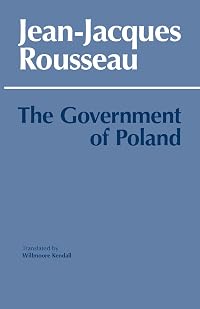
The Government of Poland
by Jean-Jacques Rousseau
55 Members (3.50)
On This Page
Description
"The Government of Poland is the only finished work in which Rousseau himself dons the mantle of legislator, applying the principles of the Social Contract to the real world around him. Poland teaches us much about the mysterious art of the Social Contract's 'legislator,' how he transforms each individual into part of a larger whole. Only in . . . Poland do we find what this crucial transformation entails and what it presupposes. But probably the greatest lesson to be learned from . . . show more Poland concerns Rousseau's understanding of the proper relationship between theory and practice. . . . Time and again we see Rousseau advising the Poles to do things which are in gross violation of the strict principles of political right he had elaborated in the Social Contract." --Richard Myers in Canadian Journal of Political Science show lessTags
Recommendations











Member Reviews
Members
- Recently Added By
Lists

Future Politics Political Science 300
18 works; 1 member
Author Information

913+ Works 27,567 Members
Jean Jacques Rousseau was a Swiss philosopher and political theorist who lived much of his life in France. Many reference books describe him as French, but he generally added "Citizen of Geneva" whenever he signed his name. He presented his theory of education in Emile (1762), a novel, the first book to link the educational process to a scientific show more understanding of children; Rousseau is thus regarded as the precursor, if not the founder, of child psychology. "The greatest good is not authority, but liberty," he wrote, and in The Social Contract (1762) Rousseau moved from a study of the individual to an analysis of the relationship of the individual to the state: "The art of politics consists of making each citizen extremely dependent upon the polis in order to free him from dependence upon other citizens." This doctrine of sovereignty, the absolute supremacy of the state over its members, has led many to accuse Rousseau of opening the doors to despotism, collectivism, and totalitarianism. Others say that this is the opposite of Rousseau's intent, that the surrender of rights is only apparent, and that in the end individuals retain the rights that they appear to have given up. In effect, these Rousseau supporters say, the social contract is designed to secure or to restore to individuals in the state of civilization the equivalent of the rights they enjoyed in the state of nature. Rousseau was a passionate man who lived in passionate times, and he still stirs passion in those who write about him today. (Bowker Author Biography) show less
Classifications
- Genres
- Politics and Government, Nonfiction, Philosophy, General Nonfiction
- DDC/MDS
- 320.9438 — Society, government, & culture Political science Types of Government Political situation and conditions Europe Germany & Central Europe Poland
- LCC
- JN6750 .R6213 — Political Science Political institutions and public administration (Europe) Political institutions and public administration (Europe) Poland
- BISAC
Statistics
- Members
- 55
- Popularity
- 557,006
- Rating
- (3.50)
- Languages
- English, Portuguese
- Media
- Paper
- ISBNs
- 2