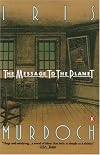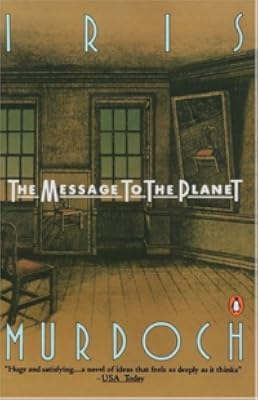
The Message to the Planet
by Iris Murdoch 
On This Page
Description
For years, Alfred Ludens has pursued mathematician and philosopher Marcus Vallar in the belief that he possesses a profound metaphysical formula, a missing link of great significance to mankind. Luden's friends are more sceptical. Jack Sheerwater, painter, thinks Marcus is crazy. Gildas herne, ex-preist, thinks he is evil. Patrick Fenman, poet, is dying because he thinks Marcus has cursed him. Marcus has disappeared and must be found. But is he a genius, a hero struggling at the bounds of show more human knowledge? Is he seeking God, or is he just another victim of the Holocaust, which casts its shadow upon him and upon Ludens, both of them Jewish? Can human thinking discover the foundations of human consciousness? Iris Murdoch's endlessly inventive imagination has touched a fundamental question of our time. show lessTags
Recommendations


















Member Reviews
I'm sadly nearing the end of my Iris Murdoch reading project. This is a decent book with many of her usual themes. A cast of strange friends interacting, some scarcely plausible events, sudden and intense love, stones, water. Reading her books over a number of years I'm struck with how each book is similar but different as she worries away at the same problems of what is good, of how we love, of what we are doing in the world. In this Patrick is a genius or possibly a madman who becomes a guru by mistake and his friends try to figure out what this means.
This is a big novel and exhibits the classic Murdochian imagery (motifs really) and themes and characters in abundance. What has begun, overall, to amaze me about her work is that each book offers a fresh approach to the same subject (nature of good and evil, within and without). In all her books, swimming (and specific swimming places), beautiful stones of all sizes, amazing houses, gardens and landscapes, women's (and some men's) clothing, especially dresses, and food, the occasional crucial cat or dog, to name a few motifs that recur and recur. One especially fine image/motif in this novel is a huge sarcen rock, called the Axle stone, on the grounds of a high end mental institution. The themes are simpler: infidelity and the show more converse, loyalty and the big questions of good and evil, innocence and depravity. She also, as often examines the link between genius, mental illness and the paranormal (if any) and faith versus rationality. In this novel two threads weave (although they only connect through one person, the main character, Alfred Ludens) one concerning the artist Jack and his attempt to get two women to consent to be his concubine-wives and the other concerning Marcus Vallar a man who has exhibited genius (early on in maths, then in painting) with whom he has been somewhat obsessed since meeting him as a student. There is a group of friends and Marcus, apparently, cursed one of them andIrishman and a poet who is now wasting away and on his deathbed. Ludens finds Marcus and begs him to come and lift the curse which Marcus does, in fact, do in a way that appears miraculous. Marcus' daughter will have none of it: she knows he is a man on the edge, close to madness. What is remarkable to me is that Murdoch convincingly portrays a man of genius in a mental torment - not an easy thing to do. Ludens is the agent who 'translates' what Marcus says and there is a constant tension between Ludens hopes and wishes that Marcus will break through into some critical insight into human nature that will help mankind progress and the fact that Marcus, while he has genuinely struggled to understand the nature of evil and suffering, has been broken by it. Sometimes you find yourself doubting Marcus only to be freshly presented with an example of his sincerity and anguish. Ludens, his acolyte, alternately seems loving and selfishly cruel and deluded. To trivialize what Murdoch is attempting to examine would be a shame. While the dresses and food and so on might seem to be in too great a contrast to the bigger theme, not at all. Such is the nature of being alive: being caught in the small details, as well as one's own emotional limitations. Ludens really is awful and naive and stupid a lot of the time, but you never doubt his love for Marcus and his sincerity and even a certain level of honesty with himself even though it doesn't make him behave any better. It is, ultimately, the story of one person growing up: Ludens, and he does successfully do this, so that is all to the good. I can't say I loved every minute - it took me two months, with several breaks, to get through. Jack is a terrible ass and you want to shake him by the scruff of his neck. It was hard reading, but the women do eventually get wise--with the help of a sensible Bostonian named Maisie (very funny!). I also found it poignant that Murdoch was examining the crumbling of a brilliant mind. This is her third from the last book, 1990, and while the next one The Green Knight is successful, the final one is shows signs, apparently of failing mental ability. I see none of that here, only perhaps, a sense of looming disaster on the far horizon. Fascinating as always. I don't really care at this point whether I 'like' a particular one of her books or not. **** show less
Would any wife allow her husband to move his young mistress into the house? That’s what happens this long novel written when Murdoch was approaching the end of her illustrious literary career. Add to that a man raised from the dead and A mathematical genius worshiped by hippies, you might think you’re immersed in a fantasy novel rather than a story about wealthy academics and artists pursuing their egotistical desires. Murdoch wouldn’t claim to be a realist writer however and philosophy, the preternatural and cosy domesticity sit happily side by side in this thoroughly entertaining tale, that even has a happy ending for most of the characters.
I couldn't resist going back to Iris Murdoch for my final book of 2020, and I have to admit that finishing a book this long in three days was more of a challenge than I anticipated, largely because of the density of the text and the amount of philosophical discussion.
There is still plenty of Murdoch's characteristic character building. For me the main character Albert Ludens (who prefers to be known by his surname) is the least interesting, but it is his story through the more charismatic characters are introduced. The most significant is Marcus Vallans, whose past include a great discovery as a young mathematician and a painting phase which was well received. Vallans now leads a reclusive life with his daughter Irina. Ludens believes show more him to be on the verge of a great discovery and feels it is his duty to facilitate its emergence. Some of his friends believe that Marcus is mad, and one of them, Patrick, is on his death bed with a mysterious illness he attributes to Marcus's curse. Ludens uses Patrick as an excuse to track Marcus down to a cottage on the Essex estate of a largely absent lord, and persuades him to see Patrick, who he succeeds in reviving in circumstances that appear miraculous. Irina then arranges for Marcus to move to another rural cottage, which is attached to an expensive mental institution, and the bulk of the book is set there.
Ludens and Patrick's friends include Jack, a painter who wants his wife Franca and mistress Alison to support his idea of living openly in menage a trois, and their machinations are in some ways more interesting than the main story.
This is another fine book, but perhaps not the best place to start for anyone new to Murdoch's writing. show less
There is still plenty of Murdoch's characteristic character building. For me the main character Albert Ludens (who prefers to be known by his surname) is the least interesting, but it is his story through the more charismatic characters are introduced. The most significant is Marcus Vallans, whose past include a great discovery as a young mathematician and a painting phase which was well received. Vallans now leads a reclusive life with his daughter Irina. Ludens believes show more him to be on the verge of a great discovery and feels it is his duty to facilitate its emergence. Some of his friends believe that Marcus is mad, and one of them, Patrick, is on his death bed with a mysterious illness he attributes to Marcus's curse. Ludens uses Patrick as an excuse to track Marcus down to a cottage on the Essex estate of a largely absent lord, and persuades him to see Patrick, who he succeeds in reviving in circumstances that appear miraculous. Irina then arranges for Marcus to move to another rural cottage, which is attached to an expensive mental institution, and the bulk of the book is set there.
Ludens and Patrick's friends include Jack, a painter who wants his wife Franca and mistress Alison to support his idea of living openly in menage a trois, and their machinations are in some ways more interesting than the main story.
This is another fine book, but perhaps not the best place to start for anyone new to Murdoch's writing. show less
Bought 30 Dec 1994
I have to say that this is not my favourite Murdoch. Like the remaining ones we have to read now, I had only read this once before. I think I recall liking The Green Knight more; I certainly hope so. Anyway. With its echos of an Indian novel whose title I can't remember (it's not Naipaul's The Mystic Masseur, but one about a chap who sits under a tree and accidentally becomes a guru), there is a good dollop of clever irony in the book, and I like the collection of Oxford friends, and a couple of the characters, but it doesn't engage and attract like The Book And The Brotherhood. There is a whopping great example of one of our group's Themes, though. I'll be interested to see what the others think of it.
I have to say that this is not my favourite Murdoch. Like the remaining ones we have to read now, I had only read this once before. I think I recall liking The Green Knight more; I certainly hope so. Anyway. With its echos of an Indian novel whose title I can't remember (it's not Naipaul's The Mystic Masseur, but one about a chap who sits under a tree and accidentally becomes a guru), there is a good dollop of clever irony in the book, and I like the collection of Oxford friends, and a couple of the characters, but it doesn't engage and attract like The Book And The Brotherhood. There is a whopping great example of one of our group's Themes, though. I'll be interested to see what the others think of it.
I tried for almost half the book, but just couldn't get into it. I couldn't figure out when the story was set, didn't warm to any of the characters, and the plot just left me cold. So, I gave up. It's a little disappointing because I loved the other books I read by Iris Murdoch, all of which either had a gripping plot or, as The Bell, were littered with quite humourous scenes.
Amazingly pretentious book filled with incredibly self-absorbed people.
Members
- Recently Added By
Lists

Religious Fiction
58 works; 13 members

Literature About Adultery
69 works; 10 members
Author Information

100+ Works 29,312 Members
Iris Murdoch was one of the twentieth century's most prominent novelists, winner of the Booker Prize for The Sea. She died in 1999. (Publisher Provided) Iris Murdoch was born in Dublin, Ireland on July 15, 1919. She was educated at Badminton School in Bristol and Oxford University, where she read classics, ancient history, and philosophy. After show more several government jobs, she returned to academic life, studying philosophy at Newnham College, Cambridge. In 1948, she became a fellow and tutor at St. Anne's College, Oxford. She also taught at the Royal College of Art in London. A professional philosopher, she began writing novels as a hobby, but quickly established herself as a genuine literary talent. She wrote over 25 novels during her lifetime including Under the Net, A Severed Head, The Unicorn, and Of the Nice and the Good. She won several awards including the James Tait Black Memorial Prize for The Black Prince in 1973 and the Booker Prize for The Sea, The Sea in 1978. She died on February 8, 1999 at the age of 79. (Bowker Author Biography) show less
Iris Murdoch has a Legacy Library. Legacy libraries are the personal libraries of famous readers, entered by LibraryThing members from the Legacy Libraries group.
Common Knowledge
- Original title
- The Message to the Planet
- Original publication date
- 1989
- Dedication
- TO
Audhild and Borys Villers - First words
- 'Of course we have to do with two madmen now, not with one.'
- Quotations
- This is a charming place, a beautiful place yet it is also a gateway into
hell. The diseased mind is in perpetual anguish, *they* suffer it, the
misery and mortality, the hopeless doomed limitation of the human soul,
of perpetual anxiety, the sound of contingency itself. Do you know what it
is to abominate the thing that one is, to be afraid of one's own mind, to
have a mind which is covered in rats, a mind which continually maims itself
and is smeared with its own blood? No, I can see that you don't, you are one
of the lucky ones, self-loving and self-satisfied, immured in innocence.
He could see the white dresses of nurses, and brownish figures sitting on garden seats. What was *that* like? The perpetual anguish of the diseased mind, the gateway into hell. - Last words
- (Click to show. Warning: May contain spoilers.)They Sang.
The day Thou gavest, Lord, is ended,
The darkness falls at Thy behest.
Classifications
Statistics
- Members
- 545
- Popularity
- 54,673
- Reviews
- 9
- Rating
- (3.60)
- Languages
- Dutch, English, French
- Media
- Paper, Audiobook, Ebook
- ISBNs
- 13
- ASINs
- 5