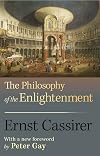
The Philosophy of the Enlightenment
by Ernst Cassirer
On This Page
Description
In this classic work of intellectual history, Ernst Cassirer provides both a cogent synthesis and a penetrating analysis of one of history's greatest intellectual epochs: the Enlightenment. Arguing that there was a common foundation beneath the diverse strands of thought of this period, he shows how Enlightenment philosophers drew upon the ideas of the preceding centuries even while radically transforming them to fit the modern world. In Cassirer's view, the Enlightenment liberated show more philosophy from the realm of pure thought and restored it to its true place as an active and creative force through which knowledge of the world is achieved. In a new foreword, Peter Gay considers The Philosophy of the Enlightenment in the context in which it was written--Germany in 1932, on the precipice of the Nazi seizure of power and one of the greatest assaults on the ideals of the Enlightenment. He also argues that Cassirer's work remains a trenchant defense against enemies of the Enlightenment in the twenty-first century. show lessTags
Recommendations









































Member Reviews
TBB-1
Jul 21, 2021Catalan
Ratings
Members
- Recently Added By
Lists

Bibliography of How the Old World Ended by Jonathan Scott
308 works; 1 member
Author Information

171+ Works 5,263 Members
Ernst Cassirer, a German neo-Kantian philosopher, taught at several European universities before moving to the United States and teaching at Yale (1941-1944) and Columbia universities. A prolific historian of philosophy, Cassirer was influenced by Immanuel Kant and Georg Hegel but originated his own distinctive doctrine. The centerpiece of show more Cassirer's thought is his theory of symbolic forms. He construed representation, the ground of symbolic form, to be essentially symbolic, fusing perceptual materials with conceptual meanings. The human species, he taught, is essentially a symbolizing animal. He maintained that symbolic forms are manifest in different modes-languages, myth, art, science, and religion. Cassirer utilized his theory of symbolic forms in the elaboration of a flexible philosophy of culture. (Bowker Author Biography) show less
Some Editions
Series
Belongs to Publisher Series
Common Knowledge
- Canonical title
- The Philosophy of the Enlightenment
- Original title
- Die Philosophie der Aufklärung
- Original publication date
- 1932
- First words
- The present book aims to be more and less than a monograph on the philosophy of the Enlightenment.
- Last words
- (Click to show. Warning: May contain spoilers.)It is above all because of him [Lessing] the the century of the Enlightenment, to a very great extent dominated by its gift of criticism, did not fall prey to the merely negative critical function--that it was able to reconvert criticism to creative activity and shape it and use it as an indispensable instrument of life and of the constant renewal of the spirit.
Classifications
Statistics
- Members
- 577
- Popularity
- 51,156
- Reviews
- 2
- Rating
- (3.71)
- Languages
- 7 — English, French, German, Hungarian, Italian, Portuguese, Spanish
- Media
- Paper, Ebook
- ISBNs
- 20
- ASINs
- 19