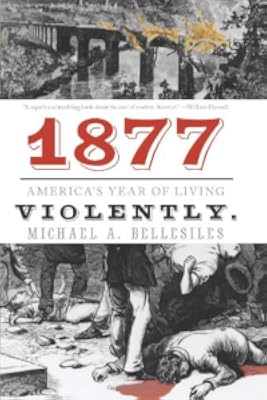
1877: America's Year of Living Violently
by Michael A. Bellesiles
On This Page
Description
Describes a time of upheaval in America--when the country was in a deep economic depression, white supremacists roamed the South, and a nationwide railroad strike led to bloodshed--and discusses how the events of 1877 also fueled cultural and intellectual innovation.Tags
Recommendations




Member Reviews
This is for those who take all the mythologizing rhetoric literally and fetishize the US Civil War as a unifying recommitment to foundational principles of liberty. Bellesiles’ technique is to take a cross-sectional moment that illuminates time both forward and back. “The war preserved the union”? Only if ‘union’ means ‘territorial integrity’ (and then only for the 36 states that existed at the end of the war). There were Indian Wars and lots of violent nativism yet to come. Outlawing slavery barely put a dent in the pervasive assertion of white supremacy. By the evidence of history, the Civil War did not foster anything resembling union among workers and factory owners, racial and ethnic groups, regional prerogatives, show more religious denominations, urban centers and the provinces, political parties, etc. show less
Where I got the book: purchased used on Amazon.
1877 was the year when Reconstruction ended. A disputed presidential election ended with the Democrats conceding to the Republicans on the condition that they withdraw Federal troops from the South, effectively handing the black population over to the white supremacists and ensuring a century of servitude and deprivation of civil rights for the former slaves they’d fought so hard to free.
And that wasn’t the only thing wrong with the year 1877 for just about anyone who wasn’t white, male and prosperous. Bellesiles shines his light around a dark and murky year that demonstrated that America had problems peculiar to its own history but that it also hadn’t escaped the class disputes show more many people thought they’d left behind in Europe. He portrays 1877 as a year of chaos—even after the dust from the election had settled and America’s Northern population, once so vehement about emancipating the blacks, had decided it was tired of the subject, the country was left with other racially based disputes such as the Indian Wars, the Chinese problem on the West Coast and clashes on the Mexican border. In addition there were strikes across the country as corporations cut wages to starvation levels while paying large dividends to their shareholders (sound familiar?); homicide rates were high and the justice system ineffective; and Social Darwinism was on the rise, providing a pseudo-scientific basis for further racial discrimination. The economic depression had put many out-of-work men onto the road, creating a national panic about tramps that equalled the panic about communism fuelled by the strikes.
There were also more encouraging signs of future developments. Women, despite having fewer rights than at almost any time in history, were starting to assert themselves in visible and powerful ways such as their strong presence at the Centennial Exhibition of 1876 and their leadership of the temperance movement in 1877 and beyond. Black activists like Booker T. Washington were finding ways to make America’s black population financially independent by working within the system rather than fighting against it, and the thirst for education that had been given a huge boost during and just after the Civil War was upheld and bravely fought for by the post-War generations. Reformers were beginning to take a stand against the injustices they saw meted out to the working poor.
This is definitely an academic book, densely if well written, rather than a popular history. As such it was sometimes a little hard to slog through (hence 4 stars), but it was also crammed with information—a definite keeper for my history shelf. It explores some of the origins of the 1877 picture and gives an idea of future developments, ending on a curiously patriotic note: America would still continue to be a haven for the poor, even though the actual experience of those who landed on its shores in the late 1800s and beyond was very different from the American dream of a straight path to prosperity via hard work. To this non-American reader it demonstrates that even for an inevitably cynical chronicler like Bellesiles, the dream of what America could be still lives in the American psyche, beside the reality of corporate and white hegemony. show less
1877 was the year when Reconstruction ended. A disputed presidential election ended with the Democrats conceding to the Republicans on the condition that they withdraw Federal troops from the South, effectively handing the black population over to the white supremacists and ensuring a century of servitude and deprivation of civil rights for the former slaves they’d fought so hard to free.
And that wasn’t the only thing wrong with the year 1877 for just about anyone who wasn’t white, male and prosperous. Bellesiles shines his light around a dark and murky year that demonstrated that America had problems peculiar to its own history but that it also hadn’t escaped the class disputes show more many people thought they’d left behind in Europe. He portrays 1877 as a year of chaos—even after the dust from the election had settled and America’s Northern population, once so vehement about emancipating the blacks, had decided it was tired of the subject, the country was left with other racially based disputes such as the Indian Wars, the Chinese problem on the West Coast and clashes on the Mexican border. In addition there were strikes across the country as corporations cut wages to starvation levels while paying large dividends to their shareholders (sound familiar?); homicide rates were high and the justice system ineffective; and Social Darwinism was on the rise, providing a pseudo-scientific basis for further racial discrimination. The economic depression had put many out-of-work men onto the road, creating a national panic about tramps that equalled the panic about communism fuelled by the strikes.
There were also more encouraging signs of future developments. Women, despite having fewer rights than at almost any time in history, were starting to assert themselves in visible and powerful ways such as their strong presence at the Centennial Exhibition of 1876 and their leadership of the temperance movement in 1877 and beyond. Black activists like Booker T. Washington were finding ways to make America’s black population financially independent by working within the system rather than fighting against it, and the thirst for education that had been given a huge boost during and just after the Civil War was upheld and bravely fought for by the post-War generations. Reformers were beginning to take a stand against the injustices they saw meted out to the working poor.
This is definitely an academic book, densely if well written, rather than a popular history. As such it was sometimes a little hard to slog through (hence 4 stars), but it was also crammed with information—a definite keeper for my history shelf. It explores some of the origins of the 1877 picture and gives an idea of future developments, ending on a curiously patriotic note: America would still continue to be a haven for the poor, even though the actual experience of those who landed on its shores in the late 1800s and beyond was very different from the American dream of a straight path to prosperity via hard work. To this non-American reader it demonstrates that even for an inevitably cynical chronicler like Bellesiles, the dream of what America could be still lives in the American psyche, beside the reality of corporate and white hegemony. show less
I thought this book was pretty good when I first read it. If you think we've got political and social troubles today, 1877 sounds worse. After I finished the book I learned that Bellesiles wrote a book in 2001 about the growth of the gun culture in the US. He won a prestigious award for that book. Later a group of historians found that Bellesiles was "guilty of unprofessional and misleading work". He had to give back the prize and resign his professorship. "1877" is a come-back book for him which has been well received.
Bellesiles' book, "1877: America's Year of Living Violently" chooses one year and one theme and discusses all aspects in a thoroughly readable fashion. He explores the violence in America for Blacks, for Indians, for Immigrants, for Women, and for Labor. In doing so, he demonstrates that 1877 was a seminal year for so much about America.
What was begun in 1877 is still visible today. Thus, this book is strongly recommended for people interested in contemporary American history as much as it is recommended for people in 19th century history.
What was begun in 1877 is still visible today. Thus, this book is strongly recommended for people interested in contemporary American history as much as it is recommended for people in 19th century history.
A book bout the time everything went wrong: Shady deals in selling bonds force the economy to head south. The President gets elected thru extra-constitutional panel. Violence and dissension everywhere. The people divided into red bloody shirt states and racist dreamers of the past. Congressmen start carrying. Extra-legal become legal. Lucky to make it thru that one. Or did we?
Ratings
Members
- Recently Added By
Lists

What A Year: Books titled with a particular year
147 works; 2 members
Author Information

8 Works 436 Members
Michael A. Bellesiles is Associate Professor of History at Emory University & Director of Emory's Center for the Study of Violence. He is the author of "Revolutionary Outlaws: Ethan Allen & the Struggle for Independence on the Early American Frontier," & of numerous articles & reviews. He lives in Atlanta. (Bowker Author Biography)
Common Knowledge
- Original publication date
- 2010
- Dedication
- For NinaWhat is essential is invisible to the eye
- First words
- (Preface) As Carl Sandburg observed, the Civil War had been fought over a verb: does one say "the United States is" or "the United States are"?
A Scottish immigrant to America, Andrew Carnegie, recorded the September 1873 advent of the nineteenth century's worst depression as the interruption of a lovely summer holiday: "All was going well when one morning in our sum... (show all)mer cotttage . . . a telegram came announcing the failure of Jay Cooke & Co." - Last words
- (Click to show. Warning: May contain spoilers.)They would come, the poor, persecuted, forlorn immigrants grieving for all they had lost, and join with the millions already living here who, behind Lady Liberty's back, also yearned to breathe the free air of America.
- Blurbers
- Wiener, Jon; Young, Alfred F; Berkin, Carol; Deverell, William
Classifications
- Genres
- History, Nonfiction, General Nonfiction
- DDC/MDS
- 973.83 — History & geography History of North America United States The Gilded Age, Reconstruction, Spanish American War (1865-1901) Rutherford Hayes (1877 - 1881) Compromise of 1877, Great Railroad Strike of 1877, End of Reconstruction
- LCC
- E671 .B47 — History of the United States United States Late nineteenth century, 1865-1900 Grant's administrations, 1869-1877
- BISAC
Statistics
- Members
- 96
- Popularity
- 335,622
- Reviews
- 5
- Rating
- (4.00)
- Languages
- English
- Media
- Paper, Ebook
- ISBNs
- 3
- ASINs
- 1