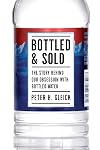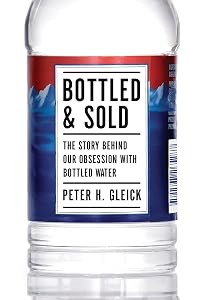
Bottled and Sold: The Story Behind Our Obsession with Bottled Water
by Peter H. Gleick
On This Page
Description
"Peter Gleick knows water. A world-renowned scientist and freshwater expert, Gleick is a MacArthur Foundation'genius,'and according to the BBC, an environmental visionary. And he drinks from the tap. Why don't the rest of us? Bottled and Sold shows how water went from being a free natural resource to one of the most successful commercial products of the last one hundred years ?and why we are poorer for it. It's a big story and water is big business. Every second of every day in the United show more States, a thousand people buy a plastic bottle of water, and every second of every day a thousand more throw one of those bottles away. That adds up to more than thirty billion bottles a year and tens of billions of dollars of sales. Are there legitimate reasons to buy all those bottles? With a scientist's eye and a natural storyteller's wit, Gleick investigates whether industry claims about the relative safety, convenience, and taste of bottled versus tap hold water. And he exposes the true reasons we've turned to the bottle, from fearmongering by business interests and our own vanity to the breakdown of public systems and global inequities.'Designer'H2O may be laughable, but the debate over commodifying water is deadly serious. It comes down to society's choices about human rights, the role of government and free markets, the importance of being'green,'and fundamental values. Gleick gets to the heart of the bottled water craze, exploring what it means for us to bottle and sell our most basic necessity."--Provided by publisher. show lessTags
Recommendations































Member Reviews
Bottled water is seductive. We drink it thinking it's healthier and better for us than the water that comes out of our sinks. When we are done with the bottles, they typically go into landfills. Reading Bottled And Sold by Peter H Gleick has further opened my eyes to this 'scam.' As basically the manufacturers of this product put out ads about how it's so much more healthy than tap water, it'll make you lose weight, and in some instances will cleanse the soul of the sinner, via blessed holy water which is also sold for profit.Bottled And Sold is a non-fiction book about, obviously, the selling of water. It goes into depth on the environmental impact of consuming bottled water. I should probably confess right now that I used to drink show more bottled water until I decided it was ludicrous for me to spend over a dollar per bottle on something I could get from the tap for free. Call me cheap. Call me environmental. I prefer to think of it this way, each dollar I save by drinking tap water could go towards a new book.Gleick explores the difference between tap and bottled water, and describes blind taste tests conducted. These tests basically found that there was no true difference in taste that people were able to detect. Other tests conducted found tap water to be more regulated and safer than bottled water - as proven by a Cleveland test of, I think, Evian water.I think if you are interested in the green movement, or preserving the Earth, then this is something you should read. It is not dense nor is it full of unreadable mumbo-jumbo jargon. It talks about how basically if you buy bottled water sold separately at the gas station, you wind up paying around 5$ per gallon, more money than you pump into your car per gallon. I thought that particular statistic was crazy, and sort of confirms my new book/tap water stance.And I do love it when my stances are confirmed. show less
This is a book about the implications of the mass consumption of bottled water. Touching on the most well-known problem created by bottled water, millions of plastic bottles left in landfills, as well as more subtle issues, Gleick provides a comprehensive look at the environmental and social effects of bottled water. And those effects are staggering.
Bottled water creates environmental issues not only in landfills, but also in communities where water is sourced. To be labeled "spring water" water must be sourced from underground aquifers, which are depleted far more quickly than their ability to self-replenish. Communities with bottling plants have found their water resources diminishing at an alarming rate.
Media and marketing play show more significant roles in creating the public frenzy for bottled water. The marketing of mainstream bottled water regularly suggests that it is better-tasting, purer, and safer than tap water. As Gleick proves, however, these claims are specious, at best. Blind taste tests have shown that many people do not prefer the taste of bottled water. Most interesting to me was the difference in safety standards applied to bottled and tap water. Tap water is regulated by the EPA, and must be tested multiple times daily. Any problem must be reported within hours. Bottled water is regulated by the FDA, and is required to be tested far less frequently, once monthly at best in many cases.
Marketing issues are not restricted to claims of safety and purity. Gleick's research also highlights the growth of a snake-oil like water hucksters who claim their bottled water has magical or healing properties. Some bottled waters claim to have realigned their molecules to create curative powers, or they claim to have spiritual powers, most famously the Kabbalah water favored by Madonna, among others. Minimal regulation allows these bottlers to make various unsubstantiated claims, and extort monies from willing believers.
Most troubling to Gleick is the fact that the increasing privitization of water may make potable water a luxury, rather than a necessity. If municipal water systems are ignored in favor of bottled water, the most vulnerable populations will be left without water resources. This is the problem Gleick most wants to stop. He is not advocating a complete ban on bottled water, but he is calling for tighter regulation, and more transparency on the effects of the bottled water industry.
One might think that a book on bottled water would not be interesting, but this was a highly readable book, decidedly engaging for anyone with an interest in social or environmental issues. Glecik's book is well-researched. This is a man who certainly knows his water. I can certainly recommend this book to other concerned readers. show less
Bottled water creates environmental issues not only in landfills, but also in communities where water is sourced. To be labeled "spring water" water must be sourced from underground aquifers, which are depleted far more quickly than their ability to self-replenish. Communities with bottling plants have found their water resources diminishing at an alarming rate.
Media and marketing play show more significant roles in creating the public frenzy for bottled water. The marketing of mainstream bottled water regularly suggests that it is better-tasting, purer, and safer than tap water. As Gleick proves, however, these claims are specious, at best. Blind taste tests have shown that many people do not prefer the taste of bottled water. Most interesting to me was the difference in safety standards applied to bottled and tap water. Tap water is regulated by the EPA, and must be tested multiple times daily. Any problem must be reported within hours. Bottled water is regulated by the FDA, and is required to be tested far less frequently, once monthly at best in many cases.
Marketing issues are not restricted to claims of safety and purity. Gleick's research also highlights the growth of a snake-oil like water hucksters who claim their bottled water has magical or healing properties. Some bottled waters claim to have realigned their molecules to create curative powers, or they claim to have spiritual powers, most famously the Kabbalah water favored by Madonna, among others. Minimal regulation allows these bottlers to make various unsubstantiated claims, and extort monies from willing believers.
Most troubling to Gleick is the fact that the increasing privitization of water may make potable water a luxury, rather than a necessity. If municipal water systems are ignored in favor of bottled water, the most vulnerable populations will be left without water resources. This is the problem Gleick most wants to stop. He is not advocating a complete ban on bottled water, but he is calling for tighter regulation, and more transparency on the effects of the bottled water industry.
One might think that a book on bottled water would not be interesting, but this was a highly readable book, decidedly engaging for anyone with an interest in social or environmental issues. Glecik's book is well-researched. This is a man who certainly knows his water. I can certainly recommend this book to other concerned readers. show less
Before tragedy strikes, there is typically a death knell. Major man-made catastrophes tend to follow a period of scholars and experts foreboding. The 9/11 attacks, the levee breaks during Hurricane Katrina, and countless other incidents did not come out of the blue. Dire predictions about the possibilities of disaster, often ignored or countered, are nothing new. Now we have another worry that is receiving attention from the environmental and scientific communities. The over-consumption of drinking bottled water is driving us down the wrong path. What we choose to do about it remains to be seen.
Gleick has been studying water issues for over a decade, and he sees that a future untempered by wisdom and foresight will bring a devastating show more impact on water resources and the habitats of species through lack of water and increasing plastics. Bottled and Sold chronicles the ways in which people have been turned against tap water through manipulation and negligence and have been turned toward bottled water despite the increasingly negative impact this will have.
The bottled water industry is a powerful force with major monetary backing. Not only do they have advertising and marketing money, they also have the power to persuade politicians to take their side in the debate. They use psychological tactics to convince consumers to rely on bottled water, using false concerns about the safety of tap water and evoking an image of a better lifestyle and a healthier choice. Despite all of their protestations, the truth is that bottled water is much less regulated than tap water. Even worse, in one study the FDA, charged with testing and enforcing bottled water standards, found problems 35 percent of the time but still did not remedy it. In addition, when bottled water is found to be contaminated, the public rarely finds out about it. When a recall is enacted, it is often weeks or months later, and it is up to the companies to instate it.
Other topics that Gleick discusses in-depth include sources of bottled water and the adverse impact on local communities when a bottled water company comes to town, the fact that in taste test after taste test people are unable to pick out the bottled water of the group despite thinking that they will be able to taste the difference, the monetary and environmental costs associated with the increased use of plastics and the bottled water companies' resistance to being required to bear the load, and the blatant false advertising about the source of water in the bottles and the healing powers that some companies claim their water possesses.
Looking at the history of providing safe drinking water for the public and our current conditions, Gleick sees that we are in a Third Water Age. In the First Water Age, humans took water when needed and available from local sources. In the Second Water Age, we began to develop water management systems through dams, aqueducts and irrigation, eventually evolving into massive pumps, treatment facilities, pipelines and collection systems in the nineteenth and twentieth centuries. The Third Water Age is what the author calls the soft path with the objective of meeting needs rather than just supplying water, matching the quality of water required with what the water will be used for. He sees this as a more holistic and responsive approach, but it will require some serious reforms of the current system: invest in building and operating strong municipal tap water systems; create stronger enforcement strategies and close current loopholes; require complete labeling of sources and mineral content on water bottles; crack down on fraud in marketing and advertising; and create recycling programs with the aim of capturing and reusing 100 percent of recyclable plastics.
The issue of water use and availability is a growing concern yet the attention it receives in the media and from politicians has not been strong. With so many competing demands on time and resources, it is too easy to ignore. We have not reached the breaking point yet, and that is what frightens me the most. With knowledge of humanity's historical approach to impending doom, it is likely that we will not remedy the problem until it becomes imperative, and by then the fix will be much more difficult to enact. show less
Gleick has been studying water issues for over a decade, and he sees that a future untempered by wisdom and foresight will bring a devastating show more impact on water resources and the habitats of species through lack of water and increasing plastics. Bottled and Sold chronicles the ways in which people have been turned against tap water through manipulation and negligence and have been turned toward bottled water despite the increasingly negative impact this will have.
The bottled water industry is a powerful force with major monetary backing. Not only do they have advertising and marketing money, they also have the power to persuade politicians to take their side in the debate. They use psychological tactics to convince consumers to rely on bottled water, using false concerns about the safety of tap water and evoking an image of a better lifestyle and a healthier choice. Despite all of their protestations, the truth is that bottled water is much less regulated than tap water. Even worse, in one study the FDA, charged with testing and enforcing bottled water standards, found problems 35 percent of the time but still did not remedy it. In addition, when bottled water is found to be contaminated, the public rarely finds out about it. When a recall is enacted, it is often weeks or months later, and it is up to the companies to instate it.
Other topics that Gleick discusses in-depth include sources of bottled water and the adverse impact on local communities when a bottled water company comes to town, the fact that in taste test after taste test people are unable to pick out the bottled water of the group despite thinking that they will be able to taste the difference, the monetary and environmental costs associated with the increased use of plastics and the bottled water companies' resistance to being required to bear the load, and the blatant false advertising about the source of water in the bottles and the healing powers that some companies claim their water possesses.
Looking at the history of providing safe drinking water for the public and our current conditions, Gleick sees that we are in a Third Water Age. In the First Water Age, humans took water when needed and available from local sources. In the Second Water Age, we began to develop water management systems through dams, aqueducts and irrigation, eventually evolving into massive pumps, treatment facilities, pipelines and collection systems in the nineteenth and twentieth centuries. The Third Water Age is what the author calls the soft path with the objective of meeting needs rather than just supplying water, matching the quality of water required with what the water will be used for. He sees this as a more holistic and responsive approach, but it will require some serious reforms of the current system: invest in building and operating strong municipal tap water systems; create stronger enforcement strategies and close current loopholes; require complete labeling of sources and mineral content on water bottles; crack down on fraud in marketing and advertising; and create recycling programs with the aim of capturing and reusing 100 percent of recyclable plastics.
The issue of water use and availability is a growing concern yet the attention it receives in the media and from politicians has not been strong. With so many competing demands on time and resources, it is too easy to ignore. We have not reached the breaking point yet, and that is what frightens me the most. With knowledge of humanity's historical approach to impending doom, it is likely that we will not remedy the problem until it becomes imperative, and by then the fix will be much more difficult to enact. show less
Full review:
http://readingthroughlife.ca/bottled-and-sold-review/
Short version:
Bottled and Sold goes farther than the difference between free and paid-for water. I was surprised and appalled at some of the things that I learned about bottled water from reading this book. Did you know that in the States, while municipal water has to be tested multiple times and day, and problems reported to the public pretty much immediately, many bottled water companies aren’t even required to test their water once a month, and there is often no requirement at all for them to report problems to the public? Yeah. Neither did I.
http://readingthroughlife.ca/bottled-and-sold-review/
Short version:
Bottled and Sold goes farther than the difference between free and paid-for water. I was surprised and appalled at some of the things that I learned about bottled water from reading this book. Did you know that in the States, while municipal water has to be tested multiple times and day, and problems reported to the public pretty much immediately, many bottled water companies aren’t even required to test their water once a month, and there is often no requirement at all for them to report problems to the public? Yeah. Neither did I.
Ratings
Members
- Recently Added By
Lists

Caring for the Earth
19 works; 2 members
Author Information
13+ Works 218 Members
Peter H. Gleick is president of the Pacific Institute for Studies in Development, Environment, and Security in Oakland, California
Classifications
- Genres
- Nonfiction, General Nonfiction, Science & Nature, Economics, Business
- DDC/MDS
- 663.61 — Applied science & technology Chemical engineering Beverage technology Soft Drinks and Bottled Non-Alcoholic Beverages
- LCC
- TP659 .G54 — Technology Chemical technology Chemical technology Fermentation industries. Beverages. Alcohol
- BISAC
Statistics
- Members
- 91
- Popularity
- 352,972
- Reviews
- 4
- Rating
- (4.00)
- Languages
- English
- Media
- Paper, Ebook
- ISBNs
- 3
- ASINs
- 1