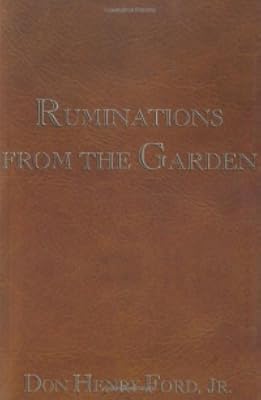
Ruminations from the Garden
by Don Henry Ford Jr.
On This Page
Description
"Ruminations From the Garden" is a book of prophesy, but not of the traditional sort. This prophecy comes from a former drug dealer and ex-convict as "revealed" to him in his garden in Seguin, Texas.Tags
Recommendations













Member Recommendations
Member Reviews
Don Henry Ford starts the year with a garden and the book follows him throughout most of the year, a diary of mental riffs that occur to him during that time. Mr. Ford's thoughts meander through a variety of political, spiritual, and earthy (no, not earthly) topics that mean you're rarely on any one topic for long. His writing style is easy going and you can sense the story teller in him.
For those who know him from his drug smuggling memoir (Contrabando: Confessions of a Drug-Smuggling Texas Cowboy ), Ruminations from the Garden may feel tame. Mr. Ford deals with some topics in the same way he describes a cow eating. As you move through the book, some topics reappear, are chewed on again, and then redigested. If you read this, Mr. show more Ford, I agree with Leah: I would have left out the story about the filly! Most of the meanderings are fun to read, others decidedly uncomfortable. He doesn't gloss over anything, so you can get a hint of envy at his successful neighboring farmer, frustration at his employees and codependents, and sadness at horses he has lost. He's also got lots of frustration with the price of corn!
When I got to the end, I felt like I'd been sitting in a coffee shop (or the Belmont Social Club) listening to someone opine on a variety of topics. Lots of religion, lots of politics relating to the economics of agriculture and immigration, and frequent comments on our over-reliance on mechanization, oil and natural resources, and globalization. If any particular entry in the book had gone on too long, I don't think it would have been enjoyable. But it was fun to eavesdrop on his thoughts, having the opportunity to fast forward where he is a bit too salty, slowing down to enjoy some of his turns of phrase. One of my favorites, when he's first preparing the garden:
"The rows are long - there's no way to con your way to the end or reason a weed out of the ground or think an education will impress a plant."
Even though I'm one of those self-same suburbanites that hasn't endured the hard struggles and labor Mr. Ford extols, he's always friendly enough about it. You don't need to be a gardener, or a Texan, or a cowboy to enjoy this book. If you have a libertarian bent, or just want a refreshing, (perhaps too) honest look at one man's year growing food in a Texas drought, you'll find this a pleasurable read. show less
For those who know him from his drug smuggling memoir (Contrabando: Confessions of a Drug-Smuggling Texas Cowboy ), Ruminations from the Garden may feel tame. Mr. Ford deals with some topics in the same way he describes a cow eating. As you move through the book, some topics reappear, are chewed on again, and then redigested. If you read this, Mr. show more Ford, I agree with Leah: I would have left out the story about the filly! Most of the meanderings are fun to read, others decidedly uncomfortable. He doesn't gloss over anything, so you can get a hint of envy at his successful neighboring farmer, frustration at his employees and codependents, and sadness at horses he has lost. He's also got lots of frustration with the price of corn!
When I got to the end, I felt like I'd been sitting in a coffee shop (or the Belmont Social Club) listening to someone opine on a variety of topics. Lots of religion, lots of politics relating to the economics of agriculture and immigration, and frequent comments on our over-reliance on mechanization, oil and natural resources, and globalization. If any particular entry in the book had gone on too long, I don't think it would have been enjoyable. But it was fun to eavesdrop on his thoughts, having the opportunity to fast forward where he is a bit too salty, slowing down to enjoy some of his turns of phrase. One of my favorites, when he's first preparing the garden:
"The rows are long - there's no way to con your way to the end or reason a weed out of the ground or think an education will impress a plant."
Even though I'm one of those self-same suburbanites that hasn't endured the hard struggles and labor Mr. Ford extols, he's always friendly enough about it. You don't need to be a gardener, or a Texan, or a cowboy to enjoy this book. If you have a libertarian bent, or just want a refreshing, (perhaps too) honest look at one man's year growing food in a Texas drought, you'll find this a pleasurable read. show less
 This review was written for LibraryThing Early Reviewers.
Almost all writers carry a notebook around with them to record thoughts and ideas as they arise. They usually end up being quite random, a mix of the brilliant and the mundane, day-to-day worries mixed in with the germs of big ideas. To get an idea of what the inside of a writer's notebook looks like, you could take a look at Ruminations from the Garden.
Strangely, it doesn't end up being a bad thing. The narrative meanders around in unexpected directions, taking in corn prices, bestiality, religion, politics, weather, corn prices, cowboys, horse riding, the Lebanon-Israel conflict and pretty much anything else you can think of that was happening around 2006. But it does so in an engaging style and with absolute candour. If you can show more embrace randomness, then this is an enjoyable read.
It's also true to life. Ford sets out with a clear plan of raising a small organic garden in the scorching heat of a Texas summer. He will clear a plot, plant it out, and tell us how it all works out over the year. He describes his rationale very well. Artificial methods of industrial-scale farming have made it possible to farm huge tracts of land with very few people, but at the cost of massive dependence on oil. Thirty gallons of oil are now needed to raise one acre of corn. The machinery, vehicles, chemicals, irrigation equipment, etc., are all dependent on oil in some way, and the oil is becoming more scarce. Prices are rising, and what happens when it runs out, or becomes so scarce that it's unaffordable? Ford decides to find out, picking up his hoe and going back to old-style manual labour on one acre of his farm.
For a while, he sticks to this plan, and it seems clear what to expect. You start to enjoy the descriptions of repetitive manual labour, the attention to detail, the observations of things that are not possible to see from a tractor, the remembrance of old, almost-forgotten techniques that assume a sudden importance when combine harvesters and industrial pesticides are not to hand.
But then, as with so many great human plans, things go a bit awry. Other things get in the way. Drought strikes. The initial enthusiasm fades. As the book goes on, the garden becomes a less and less regular feature. You wonder what happened to it, sometimes, and then it reappears again choked with weeds, and then it's back to some other anecdote. At first I got a bit frustrated and wished he would just follow through with the garden thing, but then I realised that he was just being honest. He tried to raise this organic garden in 100 degree heat, and it was really hard work, and sometimes he failed and sprayed weedkiller on the crops just because his back was aching and he couldn't face weeding by hand, and sometimes he went back to it and spent all day and night picking tomatoes. That's what people do. We work in bursts, committed one minute and distracted the next. What I wanted, the perfect story of an experiment carried through to its logical conclusion, was unrealistic. In fact, one of the points I think Ford was trying to make is that this kind of farming is incredibly tough, especially in the drought conditions of southern Texas in the throes of climate change. It's a warning us about what to expect in the future, when our current, unsustainable practices are no longer possible.
When I learned to relax and go wherever Ford wanted to take me, I started to enjoy the book a lot more. It's an entertaining read, much like listening to an opinionated, avuncular old relative telling stories at the bar. You don't necessarily agree with all of it or follow the logic, but you enjoy the ride. show less
Strangely, it doesn't end up being a bad thing. The narrative meanders around in unexpected directions, taking in corn prices, bestiality, religion, politics, weather, corn prices, cowboys, horse riding, the Lebanon-Israel conflict and pretty much anything else you can think of that was happening around 2006. But it does so in an engaging style and with absolute candour. If you can show more embrace randomness, then this is an enjoyable read.
It's also true to life. Ford sets out with a clear plan of raising a small organic garden in the scorching heat of a Texas summer. He will clear a plot, plant it out, and tell us how it all works out over the year. He describes his rationale very well. Artificial methods of industrial-scale farming have made it possible to farm huge tracts of land with very few people, but at the cost of massive dependence on oil. Thirty gallons of oil are now needed to raise one acre of corn. The machinery, vehicles, chemicals, irrigation equipment, etc., are all dependent on oil in some way, and the oil is becoming more scarce. Prices are rising, and what happens when it runs out, or becomes so scarce that it's unaffordable? Ford decides to find out, picking up his hoe and going back to old-style manual labour on one acre of his farm.
For a while, he sticks to this plan, and it seems clear what to expect. You start to enjoy the descriptions of repetitive manual labour, the attention to detail, the observations of things that are not possible to see from a tractor, the remembrance of old, almost-forgotten techniques that assume a sudden importance when combine harvesters and industrial pesticides are not to hand.
But then, as with so many great human plans, things go a bit awry. Other things get in the way. Drought strikes. The initial enthusiasm fades. As the book goes on, the garden becomes a less and less regular feature. You wonder what happened to it, sometimes, and then it reappears again choked with weeds, and then it's back to some other anecdote. At first I got a bit frustrated and wished he would just follow through with the garden thing, but then I realised that he was just being honest. He tried to raise this organic garden in 100 degree heat, and it was really hard work, and sometimes he failed and sprayed weedkiller on the crops just because his back was aching and he couldn't face weeding by hand, and sometimes he went back to it and spent all day and night picking tomatoes. That's what people do. We work in bursts, committed one minute and distracted the next. What I wanted, the perfect story of an experiment carried through to its logical conclusion, was unrealistic. In fact, one of the points I think Ford was trying to make is that this kind of farming is incredibly tough, especially in the drought conditions of southern Texas in the throes of climate change. It's a warning us about what to expect in the future, when our current, unsustainable practices are no longer possible.
When I learned to relax and go wherever Ford wanted to take me, I started to enjoy the book a lot more. It's an entertaining read, much like listening to an opinionated, avuncular old relative telling stories at the bar. You don't necessarily agree with all of it or follow the logic, but you enjoy the ride. show less
This review was written for LibraryThing Early Reviewers.Somehow the title misled me when I requested this book. I expected some folksy account from someone determined to raise a garden in the old-fashioned way – no gasoline powered rototiller, no artificial fertilizers, no chemical herbicides or insecticides or fungicides . I envisioned hitching a mule to a bull-tongue plow to prepare the ground and to a double-shovel plow to rid the garden rows of weeds every so often. I grew up on a farm in Middle Tennessee in the days of mules and double-shovel plows. I left at eighteen never to consider returning, but I still have a great deal of respect for general farmers, most of whom have long since been put out of business by large agricultural corporations. Most of the farm land in Middle show more Tennessee where I grew up now lies fallow. The lovely hill country, I suppose, does not adapt well to large-scale, mechanized farming. The land is owned by wealthy investors and developers, held in waiting. Just exactly what for, I’m not sure.
I still love to see things grow, things that are cultivated and transplanted, enjoyed for a season or cherished through the years: rose beds and rhododendron, honeysuckle and morning glories, columbine and chrysanthemum, a sugar maple, a weeping willow, two tulip trees. And, of course, Big Boy tomatoes. How well I remember the time when my little backyard garden supplied zucchini for our whole neighborhood and well beyond, when we plucked okra and cucumbers, green beans and tomatoes for every meal, when our pumpkins and watermelons grew side by side, definitely not to the advantage of watermelons.
When the book arrived in the mail, I immediately started browsing, as I would in a bookstore, perhaps deciding to purchase a book that appealed to me. There was not blurb on a book jacket. There was no introduction or preface or foreword to give me an insight into the nature of the book. So I turned randomly to a page, and read from the top.
"I pick up a newspaper and check the price of corn. $2.40 a bushel. Did you hear that? Two goddamned dollars and forty fucking cents a bushel. Same fucking price it brought in the 1950’s. Less than it brought in the 70’s. Fuck mega-agriculture and subsidized farming. I want to know why corn is selling for two goddamned dollars and forty fucking cents a bushel."
As it turns out, this wording is repeated so often in the book that I would suggest that a more appropriate title than Ruminations from the Garden would have beenTwo Goddamned Dollars and Forty Fucking Cents a Bushel. It captures the tone of the book quite well. Oh, there are some “ruminations” on gardening all right: how hard the work is, how many bushels are gathered, how many cans of vegetables are preserved by him and his wife Leah, how bad the drought is, why he would lose money selling his produce, how he finally resorted to rototiller and herbicides. These are as repetitious as the work in a garden is repetitious. Hardly the quiet, folksy “ruminations” I had expected.
He fenced off an acre. Why anyone would start with that much of a garden, or how a family of two would expect to use that much garden is never explained. Rather I should have said, a hired hand fenced off an acre for him, and another one “ran a light finishing disk over the plot . . . but it barely scratched the hard black gumbo soil.” No mule. No bull tongue or double shovel. Certainly no pleasure in the “black gumbo soil,” and not as much as one might expect in the tomatoes, peppers (all sorts of peppers), peas, beans, okra, squash, cucumbers, beets, cantaloupe, watermelon, and pumpkins. Just detailed accounts of the drudgery, the drought, and what to do with the oversupply.
But in the long run this isn’t a book about “the garden” at all. It’s about Don Henry Ford, Jr., and what he thinks about this world we live in, how really bad things are: oil is going to run out, leaving us with primitive alternatives to current mechanization; a great cataclysm is coming; farmers suffer, except those big corporate farmers who supply us with the variety of food we purchase at the grocery cheaply because it’s produced and transported by machines and vehicles powered by oil and gasoline, which we eventually will run out of (remember?). The “ruminations” are more often (and more interesting) about Ford’s immigrant employees (legal and illegal), his religion, his insights into a world of spirits, eulogies for friends, and, oh yes, his psychosexual nature. Though he’s determined to be faithful to Leah, he’s clearly born to be a polygamist. He imagines a protest march of polygamists, demanding their rights just like homosexuals. It’s the nature they were born with; shouldn’t they be allowed to be true to themselves?
What I want to know is why anybody would buy this book? Why would any bookstore stock it? Why would anybody ever read it? Why would a publisher decide to publish it? Why would anybody write it? Why would anybody review it for public dissemination? Well, I’m reviewing it because I received it free from LibraryThing’s Early Reviewers with the understanding that I would write a review to post on their site. That’s the reason I’m reviewing it, and the only reason.
But I think I also know why somebody would write such a book. For the same reason that I write a daily entry in a personal journal. The same reason hundreds of thousands (maybe millions?) of people run blogs. We like to “ruminate,” maybe just to hold on to our thoughts for ourselves and no one else, maybe for our kids to read once we’re gone. We like to hear ourselves think, see ourselves say something. It’s just a part of our day. But it takes a fairly enormous ego to imagine someone else wanting to read these daily writings. I read books for information, for ideas, for personal satisfaction, for aesthetic experience. Not to hear someone I don’t know and probably don’t want to know spout opinions in language that is as natural to him as his sexual urges for polygamy.
This book is a journal. It is not advertised or marketed as such. It is not formatted as such. But that’s what it is: a personal journal kept by a somewhat eccentric, opinionated, self-centered West Texan, writing in it from March to October, 2006. From the number of entries, ranging from a few lines of prose to a few pages of prose, it seems likely that the writer composed entries for his journal at the rate of about four or five per week.
Now why would anyone want to read someone’s personal journal? Idle curiosity maybe, like looking through a keyhole into someone’s life or eavesdropping as someone talks to himself. Maybe because of one’s interest in the person. I wish my parents had kept journals or my Southern Methodist grandmother, or any of my siblings, or my sixth-grade teacher or my 4-H leader. I would like to know more about their lives, their thinking, their feelings, their secrets. The only journal I remember reading over and over again was that of Henry David Thoreau, partly because of his ideas, his sense of values, his insights into nature and human nature, but partly too because of its literary value and the way he used it as a source for his well-known works (Walden, ”Walking,” A Week on the Concord and Merrimack Rivers).
So I gave Ruminations my best shot, and here are the types of entries I found: (1) the garden: watering, weeding, and reaping, the drought, expenses and possible income, hard work, bad luck, and failed efforts to remain organic; (2) farming, especially experiences as a cattleman, a horseman, details of calving and foaling, nursing sick and injured animals (the shortest, and one of the most moving entries: “The mare died”); (3) diatribes: political, sociocultural, religious, prognostications of cataclysms, such as depletion of oil, the Great War, an apocalypse; (4) personal: reflections on Leah, on his hyper-sexuality, including intercourse w/ animals as an adolescent; (5) character sketches, mostly of farm laborers, hired hands or neighbors, Mexican, mentally ill, black, down-and-out; e.g., Abraham, Mario, Manuel, Lupe, Betty, the xxx brothers; (6) occasional incidents, such as an auto accident in which he hits a woman with a baby in her arms and they both survive.
Briefly, here is my assessment of each type of entry: garden, boring; diatribes, tiresome; personal, embarrassingly egotistical; farming, more detailed, more effective than gardening; characters, almost always interesting (as people always are), sometimes heart-warming, often engaging; and events, rare but dramatic.
So as you can tell, generally I found the book frustrating. I definitely would not have purchased it nor read it on my own. But – here’s the clincher – I’m sorta glad I did. When I ask myself why (for I am surprised at myself), I realize that eventually I read Ruminations from the Garden as if it were a novel, the self-revelations (sometimes quite unconscious) of a captivating character – one Don Henry Ford, Jr. The key to the character just might turn out to be the “Jr.” in his name. Don, Jr., is an ex-con, having been convicted of smuggling drugs across the Mexican border He has made a hit with a book, Contrabando, about his criminal experiences and imprisonment, so he now fancies himself a writer. His second wife, Leah, seems to support him, working forty-hour weeks for $18 an hour. He is employed part-time by his father – one might even infer that he is, in part, supported by his father.
Don, Sr., is a Texas oilman, who owns at least two ranches or farms. There is a hint here and there that he is not always pleased with his son’s work. He has numerous hired hands, mostly Mexican. He raises cattle and race-horses. Though we never meet Don, Sr. personally, he is obviously a Man of the World, dominating Don, Jr.’s world.
So Jr.’s diatribes against Big Oil and the corporate elite of the US, and the powerful and affluent “upper” classes, who never do hard physical labor – well, at least there’s some indication that Don, Sr., is not too far removed from that sort of person himself. Don, Jr., sees himself as hard-working (calloused hands, so swollen he has to remove his wedding band), as a sexual athlete, paradoxically spiritual, Christian in an unorthodox way, and as a wise, common-sense philosopher who “ruminates” in writing. He has a sharp eye and an open heart for the down-and-out, whether man or beast. No doubt he knows personally what it means to be “down-and-out.”
Of course, that’s why I find myself empathizing with this character Don. Fact is, I agree with him on many of his diatribes. I simply would have stated them differently, and I would have published them only if I could support them by more cogent argument (or not published them at all). I, too, have speculate about alternative realities, spiritual dimensions, and the like. Suddenly Don’s candor and his earthy language are not the least offensive but admirable. One man, speaking out for himself and other down-and-outers, standing up against the powers that be, father-figures all. Now each entry adds to the depth of his character. “The mare is dead,” is just one more, climactic example of his ultimate powerlessness, his inability in spite of patient, strenuous, even heroic efforts to make things right. But he longs in his heart of hearts for an ideal world, a renewal of a natural world uncluttered by oil-driven machines, widespread housing developments, and miles and miles of pavement. He foresees a global catastrophe of some sort. He intuits a tragic but inevitable return to a more primitive life for the relatively few survivors, a chosen remnant.
One imagines the time of the patriarchs – the desert fathers, Abraham or Isaac or the restless, sly Jacob with his Leah – and his Rachel as well, and a couple of concubines on the side. Now, don’t get me wrong, Don Jr. never says anything exactly like this. But he does imagine a less complicated, less modern world.
Now the reader may go one step further. Don’s “garden” is certainly no Eden, but Don is an Everyman, a 21st century Adam, with a son Joshua to carry on the line and a grim determination, in some little way, to restore the Garden, to return to Eden, to regain Paradise.
That’s the novel I found myself reading. It may not be the book Don wrote, or meant to write. He might find my reading obnoxious, ridiculous, amateurishly Freudian. But he wrote these entries in his journal, he let them be published, and thus he’s now vulnerable to someone else’s reading. While he’s writing the book, it’s his. Once it’s out there, it has achieved another dimension – somewhere in the mind of a reader. Welcome to my world.
In this context, I re-read the Afterword, written at 3 A.M. on November 15, 2006. Here’s a brief excerpt:
"We will have our war, by damn.
Am I right in this assumption? I don’t know. I’ve had no divine revelation. I just know my own people and this uneasy feeling in my gut, this cloud over my head, won’t go away.
Not even in the garden. Broccoli, cauliflower, and cabbage plants have grown and will soon produce food, good Lord willing. The strawberry plants are hanging in there. We should soon have fresh spinach ready to pick. Beets and turnips are ready. I have green tomatoes, but doubt we’ll get much in the way of ripe ones. Days have slowed the growth and maturation process. I picked half a bucket of peppers and then left. A heavy weight burdens my mind and my spirit, so much that I was unable to continue."
Then, at the very end, after he loses a crop of oats to army worms, and after insects invade (“I’ve spent more on insect spray than I did seed and diesel”), he concludes
"Now the dry wind blows at thirty miles an hour sucking the moisture from the ground.
One might say God’s mighy hand is raised and ready to strike. Another might say this planet is rising up to defend itself. Damned if I know how to describe what’s happening. But it is happening and nothing you or I can do will stop it."
There in a nutshell you have the saga of Don Henry Ford, Jr. And of us all. The certainty about uncertainties: “We’ll have our war, by damn.” The uncertainty about his own certainties: “Damned if I know . . . .” Eden at his fingertips: broccoli, cauliflower, cabbage, spinach, beets and turnips, green tomatoes, peppers. Hell in the offing: “dry wind blows . . . sucking [life] from the ground.” Adam cast out: “A heavy weight burdens . . . my spirit . . . I was unable to continue.” The inevitability of the inevitable: “nothing you or I can do will stop it.”
So if I read Ruminations from the Garden, as ruminations, I find it boring and opinionated, worthless. If I read it as a private journal of one West Texan, I feel nosy and intrusive. But if I read it as a novel, it is Everyman – as all good novels are.
Leah reads what he has written and advises him to leave some of it out.
"You don’t need to say that. It isn’t necessary and it doesn’t add to the story. Especially the part about fucking the filly."
Well, if it’s “ruminations” on gardening, she’s certainly right. On the other hand, if it’s simply a private journal, it doesn’t make any difference because we shouldn’t be snooping around reading it anyway. But it it’s a novel – autobiographical fiction – then she’s wrong. It does add to the story. It’s at the heart of the story. The filly, the mare, the “non-practicing polygamist,” the father, the son, the garden, the drought, the opinions about George W. Bush (another jr., as it were), the opinions on evolution and global warming and life after death, his reading of the book of Revelation. They all matter. They all add to his story. They tell us who he is. Probably more than he meant to tell us.
"Chuck Bowden once told me the best writing puts the writer at risk. But I’ve found times when telling the truth not only endangers the teller but also others close to him or her."
"The mystery. Sometimes understanding God is not a matter of learning it’s a matter of unlearning: seeing, feeling, hearing, being, accepting, without a question for everything."
"Grasshoppers were eating the grass that grew under our irrigation machines [on his father’s farm]. We also had young huisaches coming up in the fields, so I hired a truck to apply Agent Orange and a pesticide. The pesticide killed the shit out of the grasshoppers and the Agent Orange did a number on the huisaches. So maybe we’ll get a decent cutting of hay."
"Over seven hundred jars of food line the wall next to me boxed up, for another day. The chest freezer on that wall is full to the brim.
So maybe I’ll go out to the garden and pick peas today. Dig around the peppers, pull a few weeds. Give thanks to God for what I have. And long for a return to the Garden of Eden. This one, however, good it may appear, leaves a lot to be desired."
It all matters. It all adds to the story. What Don Henry Ford, Jr., has written is a damned good novel. He is his main character. show less
I still love to see things grow, things that are cultivated and transplanted, enjoyed for a season or cherished through the years: rose beds and rhododendron, honeysuckle and morning glories, columbine and chrysanthemum, a sugar maple, a weeping willow, two tulip trees. And, of course, Big Boy tomatoes. How well I remember the time when my little backyard garden supplied zucchini for our whole neighborhood and well beyond, when we plucked okra and cucumbers, green beans and tomatoes for every meal, when our pumpkins and watermelons grew side by side, definitely not to the advantage of watermelons.
When the book arrived in the mail, I immediately started browsing, as I would in a bookstore, perhaps deciding to purchase a book that appealed to me. There was not blurb on a book jacket. There was no introduction or preface or foreword to give me an insight into the nature of the book. So I turned randomly to a page, and read from the top.
"I pick up a newspaper and check the price of corn. $2.40 a bushel. Did you hear that? Two goddamned dollars and forty fucking cents a bushel. Same fucking price it brought in the 1950’s. Less than it brought in the 70’s. Fuck mega-agriculture and subsidized farming. I want to know why corn is selling for two goddamned dollars and forty fucking cents a bushel."
As it turns out, this wording is repeated so often in the book that I would suggest that a more appropriate title than Ruminations from the Garden would have beenTwo Goddamned Dollars and Forty Fucking Cents a Bushel. It captures the tone of the book quite well. Oh, there are some “ruminations” on gardening all right: how hard the work is, how many bushels are gathered, how many cans of vegetables are preserved by him and his wife Leah, how bad the drought is, why he would lose money selling his produce, how he finally resorted to rototiller and herbicides. These are as repetitious as the work in a garden is repetitious. Hardly the quiet, folksy “ruminations” I had expected.
He fenced off an acre. Why anyone would start with that much of a garden, or how a family of two would expect to use that much garden is never explained. Rather I should have said, a hired hand fenced off an acre for him, and another one “ran a light finishing disk over the plot . . . but it barely scratched the hard black gumbo soil.” No mule. No bull tongue or double shovel. Certainly no pleasure in the “black gumbo soil,” and not as much as one might expect in the tomatoes, peppers (all sorts of peppers), peas, beans, okra, squash, cucumbers, beets, cantaloupe, watermelon, and pumpkins. Just detailed accounts of the drudgery, the drought, and what to do with the oversupply.
But in the long run this isn’t a book about “the garden” at all. It’s about Don Henry Ford, Jr., and what he thinks about this world we live in, how really bad things are: oil is going to run out, leaving us with primitive alternatives to current mechanization; a great cataclysm is coming; farmers suffer, except those big corporate farmers who supply us with the variety of food we purchase at the grocery cheaply because it’s produced and transported by machines and vehicles powered by oil and gasoline, which we eventually will run out of (remember?). The “ruminations” are more often (and more interesting) about Ford’s immigrant employees (legal and illegal), his religion, his insights into a world of spirits, eulogies for friends, and, oh yes, his psychosexual nature. Though he’s determined to be faithful to Leah, he’s clearly born to be a polygamist. He imagines a protest march of polygamists, demanding their rights just like homosexuals. It’s the nature they were born with; shouldn’t they be allowed to be true to themselves?
What I want to know is why anybody would buy this book? Why would any bookstore stock it? Why would anybody ever read it? Why would a publisher decide to publish it? Why would anybody write it? Why would anybody review it for public dissemination? Well, I’m reviewing it because I received it free from LibraryThing’s Early Reviewers with the understanding that I would write a review to post on their site. That’s the reason I’m reviewing it, and the only reason.
But I think I also know why somebody would write such a book. For the same reason that I write a daily entry in a personal journal. The same reason hundreds of thousands (maybe millions?) of people run blogs. We like to “ruminate,” maybe just to hold on to our thoughts for ourselves and no one else, maybe for our kids to read once we’re gone. We like to hear ourselves think, see ourselves say something. It’s just a part of our day. But it takes a fairly enormous ego to imagine someone else wanting to read these daily writings. I read books for information, for ideas, for personal satisfaction, for aesthetic experience. Not to hear someone I don’t know and probably don’t want to know spout opinions in language that is as natural to him as his sexual urges for polygamy.
This book is a journal. It is not advertised or marketed as such. It is not formatted as such. But that’s what it is: a personal journal kept by a somewhat eccentric, opinionated, self-centered West Texan, writing in it from March to October, 2006. From the number of entries, ranging from a few lines of prose to a few pages of prose, it seems likely that the writer composed entries for his journal at the rate of about four or five per week.
Now why would anyone want to read someone’s personal journal? Idle curiosity maybe, like looking through a keyhole into someone’s life or eavesdropping as someone talks to himself. Maybe because of one’s interest in the person. I wish my parents had kept journals or my Southern Methodist grandmother, or any of my siblings, or my sixth-grade teacher or my 4-H leader. I would like to know more about their lives, their thinking, their feelings, their secrets. The only journal I remember reading over and over again was that of Henry David Thoreau, partly because of his ideas, his sense of values, his insights into nature and human nature, but partly too because of its literary value and the way he used it as a source for his well-known works (Walden, ”Walking,” A Week on the Concord and Merrimack Rivers).
So I gave Ruminations my best shot, and here are the types of entries I found: (1) the garden: watering, weeding, and reaping, the drought, expenses and possible income, hard work, bad luck, and failed efforts to remain organic; (2) farming, especially experiences as a cattleman, a horseman, details of calving and foaling, nursing sick and injured animals (the shortest, and one of the most moving entries: “The mare died”); (3) diatribes: political, sociocultural, religious, prognostications of cataclysms, such as depletion of oil, the Great War, an apocalypse; (4) personal: reflections on Leah, on his hyper-sexuality, including intercourse w/ animals as an adolescent; (5) character sketches, mostly of farm laborers, hired hands or neighbors, Mexican, mentally ill, black, down-and-out; e.g., Abraham, Mario, Manuel, Lupe, Betty, the xxx brothers; (6) occasional incidents, such as an auto accident in which he hits a woman with a baby in her arms and they both survive.
Briefly, here is my assessment of each type of entry: garden, boring; diatribes, tiresome; personal, embarrassingly egotistical; farming, more detailed, more effective than gardening; characters, almost always interesting (as people always are), sometimes heart-warming, often engaging; and events, rare but dramatic.
So as you can tell, generally I found the book frustrating. I definitely would not have purchased it nor read it on my own. But – here’s the clincher – I’m sorta glad I did. When I ask myself why (for I am surprised at myself), I realize that eventually I read Ruminations from the Garden as if it were a novel, the self-revelations (sometimes quite unconscious) of a captivating character – one Don Henry Ford, Jr. The key to the character just might turn out to be the “Jr.” in his name. Don, Jr., is an ex-con, having been convicted of smuggling drugs across the Mexican border He has made a hit with a book, Contrabando, about his criminal experiences and imprisonment, so he now fancies himself a writer. His second wife, Leah, seems to support him, working forty-hour weeks for $18 an hour. He is employed part-time by his father – one might even infer that he is, in part, supported by his father.
Don, Sr., is a Texas oilman, who owns at least two ranches or farms. There is a hint here and there that he is not always pleased with his son’s work. He has numerous hired hands, mostly Mexican. He raises cattle and race-horses. Though we never meet Don, Sr. personally, he is obviously a Man of the World, dominating Don, Jr.’s world.
So Jr.’s diatribes against Big Oil and the corporate elite of the US, and the powerful and affluent “upper” classes, who never do hard physical labor – well, at least there’s some indication that Don, Sr., is not too far removed from that sort of person himself. Don, Jr., sees himself as hard-working (calloused hands, so swollen he has to remove his wedding band), as a sexual athlete, paradoxically spiritual, Christian in an unorthodox way, and as a wise, common-sense philosopher who “ruminates” in writing. He has a sharp eye and an open heart for the down-and-out, whether man or beast. No doubt he knows personally what it means to be “down-and-out.”
Of course, that’s why I find myself empathizing with this character Don. Fact is, I agree with him on many of his diatribes. I simply would have stated them differently, and I would have published them only if I could support them by more cogent argument (or not published them at all). I, too, have speculate about alternative realities, spiritual dimensions, and the like. Suddenly Don’s candor and his earthy language are not the least offensive but admirable. One man, speaking out for himself and other down-and-outers, standing up against the powers that be, father-figures all. Now each entry adds to the depth of his character. “The mare is dead,” is just one more, climactic example of his ultimate powerlessness, his inability in spite of patient, strenuous, even heroic efforts to make things right. But he longs in his heart of hearts for an ideal world, a renewal of a natural world uncluttered by oil-driven machines, widespread housing developments, and miles and miles of pavement. He foresees a global catastrophe of some sort. He intuits a tragic but inevitable return to a more primitive life for the relatively few survivors, a chosen remnant.
One imagines the time of the patriarchs – the desert fathers, Abraham or Isaac or the restless, sly Jacob with his Leah – and his Rachel as well, and a couple of concubines on the side. Now, don’t get me wrong, Don Jr. never says anything exactly like this. But he does imagine a less complicated, less modern world.
Now the reader may go one step further. Don’s “garden” is certainly no Eden, but Don is an Everyman, a 21st century Adam, with a son Joshua to carry on the line and a grim determination, in some little way, to restore the Garden, to return to Eden, to regain Paradise.
That’s the novel I found myself reading. It may not be the book Don wrote, or meant to write. He might find my reading obnoxious, ridiculous, amateurishly Freudian. But he wrote these entries in his journal, he let them be published, and thus he’s now vulnerable to someone else’s reading. While he’s writing the book, it’s his. Once it’s out there, it has achieved another dimension – somewhere in the mind of a reader. Welcome to my world.
In this context, I re-read the Afterword, written at 3 A.M. on November 15, 2006. Here’s a brief excerpt:
"We will have our war, by damn.
Am I right in this assumption? I don’t know. I’ve had no divine revelation. I just know my own people and this uneasy feeling in my gut, this cloud over my head, won’t go away.
Not even in the garden. Broccoli, cauliflower, and cabbage plants have grown and will soon produce food, good Lord willing. The strawberry plants are hanging in there. We should soon have fresh spinach ready to pick. Beets and turnips are ready. I have green tomatoes, but doubt we’ll get much in the way of ripe ones. Days have slowed the growth and maturation process. I picked half a bucket of peppers and then left. A heavy weight burdens my mind and my spirit, so much that I was unable to continue."
Then, at the very end, after he loses a crop of oats to army worms, and after insects invade (“I’ve spent more on insect spray than I did seed and diesel”), he concludes
"Now the dry wind blows at thirty miles an hour sucking the moisture from the ground.
One might say God’s mighy hand is raised and ready to strike. Another might say this planet is rising up to defend itself. Damned if I know how to describe what’s happening. But it is happening and nothing you or I can do will stop it."
There in a nutshell you have the saga of Don Henry Ford, Jr. And of us all. The certainty about uncertainties: “We’ll have our war, by damn.” The uncertainty about his own certainties: “Damned if I know . . . .” Eden at his fingertips: broccoli, cauliflower, cabbage, spinach, beets and turnips, green tomatoes, peppers. Hell in the offing: “dry wind blows . . . sucking [life] from the ground.” Adam cast out: “A heavy weight burdens . . . my spirit . . . I was unable to continue.” The inevitability of the inevitable: “nothing you or I can do will stop it.”
So if I read Ruminations from the Garden, as ruminations, I find it boring and opinionated, worthless. If I read it as a private journal of one West Texan, I feel nosy and intrusive. But if I read it as a novel, it is Everyman – as all good novels are.
Leah reads what he has written and advises him to leave some of it out.
"You don’t need to say that. It isn’t necessary and it doesn’t add to the story. Especially the part about fucking the filly."
Well, if it’s “ruminations” on gardening, she’s certainly right. On the other hand, if it’s simply a private journal, it doesn’t make any difference because we shouldn’t be snooping around reading it anyway. But it it’s a novel – autobiographical fiction – then she’s wrong. It does add to the story. It’s at the heart of the story. The filly, the mare, the “non-practicing polygamist,” the father, the son, the garden, the drought, the opinions about George W. Bush (another jr., as it were), the opinions on evolution and global warming and life after death, his reading of the book of Revelation. They all matter. They all add to his story. They tell us who he is. Probably more than he meant to tell us.
"Chuck Bowden once told me the best writing puts the writer at risk. But I’ve found times when telling the truth not only endangers the teller but also others close to him or her."
"The mystery. Sometimes understanding God is not a matter of learning it’s a matter of unlearning: seeing, feeling, hearing, being, accepting, without a question for everything."
"Grasshoppers were eating the grass that grew under our irrigation machines [on his father’s farm]. We also had young huisaches coming up in the fields, so I hired a truck to apply Agent Orange and a pesticide. The pesticide killed the shit out of the grasshoppers and the Agent Orange did a number on the huisaches. So maybe we’ll get a decent cutting of hay."
"Over seven hundred jars of food line the wall next to me boxed up, for another day. The chest freezer on that wall is full to the brim.
So maybe I’ll go out to the garden and pick peas today. Dig around the peppers, pull a few weeds. Give thanks to God for what I have. And long for a return to the Garden of Eden. This one, however, good it may appear, leaves a lot to be desired."
It all matters. It all adds to the story. What Don Henry Ford, Jr., has written is a damned good novel. He is his main character. show less
This review was written for LibraryThing Early Reviewers.I received my copy of Ruminations from the Garden through the Library Thing Early Reviewer's program a number of years ago. As the author would understand, I feel; life intervened and here I am having just finished reading it and now posting my review. This book presents a conundrum for the book reviewer. On the one hand, I highly commend Mr. Ford's book as a great example of keeping a journal and recording your experiences and feelings on a regular basis. I think that is a very important contribution to society, and invaluable to family members, both present and future generations. I wish everyone did this. In that regard, this book is a perfect example.
The book is laid out with Mr. Ford's thoughts, reflections, and prophecies show more intertwined with the (sometimes) daily trials and tribulations of planting, maintaining, harvesting and processing of produce of a large vegetable garden of a somewhat experimental nature. It seems he was doing this to test out what it would be like during a not-so-distant future when we could no longer get fuel, and were forced to live off the land in order to survive. Between this, and running two ranches, caring for numerous horses and herds of cattle and a mismatched collection of humans in need that gather around him like a magnet; he is one busy man, indeed. For those who didn't grow up on a farm, it may surprise you to find out that farming is a very intensive 24-7 job, with usually no time off for weekends, vacations or anything else. I grew up on a 5th generation California ranch and am well aware of what it entails.
Personally I found many of Mr. Ford's anecdotes, thoughts on current events and prophecies interesting. At times I emphasized with him. I have to admit there were times when he completely lost me, and if looking at this strictly as a book intended for public consumption; I believe there was far too much, and too disgusting, personal details in it that did not and should not, in my opinion, have been shared with the public. In this, I apparently agree with his wife, Leah; at least according to one of the author's statements. She felt it much of that material should have and could have been left out and the book could have used a lot more editing. I full heartedly agree. At times it devolved into rambling and repitition. Towards the end it seemed to unravel a bit and give in to a full on religious doom-and-gloom rant and prophecies of impending end of the world type scenarios (admittedly due to natural and man-made causes). He lost me completely on the religious jargon; but I absolutely agree with him on the grim state of the planet, the climate, our fuel dependence, corporate greed and the downfalls of capitalism and overpopulation, in particular. I think he nailed most of those things right on the head. And, overall, his prophecies have turned out to be right in the intervening 20 years, only perhaps a little slower than he felt they might. We are, indeed, on the brink of that chaos, dissolution of democracy and the end of that (great?) American experiment. In fact we are now all watching it unwind in real time. show less
The book is laid out with Mr. Ford's thoughts, reflections, and prophecies show more intertwined with the (sometimes) daily trials and tribulations of planting, maintaining, harvesting and processing of produce of a large vegetable garden of a somewhat experimental nature. It seems he was doing this to test out what it would be like during a not-so-distant future when we could no longer get fuel, and were forced to live off the land in order to survive. Between this, and running two ranches, caring for numerous horses and herds of cattle and a mismatched collection of humans in need that gather around him like a magnet; he is one busy man, indeed. For those who didn't grow up on a farm, it may surprise you to find out that farming is a very intensive 24-7 job, with usually no time off for weekends, vacations or anything else. I grew up on a 5th generation California ranch and am well aware of what it entails.
Personally I found many of Mr. Ford's anecdotes, thoughts on current events and prophecies interesting. At times I emphasized with him. I have to admit there were times when he completely lost me, and if looking at this strictly as a book intended for public consumption; I believe there was far too much, and too disgusting, personal details in it that did not and should not, in my opinion, have been shared with the public. In this, I apparently agree with his wife, Leah; at least according to one of the author's statements. She felt it much of that material should have and could have been left out and the book could have used a lot more editing. I full heartedly agree. At times it devolved into rambling and repitition. Towards the end it seemed to unravel a bit and give in to a full on religious doom-and-gloom rant and prophecies of impending end of the world type scenarios (admittedly due to natural and man-made causes). He lost me completely on the religious jargon; but I absolutely agree with him on the grim state of the planet, the climate, our fuel dependence, corporate greed and the downfalls of capitalism and overpopulation, in particular. I think he nailed most of those things right on the head. And, overall, his prophecies have turned out to be right in the intervening 20 years, only perhaps a little slower than he felt they might. We are, indeed, on the brink of that chaos, dissolution of democracy and the end of that (great?) American experiment. In fact we are now all watching it unwind in real time. show less
This review was written for LibraryThing Early Reviewers.I received this book via LibraryThing's "Early Reviewers scheme". it's published by Speir Publishing and the book included an interesting promotional postcard too. I found the farming sections very interesting, but being English had to look up some of the conversion factors to work out weights of produce grown. I found the last quarter of the book a little too religous and preachy for me. If Bible stories are your thing, then you might get a little more out of it than I did. without the philosophising and religousness I'd have given the book a four or even a five star review. But, the author's slightly unusual viewpoints put me off. Reading about life on the ranch, feeding animals, weeding crops, staff problems, wage problems was show more involving. it's a way of life that few of us could contemplate or relate to.
I would have been interested in hearing more of the author's bio. Several times it is alluded to during but no further details about prison. etc. are given.
I also just noticed that one of the five-star reviews on Amazon is from the publisher. That's a little sneaky :)
I also noticed a couple of typos but I'm not sure whether the copy I received is an uncorrected proof. show less
I would have been interested in hearing more of the author's bio. Several times it is alluded to during but no further details about prison. etc. are given.
I also just noticed that one of the five-star reviews on Amazon is from the publisher. That's a little sneaky :)
I also noticed a couple of typos but I'm not sure whether the copy I received is an uncorrected proof. show less
This review was written for LibraryThing Early Reviewers.The best way to describe this is a compilation of the author's thoughts as he tends to his "garden"; about an acre plowed, planted, and harvested in South Texas. It seems his intent was to use only hand tools, or at least those which don't use gas to power them. His reasons are grim: we will either run out of gas, or it will become far to expensive for the average farmer to use.
He rails at nearly everything: the price of corn, Monsanto, the wars, environmentalists, religion, the treatment of immigrants, you name it. And he seasons this stew with a fair amount of swearing.
He has some excellent points. But the entire time I was reading about his trials I kept wondering, "South Texas???" It certainly isn't the most farmer friendly land show more in this country. And I also wondered why he couldn't hitch up one of those horses to a plow.
I vacillated between a 2 1/2 and a 3 for a rating. In spite of the book, I'm feeling optimistic today, so a 3 it is. show less
He rails at nearly everything: the price of corn, Monsanto, the wars, environmentalists, religion, the treatment of immigrants, you name it. And he seasons this stew with a fair amount of swearing.
He has some excellent points. But the entire time I was reading about his trials I kept wondering, "South Texas???" It certainly isn't the most farmer friendly land show more in this country. And I also wondered why he couldn't hitch up one of those horses to a plow.
I vacillated between a 2 1/2 and a 3 for a rating. In spite of the book, I'm feeling optimistic today, so a 3 it is. show less
This review was written for LibraryThing Early Reviewers.I really enjoyed this book, it was a book I probably never would have picked up had I not received a free review copy. Yet, I'm really glad that I did. As a city dweller I never experience the effects of climate change on an observable level..other than an imagined level (it's so hot out, must be global warming)..but for people working the earth they can't help but notice the changes, their lives depend on the predictability of our environment and when something goes wrong, they're the first to feel it. It was good to hear that perspective, one that most of us city people too often ignore.
This review was written for LibraryThing Early Reviewers.Members
- Recently Added By
Author Information

2 Works 56 Members
Classifications
Statistics
- Members
- 23
- Popularity
- 1,150,807
- Reviews
- 15
- Rating
- (2.64)
- Languages
- English
- Media
- Paper
- ISBNs
- 2