
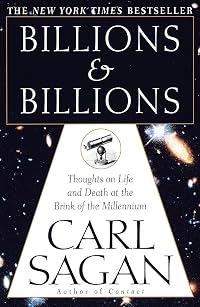
Billions and Billions: Thoughts on Life and Death at the Brink of the Millennium
by Carl Sagan
On This Page
Description
In this book, his last, Carl Sagan shows once again his extraordinary ability to interpret the mysteries of life and the majesty of the universe for the general reader. In Billions and Billions Sagan applies what we know about science, mathematics, and space to everyday life as well as to the exploration of many essential questions concerning the environment and our future. Ranging far and wide in subject matter, he takes his readers on a soaring journey, from the invention of chess to the show more possibility of life on Mars, from Monday Night Football to the relationship between the United States and Russia, from global warming to the abortion debate. And, on a more intimate note, we are given a rare glimpse of the author himself as he movingly describes his valiant fight for his life, his love for his family, and his personal beliefs about death and God. show lessTags
Recommendations










Member Reviews
"Our technology has becoms so powerful that—not only consciously, but inadvertently—we are becoming a danger to ourselves. Science and technology have saved billions of lives, improved the well-being of many more, built up the planet in a slowly anastomosing unity—and at the same time, changed the world so much that many people no longer feel at home in it. We've created a range of new evils; hard to see, hard to understand, problems that cannot be readily cured—certainly not without challenging those already in power."
Carl Sagan never said "billions and billions," despite Johnny Carson's parody of Dr. Sagan on The Tonight Show (on which Sagan was a guest nearly 30 times).
Sagan begins his final book on this humorous note before show more delving into a diverse range of topics from human evolution and cultural development to ethnocentrism and xenophobia. He discusses the advancement of communications technology from the telegraph to satellites, and while he touches on astronomy and cosmology, a large portion of the book is spent reviewing the current state (as of the mid-1990s), and pondering the future of, our environment and the dangers we face if we do not cease our reliance on fossil fuels.
Sagan also tackles the controversial and often incendiary topic of abortion and the question of when human life truly begins. He discusses the religious and political points of view on abortion, Roe vs. Wade, and women's reproductive rights.
Although I have this book in paperback at home, I listened to the audiobook over three days at work. The narrator for most of the book is the fabulous Adenrele Ojo. The final chapter was co-written with Sagan's wife, Ann Druyan, and describes his diagnosis of, and struggle with, myelodysplasia.
It was a grueling experience for Sagan and his family, involving four trips from his home in Ithaca, NY to the Fred Hutchinson Cancer Research Center (aka "The Hutch") in Seattle and the bone marrow transplant from his sister, Cari.
Ann narrated the epilogue, which she wrote after Sagan's death. In it, she details the events of the last month of his life and of their final trip to "The Hutch" where he died in December 1996. No, I wasn't choked up at all. Nope, I'm fine...
Where's that damn box of tissues?
Five stars all the way, Carl. I'd give you a billion, if I could. show less
Carl Sagan never said "billions and billions," despite Johnny Carson's parody of Dr. Sagan on The Tonight Show (on which Sagan was a guest nearly 30 times).
Sagan begins his final book on this humorous note before show more delving into a diverse range of topics from human evolution and cultural development to ethnocentrism and xenophobia. He discusses the advancement of communications technology from the telegraph to satellites, and while he touches on astronomy and cosmology, a large portion of the book is spent reviewing the current state (as of the mid-1990s), and pondering the future of, our environment and the dangers we face if we do not cease our reliance on fossil fuels.
Sagan also tackles the controversial and often incendiary topic of abortion and the question of when human life truly begins. He discusses the religious and political points of view on abortion, Roe vs. Wade, and women's reproductive rights.
Although I have this book in paperback at home, I listened to the audiobook over three days at work. The narrator for most of the book is the fabulous Adenrele Ojo. The final chapter was co-written with Sagan's wife, Ann Druyan, and describes his diagnosis of, and struggle with, myelodysplasia.
It was a grueling experience for Sagan and his family, involving four trips from his home in Ithaca, NY to the Fred Hutchinson Cancer Research Center (aka "The Hutch") in Seattle and the bone marrow transplant from his sister, Cari.
Ann narrated the epilogue, which she wrote after Sagan's death. In it, she details the events of the last month of his life and of their final trip to "The Hutch" where he died in December 1996. No, I wasn't choked up at all. Nope, I'm fine...
Where's that damn box of tissues?
Five stars all the way, Carl. I'd give you a billion, if I could. show less
This is the most depressing non-fiction I've ever read. Not only does the author somehow manage to die at the end (tholins are carcinogenic), but all throughout he is clearly, simply, and pointedly, laying out all the ecological and economical problems we are currently failing to deal with. He died in '96. Worst death letter ever, only read if you want to mainline shame.
Sagan
This falls into the Books I Should Have Read Already category, although it could also be in the Small Stacks of Found Books one because I did find it at a used bookstore while looking for something else.
Sagan covered a lot, in his very accessible way, and a reader might get an impression that he ran out of time, which of course, he did. I’ll not summarize here but I will share a few notes I made and observations I flagged...
On language and communication
On the environment
I’d forgotten that the first truly horrendous president of my adulthood, Reagan, had the solar-thermal converter take off the White House roof. Sagan observes “It was somehow ideologically offensive.” Idiot (not Sagan, of course.) And now the administration of 2017 is bent on rolling back all environmental progress of the last 100 years. Ideological offense has something to do with it, as does lining the pockets of the billionaire cronies.
An uncomfortable truth, Sagan, after noting the annexations and occupations of the Soviet Union, turned to the United States
He talks about abortion and opens "The issue had been decided years ago. The court had chosen the middle ground, You'd think the fight was over." ... well, actually... far from. He'd likely not be surprised, and still somehow remain optimistic.
Ann wrote a heart-tugging epilogue that if you aren't moved after reading, well, you're not human.
I should have read this long ago - I had an unread copy that was lost to a fire. Life's too short to keep making that mistake. I do believe I'll revisit Demon Haunted World this year...we'll see. show less
This falls into the Books I Should Have Read Already category, although it could also be in the Small Stacks of Found Books one because I did find it at a used bookstore while looking for something else.
Sagan covered a lot, in his very accessible way, and a reader might get an impression that he ran out of time, which of course, he did. I’ll not summarize here but I will share a few notes I made and observations I flagged...
On language and communication
Ethnocentrism - the idea that our little group, no matter which one it is, is better than any other - and xenophobia - a “shoot first, ask questions later” fear of strangers -are deeply built into us. They are by no means peculiarly human; all our monkey and ape cousinsshow more
behave similarly, as do many other mammals. These attitudes are at east aided and abetted by the short distance over which speech is possible.Some humans, and human mimics, have a hard time with that simple fact that we are genetically still rather primitive. Aggression and fear of others is sadly normal.
On the environment
The worse the catastrophe is, the harder it is to keep our balance. We want so badly to either ignore it utterly or to devote all our resources to circumventing it.Hard truth boiled down to a simple dichotomy. And on the predictions of climate change, for the ignorant “ideologically driven radio talk-show hosts [and wrongwing politicians and media] who insist that the greenhouse effect is a ‘hoax.’”To roughly quote Richard Dawkins, it’s science b*itches! He notes “Considering hw contentious the scientific community is, it is notable that not a single paper is offered claiming that depletion of the ozone layer or global warming are snares and delusions or that global warming is considerably less than the estimated 1 to 4 C for a doubling in the carbon dioxide abundance.” Well, no legitimate scientific peer-reviewed paper - there is a host of cottage industry trolls masquerading as scientists that have cropped up since Sagan’s death spewing gibberish that is eaten up by the wrongwing.
I’d forgotten that the first truly horrendous president of my adulthood, Reagan, had the solar-thermal converter take off the White House roof. Sagan observes “It was somehow ideologically offensive.” Idiot (not Sagan, of course.) And now the administration of 2017 is bent on rolling back all environmental progress of the last 100 years. Ideological offense has something to do with it, as does lining the pockets of the billionaire cronies.
An uncomfortable truth, Sagan, after noting the annexations and occupations of the Soviet Union, turned to the United States
Excluding World Wars and expeditions to suppress piracy or the slave trade, the United States has made [as of 1996] armed invasions and interventions in other countries on more than 130 separate occasions, including China (on 18 separate occasions), Mexico (13), Nicaragua and Panama (9 each), Honduras (7), Columbia and Turkey (6 each), the Dominican Republic, Korea, and Japan (5 each), Argentina, Cuba, Haiti, the Kingdom of Hawaii, and Samoa (4 each), Uruguay and Fiji (3 each), Guatemala, Lebanon, the Soviet Union, and Sumatra (2 each), Grenada, Puerto Rico, Brazil, Chile, Morocco, Egypt, Ivory Coast, Syria, Iraq, Peru, Formosa, the Philippines, Cambodia, Laos, and Vietnam.Add Iraq again, Afghanistan, Syria again, Somalia, and I don't know how many more. Those data came from records of the House Armed Services Committee. We're not clean and never have been.
He talks about abortion and opens "The issue had been decided years ago. The court had chosen the middle ground, You'd think the fight was over." ... well, actually... far from. He'd likely not be surprised, and still somehow remain optimistic.
Ann wrote a heart-tugging epilogue that if you aren't moved after reading, well, you're not human.
I should have read this long ago - I had an unread copy that was lost to a fire. Life's too short to keep making that mistake. I do believe I'll revisit Demon Haunted World this year...we'll see. show less
In his last published work Carl Sagan explores the beauty of quantification, the dangers humans pose to the environment, and human morality through his many speeches and essays. All the essays and speeches presented well reasoned arguments and simple explanations that made Sagan such a powerful spoke person and popular figure. While some of the material is dated and the dire warnings of ozone depletion, global warming, and all out nuclear war can get repetitious, they are still worthy of our attention. The last third of the book is in my estimation the most important. In this section Sagan argues for us as species to learn to cooperate with one another so that we can solve the issues that impact the planet we all share.
The most poignant show more of the essays in this collection was his last, "In the Valley of the Shadow," an emotional account of his struggles with the illness, myelodysplasia, that would ultimately take his life. Through all the bone marrow transplants and chemotherapy treatments, Sagan still manages to sustain his usual wit and optimism that we have all come to know and love. Sadly the treatments didn't work and we lost one of the greatest popularize of science we have ever known.
Ann Druyan, Sagan’s loving wife, adds a moving epilogue in which she describes Sagan’s last days and the courage Sagan exhibits while facing death without the comfort of faith in a world beyond our own. show less
The most poignant show more of the essays in this collection was his last, "In the Valley of the Shadow," an emotional account of his struggles with the illness, myelodysplasia, that would ultimately take his life. Through all the bone marrow transplants and chemotherapy treatments, Sagan still manages to sustain his usual wit and optimism that we have all come to know and love. Sadly the treatments didn't work and we lost one of the greatest popularize of science we have ever known.
Ann Druyan, Sagan’s loving wife, adds a moving epilogue in which she describes Sagan’s last days and the courage Sagan exhibits while facing death without the comfort of faith in a world beyond our own. show less
“Billions and Billions” reads as a collection of essays by Carl Sagan, grouped by broad themes.
Part one is perhaps the most eclectic, navigating topics from the evolutionary history of homo sapiens to discoveries of solar systems with potentially life-supporting planets. This part of the book also contains a very accessible but surficial overview of a handful of physical phenomena, such as electromagnetic radiation, and mathematical fundamentals, such as exponents and progressions – concepts that Sagan must have felt were essential to our understanding of the world.
Part two is an exploration of environmental crises facing humanity, with special attention given to ozone depletion and climate change. The information in these show more chapters, while as relevant today as when first written, will probably generate few surprises for anyone who hasn’t been hiding in a Rush Limbaugh cave in the past few decades.
Part two ends with a chapter discussing the role of organized religion in developing public awareness of environmental issues. A reader in the second decade of the 21st century will probably be jarred by the optimistic tone of this chapter given the frequency with which environmental “debates” in the United States are framed in political and quasi-religious terms. My own brief research into the handful of religiously based organizations, mentioned by Sagan in this chapter, formed with the ostensible purpose of promoting environmental education, leaves the impression that most have faded into irrelevance since the time of the book’s writing.
In the opinion of this reviewer, part three contains some of the most interesting essays in the book. The topics explored include the ethics of abortion, game theory, nuclear war, and finally Sagan’s very personal account of his terminal illness. The chapter on abortion is interesting both for its ethical arguments and the historical information, which describes the evolving views of abortion in the United States over the nineteenth and twentieth centuries, paralleled by changing legislation. Sagan also attempts to trace the causes of the changes. Finally, the epilogue by Ann Druyan is moving and adds many fine strokes to the portrait of Sagan himself.
This in short is a book that is easy to read, lucidly argued, and still highly relevant, even if the topics are acutely familiar. show less
Part one is perhaps the most eclectic, navigating topics from the evolutionary history of homo sapiens to discoveries of solar systems with potentially life-supporting planets. This part of the book also contains a very accessible but surficial overview of a handful of physical phenomena, such as electromagnetic radiation, and mathematical fundamentals, such as exponents and progressions – concepts that Sagan must have felt were essential to our understanding of the world.
Part two is an exploration of environmental crises facing humanity, with special attention given to ozone depletion and climate change. The information in these show more chapters, while as relevant today as when first written, will probably generate few surprises for anyone who hasn’t been hiding in a Rush Limbaugh cave in the past few decades.
Part two ends with a chapter discussing the role of organized religion in developing public awareness of environmental issues. A reader in the second decade of the 21st century will probably be jarred by the optimistic tone of this chapter given the frequency with which environmental “debates” in the United States are framed in political and quasi-religious terms. My own brief research into the handful of religiously based organizations, mentioned by Sagan in this chapter, formed with the ostensible purpose of promoting environmental education, leaves the impression that most have faded into irrelevance since the time of the book’s writing.
In the opinion of this reviewer, part three contains some of the most interesting essays in the book. The topics explored include the ethics of abortion, game theory, nuclear war, and finally Sagan’s very personal account of his terminal illness. The chapter on abortion is interesting both for its ethical arguments and the historical information, which describes the evolving views of abortion in the United States over the nineteenth and twentieth centuries, paralleled by changing legislation. Sagan also attempts to trace the causes of the changes. Finally, the epilogue by Ann Druyan is moving and adds many fine strokes to the portrait of Sagan himself.
This in short is a book that is easy to read, lucidly argued, and still highly relevant, even if the topics are acutely familiar. show less
This book shows Carl Sagan's wonderful way of explaining ideas. He can also productively discuss controversial ideas because he makes the discussion about the merits of his case rather than claiming that his view should be accepted because of various reasons the other side is wrong (which may well be true, but rarely convinces anyone if they aren't already convinced that your side is at least a viable alternative).
The main reason for 3 stars instead of more is that many of the essays are rather dated. For example, most of the information that Sagan had to share about ozone depletion and global warming is mainstream now. We know a lot more and much has changed since then (not always for the better), so it's hard to get much out of these show more essays. Essays about the state of humanity that were written from a perspective of a recently ended Cold War also don't have the same impact in a post-9/11 world.
But there was one essay I loved, and that was Sagan's essay that he wrote on the brink of death. It shows so much hope and wonder even in the face of what Sagan still believed to be the final end. That alone was worth the price of the book (and was, in fact, the reason I bought the book). show less
The main reason for 3 stars instead of more is that many of the essays are rather dated. For example, most of the information that Sagan had to share about ozone depletion and global warming is mainstream now. We know a lot more and much has changed since then (not always for the better), so it's hard to get much out of these show more essays. Essays about the state of humanity that were written from a perspective of a recently ended Cold War also don't have the same impact in a post-9/11 world.
But there was one essay I loved, and that was Sagan's essay that he wrote on the brink of death. It shows so much hope and wonder even in the face of what Sagan still believed to be the final end. That alone was worth the price of the book (and was, in fact, the reason I bought the book). show less
Being the first book of Carl Sagan's that I've ever read, I imagine that this is an excellent introduction to the brilliance, style, and great variety of his thought. It suffers only from being somewhat superficial, as any book of essays must necessarily be (indeed, this is more a personal preference of mine than an objective condemnation of the book).
The clarity of Sagan's thought and his conversational tone of argumentation make the ideas contained here exceedingly accessible and refreshing. In this way his style recalls other brilliant-yet-easy-to-understand thinkers such as [a:Erich Fromm|8788|Erich Fromm|http://d.gr-assets.com/authors/1221544425p2/8788.jpg], [a:Howard Zinn|1899|Howard show more Zinn|http://d.gr-assets.com/authors/1245211489p2/1899.jpg], [a:Colin Wilson|9016|Colin Wilson|http://d.gr-assets.com/authors/1243584403p2/9016.jpg], [a:Daniel Quinn|10330|Daniel Quinn|http://d.gr-assets.com/authors/1209401415p2/10330.jpg], [a:Alan Watts|2974364|Alan Watts|http://www.goodreads.com/assets/nophoto/nophoto-U-50x66-251a730d696018971ef4a443cdeaae05.jpg], [a:Michael Pollan|2121|Michael Pollan|http://d.gr-assets.com/authors/1258275549p2/2121.jpg], [a:Derrick Jensen|34283|Derrick Jensen|http://d.gr-assets.com/authors/1229313654p2/34283.jpg], [a:Robert Pirsig|5794531|Robert Pirsig|http://www.goodreads.com/assets/nophoto/nophoto-U-50x66-251a730d696018971ef4a443cdeaae05.jpg], [a:Thom Hartmann|1433|Thom Hartmann|http://d.gr-assets.com/authors/1205327892p2/1433.jpg], [a:Malcolm Gladwell|1439|Malcolm Gladwell|http://d.gr-assets.com/authors/1224601838p2/1439.jpg] and even [a:George Orwell|3706|George Orwell|http://d.gr-assets.com/authors/1175614486p2/3706.jpg], among others.
The essay on abortion was probably the single essay that I most appreciated, as it was the only topic on which he offered thoughts and facts of which I wasn't already aware. On the other hand, he continually wrote about familiar topics in such a way that I greatly appreciated and even cherished reading certain passages. His discussion of the Prisoner's Dilemma and the Brazen Rule in Ch. 16, "The Rules of the Game" is one such example. Here's another great passage from Ch. 12, "Escape from Ambush," that exemplifies the way he states things that seem so obvious, even though they've never occurred to you before:
There are other little snippets here and there that I greatly enjoyed reading but unfortunately did not mark. I would definitely recommend this book to anyone who is not overly familiar with Sagan's work. For dedicated fans, however, who are already familiar with his stances and arguments, it may be less rewarding. They could very well appreciate, however, the fact that this was his last book and includes a fairly thorough description of his ultimately terminal illness. show less
The clarity of Sagan's thought and his conversational tone of argumentation make the ideas contained here exceedingly accessible and refreshing. In this way his style recalls other brilliant-yet-easy-to-understand thinkers such as [a:Erich Fromm|8788|Erich Fromm|http://d.gr-assets.com/authors/1221544425p2/8788.jpg], [a:Howard Zinn|1899|Howard show more Zinn|http://d.gr-assets.com/authors/1245211489p2/1899.jpg], [a:Colin Wilson|9016|Colin Wilson|http://d.gr-assets.com/authors/1243584403p2/9016.jpg], [a:Daniel Quinn|10330|Daniel Quinn|http://d.gr-assets.com/authors/1209401415p2/10330.jpg], [a:Alan Watts|2974364|Alan Watts|http://www.goodreads.com/assets/nophoto/nophoto-U-50x66-251a730d696018971ef4a443cdeaae05.jpg], [a:Michael Pollan|2121|Michael Pollan|http://d.gr-assets.com/authors/1258275549p2/2121.jpg], [a:Derrick Jensen|34283|Derrick Jensen|http://d.gr-assets.com/authors/1229313654p2/34283.jpg], [a:Robert Pirsig|5794531|Robert Pirsig|http://www.goodreads.com/assets/nophoto/nophoto-U-50x66-251a730d696018971ef4a443cdeaae05.jpg], [a:Thom Hartmann|1433|Thom Hartmann|http://d.gr-assets.com/authors/1205327892p2/1433.jpg], [a:Malcolm Gladwell|1439|Malcolm Gladwell|http://d.gr-assets.com/authors/1224601838p2/1439.jpg] and even [a:George Orwell|3706|George Orwell|http://d.gr-assets.com/authors/1175614486p2/3706.jpg], among others.
The essay on abortion was probably the single essay that I most appreciated, as it was the only topic on which he offered thoughts and facts of which I wasn't already aware. On the other hand, he continually wrote about familiar topics in such a way that I greatly appreciated and even cherished reading certain passages. His discussion of the Prisoner's Dilemma and the Brazen Rule in Ch. 16, "The Rules of the Game" is one such example. Here's another great passage from Ch. 12, "Escape from Ambush," that exemplifies the way he states things that seem so obvious, even though they've never occurred to you before:
Shouldn't lumber companies plant more forests -- of the fast-growing, leafy variety useful for mitigating the greenhouse effect -- than they cut down? What about the coal, oil, natural gas, petroleum, and automobile industries? Shouldn't every company that puts (carbon dioxide) into the atmosphere be engaged in removing it as well? Shouldn't every citizen? What about planting trees at Christmastime? Or birthdays, weddings, and anniversaries. Our ancestors came from the trees, and we have a natural affinity for them. It is perfectly appropriate for us to plant more. 132-3Until I read this, it had never occurred to me how strange a tradition it is to kill millions of trees every year in order to honor a God. But when you think of it that way it certainly seems pretty effed up. I also like the way in which he stays balanced while talking about the environmental crisis. At no point does he make the CEOs of Exxon-Mobil, et al. out to be conniving villains, or get too emotional about the issue. Rather, he recognizes that we have arrived at this point unintentionally. This rational argument is actually much more powerful than any hysterical blame game.
There are other little snippets here and there that I greatly enjoyed reading but unfortunately did not mark. I would definitely recommend this book to anyone who is not overly familiar with Sagan's work. For dedicated fans, however, who are already familiar with his stances and arguments, it may be less rewarding. They could very well appreciate, however, the fact that this was his last book and includes a fairly thorough description of his ultimately terminal illness. show less
Members
- Recently Added By
Author Information

88+ Works 48,285 Members
A respected planetary scientist best known outside the field for his popularizations of astronomy, Carl Sagan was born in New York City on November 9, 1934. He attended the University of Chicago, where he received a B.A. in 1954, a B.S. in 1955, and a M.S. in 1956 in physics as well as a Ph.D. in 1960 in astronomy and astrophysics. He has several show more early scholarly achievements including the experimental demonstration of the synthesis of the energy-carrying molecule ATP (adenosine triphosphate) in primitive-earth experiments. Another was the proposal that the greenhouse effect explained the high temperature of the surface of Venus. He was also one of the driving forces behind the mission of the U.S. satellite Viking to the surface of Mars. He was part of a team that investigated the effects of nuclear war on the earth's climate - the "nuclear winter" scenario. Sagan's role in developing the "Cosmos" series, one of the most successful series of any kind to be broadcast on the Public Broadcasting System, and his book The Dragons of Eden (1977) won the Pulitzer Prize in 1978. He also wrote the novel Contact, which was made into a movie starring Jodie Foster. He died from pneumonia on December 20, 1996. (Bowker Author Biography) show less
All Editions
Some Editions
Awards and Honors
Distinctions
Common Knowledge
- Canonical title
- Billions and Billions: Thoughts on Life and Death at the Brink of the Millennium
- Original title
- Billions and Billions: Thoughts on Life and Death at the Brink of the Millennium
- Original publication date
- 1997
- People/Characters
- Carl Sagan
- Dedication
- To my sister, Cari, one in six billion
- First words
- I never said it.
- Quotations
- There's an old joke about the plantarium lecturer who tells his audience that in 5 billion years the Sun will swell to become a bloated red giant, engulfing the planets Mercury and Venus and eventually perhaps even gobbling u... (show all)p the Earth. Afterward, an anxious member of the audience buttonholes him:
'Excuse me, Doctor, did you say that the Sun will burn up the Earth in 5 billion years?'
'Yes, more or less.'
'Thank God. For a moment I thought you said 5 million.' - Last words
- (Click to show. Warning: May contain spoilers.)They allow me to feel, without resorting to the supernatural, that Carl lives.
- Original language
- English
Classifications
Statistics
- Members
- 2,627
- Popularity
- 7,139
- Reviews
- 19
- Rating
- (4.11)
- Languages
- 9 — Czech, English, German, Hungarian, Polish, Portuguese, Romanian, Spanish, Turkish
- Media
- Paper, Audiobook, Ebook
- ISBNs
- 30
- ASINs
- 9