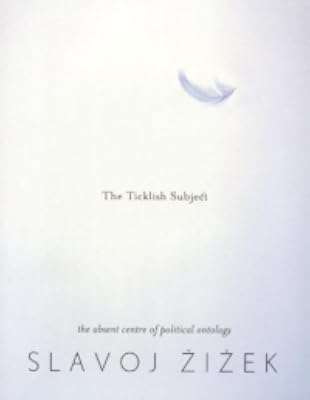
The Ticklish Subject: The Absent Centre of Political Ontology
by Slavoj Žižek
On This Page
Description
This work confronts Deconstructionists and Habermasians, cognitive scientists and Heideggerians, feminists and New Age obscurantists by unearthing a subversive core to this elusive spectre, and finding the philosophical point of reference of any emancipatory politics.Tags
Recommendations






Member Reviews
This was quite a slog- like a classical author writing an impenetrable first paragraph just to prove he (always he) can, Zizek writes an incredibly dense first chapter on Heidegger, when all he needed to say was: Heidegger was wrong to reject the subject of German idealism. That aside...
TS is probably a good book to read as a summary of contemporary continental thought. It sums it up both concretely (i.e., chapters on Badiou, Ranciere, Laclau, Butler etc) and more symbolically: this is a book about whether we can have a theory of revolution that won't force us to call Fascism revolutionary.
Zizek's basic conclusion is something like: yes, we can, if we follow Lacan, and theorize the subject as a passive crack in reality. Fascism is the show more result of humans taking themselves as willpowers rather than cracks, so what we need is a theory that doesn't imagine human will power to be the force behind revolution. Lacan provides us with this.
At the end of the day, Zizek's approach doesn't look much different from Badiou or Ranciere's. All three stress an 'event' or 'act' that just kind of sort of happens, and take revolution to be subjective faith in that event. There are subtleties underneath this - Zizek is right to say that Badiou's theory looks a bit too much like an appeal to the Beautiful Soul of the Pure and Incorruptible Revolutionary; right to say that 'transgression' (so highly valued by Butler) is just the flipside to the norms that are being transgressed. But at the end of the day, you have to ask yourself: i) do you care to have a theory of revolution at all? ii) if so, do you want one that leaves human beings in the situation of sitting around waiting for something to happen? [which, by the way, is very Heideggerian]; iii) isn't this all just a bit too much like old school Dialectical Materialism of the History is the Subject type? You can use Lacanian and Hegelian language all you want, but if you theorize yourself as nothing more than a disciple waiting for a messiah, you won't get very far.
[NB: a friend explained to me the possible motivation behind Zizek's theory here. In short, Z takes deconstructionists' rejection of the subject to be identical to a kind of limp, liberal capitalist 'ethics' of the individual, according to which what really matters is the kind of light-bulbs you buy. Now, this really is quite limp, and I can see why someone would want to reject it. But Z swings too far the other way: not liberal individualism, but the kind of History that Tolstoy wrote about in War and Peace. To put it mildly, such radical, pointless opposition isn't very dialectical.] show less
TS is probably a good book to read as a summary of contemporary continental thought. It sums it up both concretely (i.e., chapters on Badiou, Ranciere, Laclau, Butler etc) and more symbolically: this is a book about whether we can have a theory of revolution that won't force us to call Fascism revolutionary.
Zizek's basic conclusion is something like: yes, we can, if we follow Lacan, and theorize the subject as a passive crack in reality. Fascism is the show more result of humans taking themselves as willpowers rather than cracks, so what we need is a theory that doesn't imagine human will power to be the force behind revolution. Lacan provides us with this.
At the end of the day, Zizek's approach doesn't look much different from Badiou or Ranciere's. All three stress an 'event' or 'act' that just kind of sort of happens, and take revolution to be subjective faith in that event. There are subtleties underneath this - Zizek is right to say that Badiou's theory looks a bit too much like an appeal to the Beautiful Soul of the Pure and Incorruptible Revolutionary; right to say that 'transgression' (so highly valued by Butler) is just the flipside to the norms that are being transgressed. But at the end of the day, you have to ask yourself: i) do you care to have a theory of revolution at all? ii) if so, do you want one that leaves human beings in the situation of sitting around waiting for something to happen? [which, by the way, is very Heideggerian]; iii) isn't this all just a bit too much like old school Dialectical Materialism of the History is the Subject type? You can use Lacanian and Hegelian language all you want, but if you theorize yourself as nothing more than a disciple waiting for a messiah, you won't get very far.
[NB: a friend explained to me the possible motivation behind Zizek's theory here. In short, Z takes deconstructionists' rejection of the subject to be identical to a kind of limp, liberal capitalist 'ethics' of the individual, according to which what really matters is the kind of light-bulbs you buy. Now, this really is quite limp, and I can see why someone would want to reject it. But Z swings too far the other way: not liberal individualism, but the kind of History that Tolstoy wrote about in War and Peace. To put it mildly, such radical, pointless opposition isn't very dialectical.] show less
Ratings
Members
- Recently Added By
Author Information

327+ Works 18,087 Members
Slavoj Zizek is a Hegelian philosopher, Lacanian psychoanalyst, and political activist. He is international director of the Birkbeck Institute for the Humanities, and Global Distinguished Professor of German at New York University. He is the author of numerous books on dialectical materialism, as well as critique of ideology and art, including show more Event, and Trouble in Paradise, both published by Melville House. show less
Series
Belongs to Publisher Series
The Essential Žižek (1.3)
Work Relationships
Is contained in
Classifications
Statistics
- Members
- 483
- Popularity
- 63,114
- Reviews
- 1
- Rating
- (3.70)
- Languages
- 8 — Czech, Dutch, English, French, German, Italian, Spanish, Turkish
- Media
- Paper, Ebook
- ISBNs
- 17
- ASINs
- 2