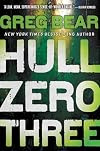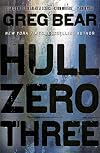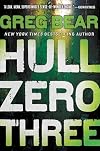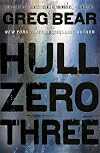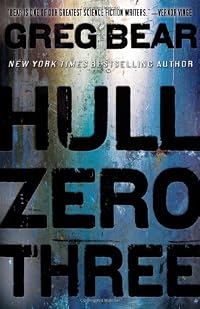
Hull Zero Three
by Greg Bear
On This Page
Description
A starship hurtles through the emptiness of space. It's destination-unknown. Its purpose-a mystery. Now, one man wakes up. Ripped from a dream of a new home-a new planet and the woman he was meant to love in his arms-he finds himself wet, naked, and freezing to death. The dark halls are full of monsters but trusting other survivors he meets might be the greater danger. All he has are questions-- Who is he? Where are they going? What happened to the dream of a new life? What happened to Hull show more 03? All will be answered, if he can survive the ship. HULL ZERO THREE is an edge-of-your-seat thrill ride through the darkest reaches of space. show lessTags
Recommendations





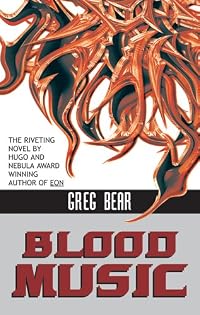



Member Recommendations
by knownever
Member Reviews
"Hull Zero Three" is deceptive in its appearance: it _is_, after all, a space-SF novel by Greg Bear about bad craziness on a generation ship, right? Well, yes and no. Taken on those grounds alone, it's a muddled misstep. A broader perspective brings out the real nature of this book: it's far more in keeping with "Ubik" than with "Alien."
In keeping with PK Dick, "Hull Zero Three" is a ramble to answer some basic questions: "who am I?", "what am I?", and most critically "what's real and what's delusion?" The writing seems fast and loose in places where hard-SF would demand some clarity and detail, but appropriate for peering through-the-looking-glass at what lies beyond.
I'd rate this at 3.5 stars, but bump it up to 4 since Bear does show more succeed in getting the reader to share in the p-o-v character's misgivings about just what to believe. Can he trust his senses, his memories? Dick would have answered "of course not" and the reader of this book is lead to agree. show less
In keeping with PK Dick, "Hull Zero Three" is a ramble to answer some basic questions: "who am I?", "what am I?", and most critically "what's real and what's delusion?" The writing seems fast and loose in places where hard-SF would demand some clarity and detail, but appropriate for peering through-the-looking-glass at what lies beyond.
I'd rate this at 3.5 stars, but bump it up to 4 since Bear does show more succeed in getting the reader to share in the p-o-v character's misgivings about just what to believe. Can he trust his senses, his memories? Dick would have answered "of course not" and the reader of this book is lead to agree. show less
I think I did Greg Bear a disservice. I kinda avoided his more recent novels ever since Quantico and all the Halo tie-in novels because A: I wasn't all that interested in Quantico and B: I never played the Halo games.
Oh, I know, I know, SHAME ON ME... but then I saw the rating of this book in GR and thought... huh... maybe I ought to pass.
Well, that is a DEFINITE SHAME ON ME.
Why? Because Bear goes all out with the Hard-SF with a grand reprisal of the delightful Biopunk glories I tended to associate with him. Plus this is a total space opera horror with our MC waking without memories and losing skin to the freezing surfaces while a young woman tells him to ignore all the dying men in pods all around him.
Great opening. Sure, it might be show more like one or two horror SF movies you might have seen, but never mind that. Bear just opens there and turns this into an adventure on a very interesting HUGE spacecraft surrounding an ice moon it is consuming, all the bots and biological horrors seem to be out to clean up or destroy the newly awoken clones, and the rest is all pure mystery.
MYSTERY IN SPACE. :)
Great golly! If I was just reading this without knowing the author at all or knowing what great books he has written in the past, I would still probably rate this the same. It has elements of Indiana Jones with biological monstrosities on a broken Big Dumb Object that feels like that old movie The Cube, where sooooo many copies of the core characters keep getting ushered out like a respawn in a video game, where the whole damn ship is BROKEN and all we want to do is figure out WHY.
And Bear does it. He keeps things hopping and full of great descriptions and hints and images that would translate awesomely to the big screen or a full miniseries. Impalements, jumps, monsters, corpses galore, and nasty robots. :) Too awesome! And it's a straight adventure, too, starting out in the first part of the ship, Hull Zero One, barely surviving the trek across the almost destroyed Hull Zero Two, and praying there is safety and answers on Hull Zero Three.
And all the time, the spaceship revolves and revolves and does it's gorgeous interstellar thing. :)
Don't think that's all, tho. There's great introverted stuff here and his exploration of memory and identity gets full marks here just as it used to in, say, his Queen of Angels. This is chock-full of all the goodies and ambition I've come to admire in all his writing.
Where it doesn't succeed is not of consequence. On the whole, when compared to similar kinds of Space Opera SF, hard or otherwise, Bear's imagination is truly one to behold and love. I'm reminded of just how much stock I always put in his books.
I'm back.
I should never have doubted. show less
Oh, I know, I know, SHAME ON ME... but then I saw the rating of this book in GR and thought... huh... maybe I ought to pass.
Well, that is a DEFINITE SHAME ON ME.
Why? Because Bear goes all out with the Hard-SF with a grand reprisal of the delightful Biopunk glories I tended to associate with him. Plus this is a total space opera horror with our MC waking without memories and losing skin to the freezing surfaces while a young woman tells him to ignore all the dying men in pods all around him.
Great opening. Sure, it might be show more like one or two horror SF movies you might have seen, but never mind that. Bear just opens there and turns this into an adventure on a very interesting HUGE spacecraft surrounding an ice moon it is consuming, all the bots and biological horrors seem to be out to clean up or destroy the newly awoken clones, and the rest is all pure mystery.
MYSTERY IN SPACE. :)
Great golly! If I was just reading this without knowing the author at all or knowing what great books he has written in the past, I would still probably rate this the same. It has elements of Indiana Jones with biological monstrosities on a broken Big Dumb Object that feels like that old movie The Cube, where sooooo many copies of the core characters keep getting ushered out like a respawn in a video game, where the whole damn ship is BROKEN and all we want to do is figure out WHY.
And Bear does it. He keeps things hopping and full of great descriptions and hints and images that would translate awesomely to the big screen or a full miniseries. Impalements, jumps, monsters, corpses galore, and nasty robots. :) Too awesome! And it's a straight adventure, too, starting out in the first part of the ship, Hull Zero One, barely surviving the trek across the almost destroyed Hull Zero Two, and praying there is safety and answers on Hull Zero Three.
And all the time, the spaceship revolves and revolves and does it's gorgeous interstellar thing. :)
Don't think that's all, tho. There's great introverted stuff here and his exploration of memory and identity gets full marks here just as it used to in, say, his Queen of Angels. This is chock-full of all the goodies and ambition I've come to admire in all his writing.
Where it doesn't succeed is not of consequence. On the whole, when compared to similar kinds of Space Opera SF, hard or otherwise, Bear's imagination is truly one to behold and love. I'm reminded of just how much stock I always put in his books.
I'm back.
I should never have doubted. show less
Wow. One of those "out there" type of stories. A blank-slate character in a confused, crazy, deadly world.
So, the protagonist awakes from what appears to be a cryo-sleep chamber. Apparently a crew member of an expedition sent from Earth, to allow humanity to reach the stars. Maybe. But his memory is choppy, uncertain... confused. He's saved by a little girl, who isn't forthcoming with any further details. He's on a spaceship, but not where he "should" be; not with whom he should be.
Nothing is as it should be. Something is wrong. People are dying or dead. Monsters roam the halls of the spaceship. Impossible monsters. And the first task is to run. Run from the monsters, run from the cold as the ship freezes, run for the heat that always show more seems to be moving away, farther along the ship.
All he knows, all he's told, is that he is "Teacher". A teacher who knows nothing. Or, at least, who only learns to doubt what he does know. And to fear everything.
A meditation on the existential crisis? Who are we? Who am I? What is my purpose? Where are we? Why this, that, and everything else?
I quite enjoyed this. The puzzle, the answers, the answers that only lead to deeper questions... and a final resolution that is satisfying and right.
This is science fiction, set in the future, but as relevant and meaningful as a contemporary war story. Bravo, Mr. Bear! show less
So, the protagonist awakes from what appears to be a cryo-sleep chamber. Apparently a crew member of an expedition sent from Earth, to allow humanity to reach the stars. Maybe. But his memory is choppy, uncertain... confused. He's saved by a little girl, who isn't forthcoming with any further details. He's on a spaceship, but not where he "should" be; not with whom he should be.
Nothing is as it should be. Something is wrong. People are dying or dead. Monsters roam the halls of the spaceship. Impossible monsters. And the first task is to run. Run from the monsters, run from the cold as the ship freezes, run for the heat that always show more seems to be moving away, farther along the ship.
All he knows, all he's told, is that he is "Teacher". A teacher who knows nothing. Or, at least, who only learns to doubt what he does know. And to fear everything.
A meditation on the existential crisis? Who are we? Who am I? What is my purpose? Where are we? Why this, that, and everything else?
I quite enjoyed this. The puzzle, the answers, the answers that only lead to deeper questions... and a final resolution that is satisfying and right.
This is science fiction, set in the future, but as relevant and meaningful as a contemporary war story. Bravo, Mr. Bear! show less
This novel, released in November 2010 and received by me as an ARC, is serious science fiction. It's not a subgenre -- not space opera, not *punk -- but true science fiction, with astrophysics, "aliens" (so to speak), conflict... in short all the ingredients of a classic science fiction plot. It is also complex, sometimes confusing, and occasionally downright creepy. I quite liked it.
The novel is written in first person from the perspective of an individual usually referred to as "Teacher" -- Bear plays with the irony of that title throughout the novel, starting from page three, because Teacher begins the novel as ignorant as the reader, and progresses slowly toward a knowledge of who/what/where/why he is. The reader follows that show more journey, through a hostile environment in a damaged spaceship, where nearly everything is trying to kill nearly everything else. The reader is often as confused as Teacher is, but the small steps toward the resolution of the ship's mystery keep one turning pages.
The environment of the ship itself is eerily evoked through Bear's descriptions. We see this world through Teacher's eyes, including as his memory awakens, so things for which the reader might have a ready word or comparison are sometimes described in new, alien terms or with a sense of rediscovery. Most of the time, this works to enhance the sense of eerie otherness that the novel is building -- occasionally Teacher's "hey, I remembered a new word!" moments are a little annoying, but that is generally outweighed by some of the sly allusions that Bear uses Teacher's wakening memory to make. References to literature (including Carroll's 'The Hunting of the Snark', unless I am way off) and scientific knowledge abound.
The characters that Teacher meets along the way are puzzles unto themselves, and the reader could easily spend plenty of time considering their particular evolution. Bear has put a great deal of thought and craftsmanship into the logical pattern of development for the ship, its inhabitants, and how they all fit into the mysterious circumstances he has created. There is a lot of crafty build-up in this novel, to the point that the final chapters seem to fly by as the pieces of the larger puzzle start to come together. The end, which of course I will not reveal here, is perhaps not as mindblowing as one might expect from that build-up, but still works in the grand scheme of the book.
Bottom line: If you are a fan of science fiction in its purest form, this is the book for you. It has all the ingredients -- a tight plot, suspense, science, space travel, strange beings, even a healthy dollop of blood and gore -- that made classic sci-fi great. Warning: it also contains a touch of the surreal (as the allusion to Carroll would testify), so don't expect simplicity here. show less
The novel is written in first person from the perspective of an individual usually referred to as "Teacher" -- Bear plays with the irony of that title throughout the novel, starting from page three, because Teacher begins the novel as ignorant as the reader, and progresses slowly toward a knowledge of who/what/where/why he is. The reader follows that show more journey, through a hostile environment in a damaged spaceship, where nearly everything is trying to kill nearly everything else. The reader is often as confused as Teacher is, but the small steps toward the resolution of the ship's mystery keep one turning pages.
The environment of the ship itself is eerily evoked through Bear's descriptions. We see this world through Teacher's eyes, including as his memory awakens, so things for which the reader might have a ready word or comparison are sometimes described in new, alien terms or with a sense of rediscovery. Most of the time, this works to enhance the sense of eerie otherness that the novel is building -- occasionally Teacher's "hey, I remembered a new word!" moments are a little annoying, but that is generally outweighed by some of the sly allusions that Bear uses Teacher's wakening memory to make. References to literature (including Carroll's 'The Hunting of the Snark', unless I am way off) and scientific knowledge abound.
The characters that Teacher meets along the way are puzzles unto themselves, and the reader could easily spend plenty of time considering their particular evolution. Bear has put a great deal of thought and craftsmanship into the logical pattern of development for the ship, its inhabitants, and how they all fit into the mysterious circumstances he has created. There is a lot of crafty build-up in this novel, to the point that the final chapters seem to fly by as the pieces of the larger puzzle start to come together. The end, which of course I will not reveal here, is perhaps not as mindblowing as one might expect from that build-up, but still works in the grand scheme of the book.
Bottom line: If you are a fan of science fiction in its purest form, this is the book for you. It has all the ingredients -- a tight plot, suspense, science, space travel, strange beings, even a healthy dollop of blood and gore -- that made classic sci-fi great. Warning: it also contains a touch of the surreal (as the allusion to Carroll would testify), so don't expect simplicity here. show less
A spaceship hurdles through space, seeking the perfect planet, and within the ship sleeps the planet’s future population: men, women, and creatures designed to help populate and settle the world to which they fly. Until something goes wrong, and ship goes to war with itself.
Teacher is jerked from dreams of this new world and brought into the harsh reality of ship. He can remember only bits and pieces of his life before awakening. Cold, he runs toward warmth and the mysteries of ship.
This is the best science fiction I have read in years. Bear’s command of Teacher’s story grips the reader from page one and does not let go. The story is dark and haunting, and I loved every page of it.
Science fiction writers sometimes make their tales show more more about the science and less about the characters. Not Bear. He carefully intertwines all the qualities of science, which makes science fiction fun, yet he never loses Teacher or his bleak story.
Nuanced with lovely prose, Bear reminds us that science without a conscience can be deadly. show less
Teacher is jerked from dreams of this new world and brought into the harsh reality of ship. He can remember only bits and pieces of his life before awakening. Cold, he runs toward warmth and the mysteries of ship.
This is the best science fiction I have read in years. Bear’s command of Teacher’s story grips the reader from page one and does not let go. The story is dark and haunting, and I loved every page of it.
Science fiction writers sometimes make their tales show more more about the science and less about the characters. Not Bear. He carefully intertwines all the qualities of science, which makes science fiction fun, yet he never loses Teacher or his bleak story.
Nuanced with lovely prose, Bear reminds us that science without a conscience can be deadly. show less
Hard science fiction is a category of science fiction characterized by an emphasis on scientific or technical detail, or on scientific accuracy, or on both. Greg Bear has recently done this best with Darwin's Radio and Darwin's Children, but I'd like to add Hull Zero Three to my list of great SF with hard science behind it.
With the questions that Greg Bear raises about our technical prowess as a species, our capacity for both great love and great destruction, and the relationships we share with one another, Hull Zero Three reminds me of Robert Silverberg's The Man in the Maze. Audiences might enjoy The Man in the Maze more for the social commentary and the deadly, technological wizardary of the Maze, but at their heart, both novels deal show more with the paranoia that one species feels when dealing with an alien other.
Hull Zero Three starts in confusion, of an interrrupted Dreamtime of a multi-generational, 500-light-year journey from our Solar Systems's OORT cloud to a distant planet. Our protagonist (later named Sanjay) comes to realize the history of his Ship, the people and creatures aboard it, and its deadly purpose and technology. For the confusion of the beginning, the growth and journey of the characters, and the climax where all is revealed about Destination Guidance, Ship Control, Mother, and the damage/confusion/growth/maturity of the Ship, we see in it's entirety the potential of the human race: are we fit to colonize other worlds, or would our colonization be no different than other conquests in human history? show less
With the questions that Greg Bear raises about our technical prowess as a species, our capacity for both great love and great destruction, and the relationships we share with one another, Hull Zero Three reminds me of Robert Silverberg's The Man in the Maze. Audiences might enjoy The Man in the Maze more for the social commentary and the deadly, technological wizardary of the Maze, but at their heart, both novels deal show more with the paranoia that one species feels when dealing with an alien other.
Hull Zero Three starts in confusion, of an interrrupted Dreamtime of a multi-generational, 500-light-year journey from our Solar Systems's OORT cloud to a distant planet. Our protagonist (later named Sanjay) comes to realize the history of his Ship, the people and creatures aboard it, and its deadly purpose and technology. For the confusion of the beginning, the growth and journey of the characters, and the climax where all is revealed about Destination Guidance, Ship Control, Mother, and the damage/confusion/growth/maturity of the Ship, we see in it's entirety the potential of the human race: are we fit to colonize other worlds, or would our colonization be no different than other conquests in human history? show less
Hard science fiction is a category of science fiction characterized by an emphasis on scientific or technical detail, or on scientific accuracy, or on both. Greg Bear has recently done this best with Darwin's Radio and Darwin's Children, but I'd like to add Hull Zero Three to my list of great SF with hard science behind it.
With the questions that Greg Bear raises about our technical prowess as a species, our capacity for both great love and great destruction, and the relationships we share with one another, Hull Zero Three reminds me of Robert Silverberg's The Man in the Maze. Audiences might enjoy The Man in the Maze more for the social commentary and the deadly, technological wizardary of the Maze, but at their heart, both novels deal show more with the paranoia that one species feels when dealing with an alien other.
Hull Zero Three starts in confusion, of an interrrupted Dreamtime of a multi-generational, 500-light-year journey from our Solar Systems's OORT cloud to a distant planet. Our protagonist (later named Sanjay) comes to realize the history of his Ship, the people and creatures aboard it, and its deadly purpose and technology. For the confusion of the beginning, the growth and journey of the characters, and the climax where all is revealed about Destination Guidance, Ship Control, Mother, and the damage/confusion/growth/maturity of the Ship, we see in it's entirety the potential of the human race: are we fit to colonize other worlds, or would our colonization be no different than other conquests in human history? show less
With the questions that Greg Bear raises about our technical prowess as a species, our capacity for both great love and great destruction, and the relationships we share with one another, Hull Zero Three reminds me of Robert Silverberg's The Man in the Maze. Audiences might enjoy The Man in the Maze more for the social commentary and the deadly, technological wizardary of the Maze, but at their heart, both novels deal show more with the paranoia that one species feels when dealing with an alien other.
Hull Zero Three starts in confusion, of an interrrupted Dreamtime of a multi-generational, 500-light-year journey from our Solar Systems's OORT cloud to a distant planet. Our protagonist (later named Sanjay) comes to realize the history of his Ship, the people and creatures aboard it, and its deadly purpose and technology. For the confusion of the beginning, the growth and journey of the characters, and the climax where all is revealed about Destination Guidance, Ship Control, Mother, and the damage/confusion/growth/maturity of the Ship, we see in it's entirety the potential of the human race: are we fit to colonize other worlds, or would our colonization be no different than other conquests in human history? show less
Members
- Recently Added By
Lists

Generation Ship
28 works; 7 members

Arthur C. Clarke Award Winners and Shortlisted Books
219 works; 14 members

2016 UpROOTed
11 works; 1 member

Books Read in 2016
4,666 works; 197 members
Author Information

Greg Bear was born in San Diego, California, on August 20, 1951. He received a Bachelor of Arts degree from San Diego State University in 1973. At age 14, he began submitting pieces to magazines and at 15 he sold his first story to Robert Lowndes' Famous Science Fiction. It would be five years before he sold another piece, but by 23 he was selling show more stories regularly. He has written more than 30 science fiction and fantasy books and has won numerous awards for his work. In 1984, Hardfought and Blood Music won the Nebula Awards for best novella and novelette; Blood Music went on to win the Hugo Award. The novel version of that story, also called Blood Music, won the Prix Apollo in France. In 1987, Tangents won the Hugo and Nebula awards for best short story. He also won a Nebula in 1994 for Moving Mars and in 2001 for Darwin's Radio. Both Dinosaur Summer and Darwin's Radio have been awarded the Endeavour for best novel published by a Northwest science fiction author. He is also an illustrator and his work has appeared in Galaxy, Fantasy and Science Fiction, and Vertex, and in both hardcover and paperback books. He was a founding member of ASFA, the Association of Science Fiction Artists. His works include City at the End of Time, Hull Zero Three, The Mongoliad, Mariposa, Halo: Cryptum, Halo: Primordium and Halo: Silentium. (Bowker Author Biography) show less
Some Editions
Awards and Honors
Work Relationships
Has as a commentary on the text
Common Knowledge
- Original publication date
- 2010
- People/Characters
- Teacher; Tsinoy; Big Yellow / Kim; Nell
- Dedication
- FOR VINCE GERARDIS,
Master of the Big Idea - First words
- Cloud modest, the planet covers herself.
- Last words
- (Click to show. Warning: May contain spoilers.)WE ARE HERE
Classifications
Statistics
- Members
- 990
- Popularity
- 26,344
- Reviews
- 52
- Rating
- (3.21)
- Languages
- English, German, Polish
- Media
- Paper, Audiobook, Ebook
- ISBNs
- 20
- ASINs
- 8