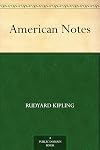
American Notes
by Rudyard Kipling 
On This Page
Description
It is hardly fair to Mr. Kipling to call American Notes first impressions, for one reading them will readily see that the impressions are superficial, little thought being put upon the writing. They seem super-sarcastic, and would lead one to believe that Mr. Kipling is antagonistic to America in every respect. This, however, is not true. These Notes aroused much protest and severe criticism when they appeared in 1891, and are considered so far beneath Mr. Kipling's real work that they have show more been nearly suppressed and are rarely found in a list of his writings. show lessTags
Recommendations















Member Reviews
Highly sarcastic in spots, some absolutely gorgeous descriptions of scenery, cities, and people. I found the politics described in the San Fran section very amusing, mostly because they were so familiar - the attitudes and opinions of the handlers and the voters. San Fran and Buffalo were the most interesting, because I'm more familiar with them - I've never spent much time in Chicago. Or Yellowstone, but there descriptions differ only in details. His are lovely, but what he's describing is familiar from many many other sources... Actually, his descriptions of travel were reminding me of the stuff I saw in the Tahoe museums, about the early days at the lake - wagons and horses, multiple days of travel, and so on. Kipling is very show more sarcastic about America's defenses, which was interesting to read so soon after (this year's anniversary of) 9/11. Though he's talking mostly about bombardment from ships off the coast - and repeatedly commenting that it's too bad England is at peace with America. Also interesting that he points out China as a maritime danger - wonder if this kind of thinking contributed to the anti-Japanese hysteria after Pearl Harbor. show less
The following letters were written by Mr. Kipling in 1889, while on a trip from India to England by way of the United States. They were published as special correspondence in the Pioneer of India at that time.
Ratings
Members
- Recently Added By
Author Information

2,469+ Works 91,183 Members
Kipling, who as a novelist dramatized the ambivalence of the British colonial experience, was born of English parents in Bombay and as a child knew Hindustani better than English. He spent an unhappy period of exile from his parents (and the Indian heat) with a harsh aunt in England, followed by the public schooling that inspired his "Stalky" show more stories. He returned to India at 18 to work on the staff of the Lahore Civil and Military Gazette and rapidly became a prolific writer. His mildly satirical work won him a reputation in England, and he returned there in 1889. Shortly after, his first novel, The Light That Failed (1890) was published, but it was not altogether successful. In the early 1890s, Kipling met and married Caroline Balestier and moved with her to her family's estate in Brattleboro, Vermont. While there he wrote Many Inventions (1893), The Jungle Book (1894-95), and Captains Courageous (1897). He became dissatisfied with life in America, however, and moved back to England, returning to America only when his daughter died of pneumonia. Kipling never again returned to the United States, despite his great popularity there. Short stories form the greater portion of Kipling's work and are of several distinct types. Some of his best are stories of the supernatural, the eerie and unearthly, such as "The Phantom Rickshaw," "The Brushwood Boy," and "They." His tales of gruesome horror include "The Mark of the Beast" and "The Return of Imray." "William the Conqueror" and "The Head of the District" are among his political tales of English rule in India. The "Soldiers Three" group deals with Kipling's three musketeers: an Irishman, a Cockney, and a Yorkshireman. The Anglo-Indian Tales, of social life in Simla, make up the larger part of his first four books. Kipling wrote equally well for children and adults. His best-known children's books are Just So Stories (1902), The Jungle Books (1894-95), and Kim (1901). His short stories, although their understanding of the Indian is often moving, became minor hymns to the glory of Queen Victoria's empire and the civil servants and soldiers who staffed her outposts. Kim, an Irish boy in India who becomes the companion of a Tibetan lama, at length joins the British Secret Service, without, says Wilson, any sense of the betrayal of his friend this actually meant. Nevertheless, Kipling has left a vivid panorama of the India of his day. In 1907, Kipling became England's first Nobel Prize winner in literature and the only nineteenth-century English poet to win the Prize. He won not only on the basis of his short stories, which more closely mirror the ambiguities of the declining Edwardian world than has commonly been recognized, but also on the basis of his tremendous ability as a popular poet. His reputation was first made with Barrack Room Ballads (1892), and in "Recessional" he captured a side of Queen Victoria's final jubilee that no one else dared to address. (Bowker Author Biography) show less
Rudyard Kipling has a Legacy Library. Legacy libraries are the personal libraries of famous readers, entered by LibraryThing members from the Legacy Libraries group.
Some Editions
Classifications
Statistics
- Members
- 130
- Popularity
- 251,541
- Reviews
- 2
- Rating
- (3.00)
- Languages
- English, French
- Media
- Paper, Audiobook, Ebook
- ISBNs
- 28
- ASINs
- 17